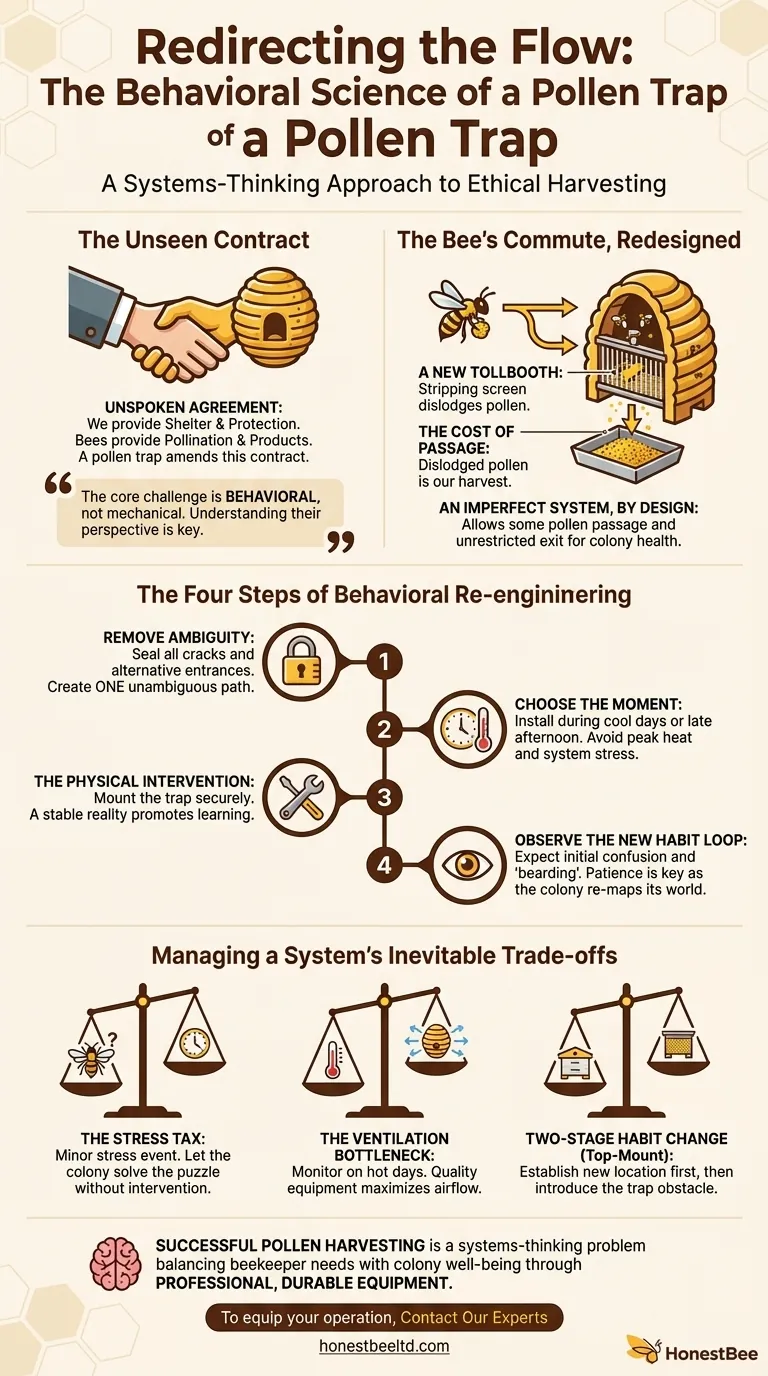
The Unseen Contract
When we manage a beehive, we enter into an unspoken contract with a superorganism. We provide shelter and protection; they provide pollination and products of the hive.
Installing a pollen trap is an attempt to amend this contract.
The core challenge isn't mechanical—it's not about screws and brackets. It's behavioral. We are asking thousands of individual foragers, each hardwired by millions of years of evolution, to change their daily routine.
Success hinges on how well we understand their perspective.
The Bee's Commute, Redesigned
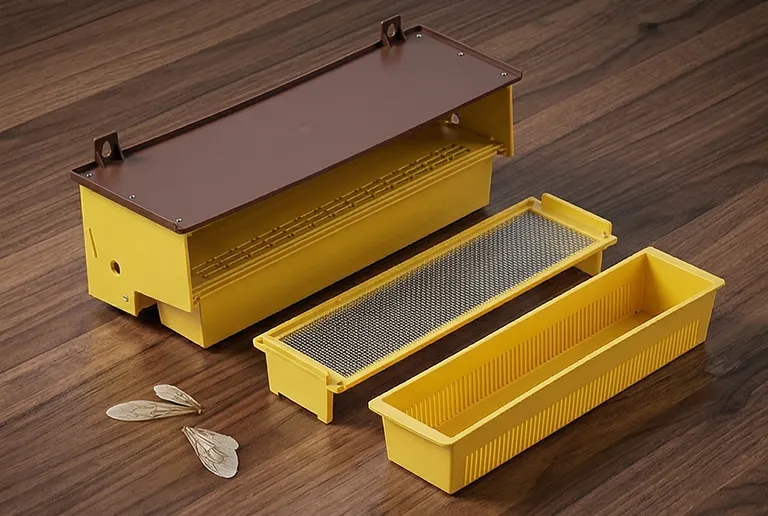
To gently guide a colony, we must first appreciate what we're asking of them. A pollen trap is a deliberate, engineered interruption in their daily "commute."
A New Tollbooth
Returning foragers, heavy with pollen, must now navigate a stripping screen—a grid with openings just large enough for their bodies, but small enough to dislodge the pollen pellets from their legs. It's an obstacle placed directly in their path home.
The Cost of Passage
The dislodged pollen falls through a mesh floor into a collection tray. This is our harvest. But for the bee, it's a resource collected over miles of flight that never reaches its intended destination.
An Imperfect System, By Design
A well-engineered trap is intentionally imperfect. It must allow some bees to pass with their pollen intact. It must also provide a completely unrestricted exit.
The goal is not to capture everything. The goal is to collect a surplus while ensuring the colony has more than enough protein to raise its brood and thrive. This is where the quality of the equipment becomes non-negotiable.
The Four Steps of Behavioral Re-engineering
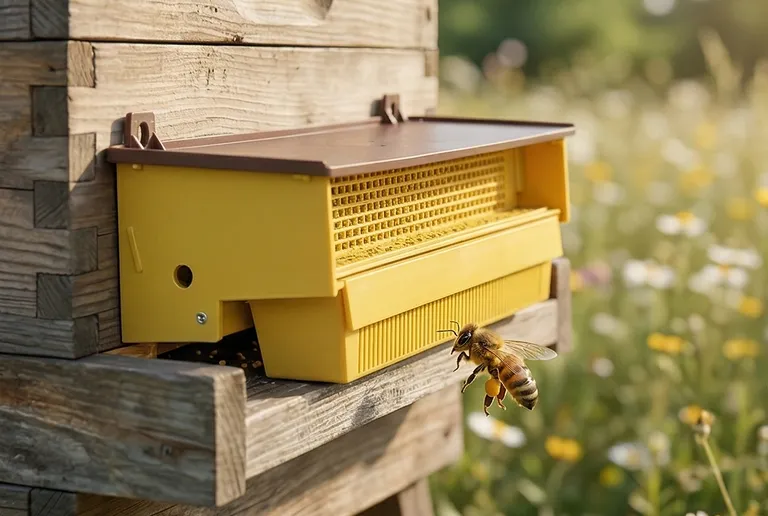
Methodically implementing the trap is about managing the colony's response to change. Think of it less as installation and more as a phased negotiation.
Step 1: Remove Ambiguity
Bees, like water or electricity, follow the path of least resistance. Before mounting the trap, you must meticulously seal every other crack, hole, or alternative entrance to the hive.
If there is an easier way in, they will find it. By creating a single, unambiguous entrance, you make the "right" choice the only choice.
Step 2: Choose the Moment
Never introduce a significant change when the system is already under stress. Install the trap on a cool day or in the late afternoon.
A trap slightly reduces ventilation. Doing this during peak heat adds an unnecessary physical stressor on top of the behavioral one, risking overheating and compounding the colony's agitation.
Step 3: The Physical Intervention
Mount the trap securely. A loose or wobbly installation creates an unpredictable and confusing environment. The new entrance must be a stable, reliable reality that the bees can learn and adapt to.
Step 4: Observe the New Habit Loop
For the first few hours, expect confusion. You'll see bees "bearding" on the front of the hive, searching for the entrance they've known their entire lives. This is normal.
This is the colony re-mapping its world. Within a day or two, the new pathway will become the new habit. The traffic flow will normalize. Your role here is simply to be a patient observer.
Managing a System's Inevitable Trade-offs
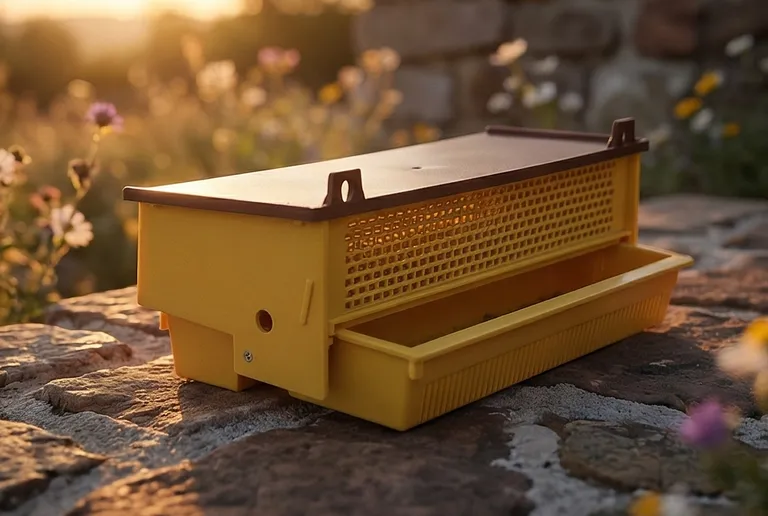
Every intervention has consequences. A professional beekeeper anticipates and manages them.
-
The Stress Tax: The initial confusion is a minor stress event. Resist the urge to intervene further during this period. Don't open the hive. Let the colony solve the puzzle you've presented.
-
The Ventilation Bottleneck: The trap is a bottleneck. On exceptionally hot days, monitor the hive closely. The integrity of your operation depends on equipment designed to maximize airflow while still performing its function.
-
The Two-Stage Habit Change: For top-mounted traps, the behavioral change is more significant. You must separate the challenges. First, close the bottom entrance and force the bees to learn the new top entrance for a week or two. Only after that new location is an established habit should you introduce the new obstacle of the trap itself.
Ultimately, successful and ethical pollen harvesting is a systems-thinking problem. It requires balancing the needs of the beekeeper with the well-being of the colony. This balance is achieved not just through process, but through professionally designed equipment that minimizes stress and maximizes efficiency.
For commercial apiaries and distributors, managing dozens or hundreds of hives at this level of detail requires equipment that is reliable, consistent, and built with a deep understanding of bee behavior.
To equip your operation with durable, hive-friendly pollen traps and other essential beekeeping supplies, Contact Our Experts
Visual Guide
Related Products
- Removable Plastic Pollen Trap With Ventilated Tray for Bees Pollen Collector
- 30 cm Plastic Entrance Hole Bee Pollen Trap and Collector
- Plastic Bee Pollen Trap Strips Comb Catcher Collector
- High-Efficiency Diamond Maze Bee Escape for Clearing Supers
- Professional Bucket Style Wasp and Moth Pheromone Trap
Related Articles
- The Interface Problem: How Pollen Trap Design Shapes Colony Behavior and Harvest Quality
- How to Install Pollen Traps Without Stressing Your Hive: A Beekeeper’s Guide
- The Paradox of the Pollen Trap: Engineering for Harvest and Hive Health
- Beyond Honey: The Strategic Calculus of the Pollen Trap
- How Pollen Traps Transform Beekeeping: From Hive Health to Additional Income