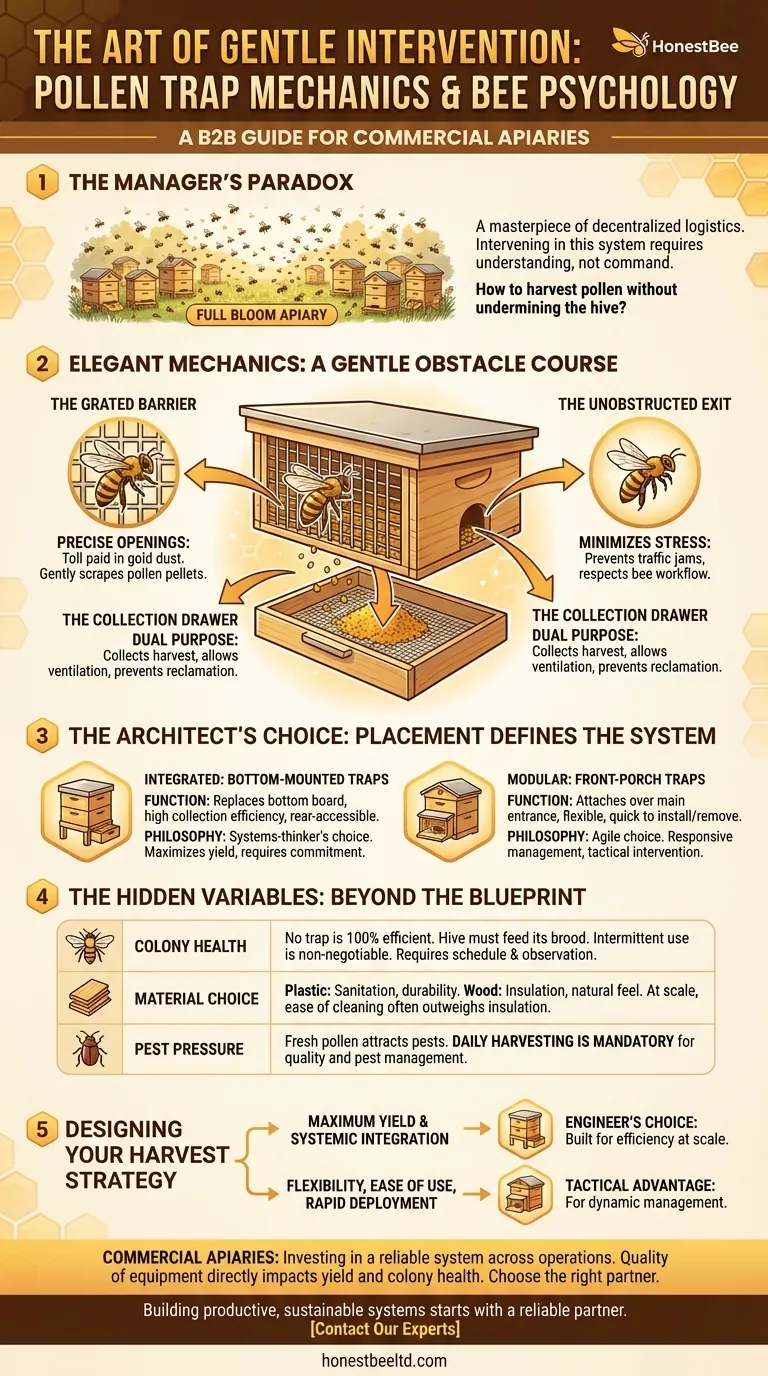
The Manager's Paradox
An apiary in full bloom is a masterpiece of decentralized logistics. Thousands of foragers execute millions of tiny, perfect decisions, creating a system of astounding efficiency. As a commercial beekeeper, your job is not to command this system, but to interface with it.
The decision to harvest pollen introduces a fundamental paradox: how do you intervene in a near-perfect system for your benefit without undermining the very system you depend on?
A pollen trap is not merely a filter. It is a tool of negotiation. Choosing the right one is less about the hardware and more about understanding the psychology of the hive and the philosophy of your own operation.
The Elegant Mechanics of a Necessary Intrusion
At its core, a pollen trap is a marvel of simple, passive engineering. It works by creating a gentle, non-harmful obstacle course for returning foragers.
The Grated Barrier
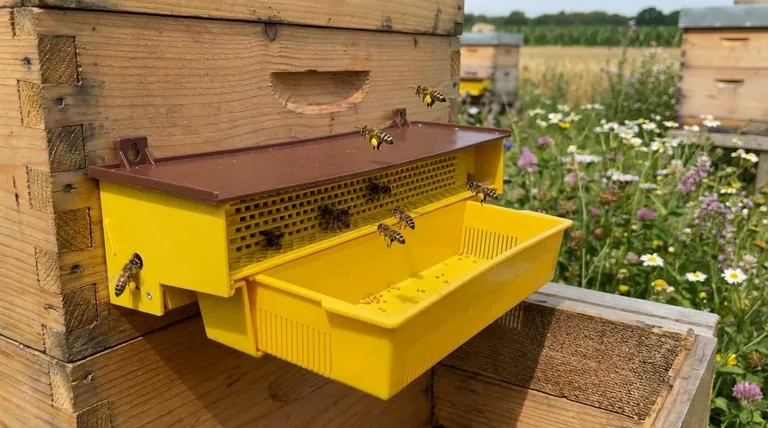
The bee must pass through a screen or a grid with precisely sized openings. The aperture is a critical dimension—just large enough for the bee, just small enough to gently scrape the pollen pellets from her legs. It’s a physical conversation, a toll paid in gold dust.
The Collection Drawer
The dislodged pollen falls through a second screen into a protected drawer. This lower screen serves a dual purpose: it keeps the bees from reclaiming the pollen while allowing for ventilation, which is crucial for preventing mold and preserving the harvest's quality.
The Unobstructed Exit
The most elegant part of the design is the one often overlooked: a clear, separate exit. By providing an alternate route out, the trap prevents a traffic jam at the entrance. This minimizes colony stress, a factor that is exponentially more important at commercial scale. It respects the bee's workflow.
The Architect's Choice: Placement Defines the System
The primary distinction between trap designs is their location on the hive. This choice reflects two different philosophies of apiary management.
The Integrated System: Bottom-Mounted Traps
These traps replace the standard bottom board, becoming a fundamental part of the hive's architecture.
- Function: By integrating into the hive's floor, they process nearly every returning forager, leading to exceptionally high collection efficiency. The pollen is often collected from a large, rear-accessible drawer, minimizing disturbance to the hive's main entrance.
- Philosophy: This is the choice for the systems-thinker. It's for the operator focused on maximizing yield and integrating collection into the permanent infrastructure of the hive. It requires more commitment to install, but it runs with unparalleled efficiency once in place.
The Modular Approach: Front-Porch Traps
These are the most common traps, attaching directly over the hive's main entrance like a temporary vestibule.
- Function: Their primary advantage is flexibility. They can be installed, monitored, bypassed, or removed in minutes. This allows the beekeeper to react dynamically to the colony's needs and the changing seasons.
- Philosophy: This is the agile choice. It’s for the manager who values responsiveness and tactical intervention. You engage the trap during strong pollen flows and disengage it during brood-rearing peaks, all with minimal effort.
The Hidden Variables: Beyond the Blueprint
A pollen trap is not a "set and forget" device. Its use adds a layer of responsibility to your management routine, forcing you to be more attuned to the colony's health.
| Consideration | Key Insight | Impact on Commercial Operations |
|---|---|---|
| Colony Health | No trap is 100% efficient, and this is by design. The hive must retain enough pollen to feed its brood. Trapping is a tax, and you can only tax a strong, thriving economy. | Intermittent use is non-negotiable. It requires a schedule and disciplined observation across dozens or hundreds of hives. |
| Material Choice | Plastic offers ease of sanitation and durability, critical for preventing disease spread. Wood provides superior insulation, a more "natural" interface for the bees. | At scale, the ability to quickly clean and sanitize equipment (plastic) often outweighs the insulative properties of wood. |
| Pest Pressure | A drawer full of fresh pollen is a powerful attractant for pests like Small Hive Beetles. | Daily harvesting is mandatory. This isn't just for freshness; it's a critical pest management protocol. |
Designing Your Harvest Strategy
Choosing a pollen trap isn't about finding the "best" one. It's about selecting the right tool for your specific operational model.
- For maximum yield and systemic integration, the bottom-mounted trap is the engineer's choice. It’s built for efficiency at scale.
- For flexibility, ease of use, and rapid deployment, the entrance trap provides the tactical advantage needed for dynamic management.
For commercial apiaries, the decision transcends a single hive. You are investing in a system that must be reliable, durable, and consistent across your entire operation. The quality of the equipment—the precision of the grid, the durability of the materials, the thoughtfulness of the design—directly impacts your yield and the long-term health of your colonies.
Building a productive and sustainable harvesting system starts with a partner who understands the demands of commercial beekeeping. For operations that depend on reliable, well-designed systems, choosing the right equipment partner is the first critical step. Contact Our Experts
Visual Guide
Related Products
- Removable Plastic Pollen Trap With Ventilated Tray for Bees Pollen Collector
- 30 cm Plastic Entrance Hole Bee Pollen Trap and Collector
- Plastic Bee Pollen Trap Strips Comb Catcher Collector
- High-Efficiency Diamond Maze Bee Escape for Clearing Supers
- Professional Bucket Style Wasp and Moth Pheromone Trap
Related Articles
- The Interface Problem: How Pollen Trap Design Shapes Colony Behavior and Harvest Quality
- How to Install Pollen Traps Without Stressing Your Hive: A Beekeeper’s Guide
- The Paradox of the Pollen Trap: Engineering for Harvest and Hive Health
- Beyond Honey: The Strategic Calculus of the Pollen Trap
- How Pollen Traps Transform Beekeeping: From Hive Health to Additional Income