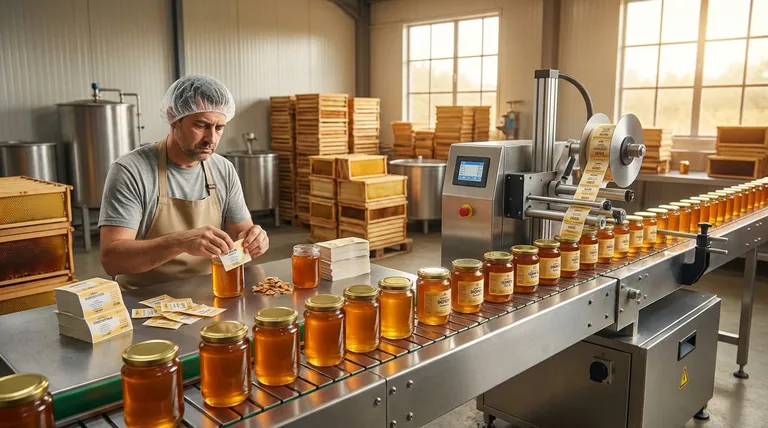
It’s a familiar story for successful apiaries. The harvest was incredible, the honey is pure gold, and the orders are flooding in from distributors. Your business is growing. But then, you hit a wall—a sticky, frustrating wall made of thousands of unlabeled glass jars.
Your production line, which ran so smoothly, now slows to a crawl. A dedicated team stands at a table, painstakingly peeling and applying labels by hand. Some are crooked, others have bubbles. A pile of "rejects" grows in the corner. You're watching your profits get eaten up by a task that feels like it should be simple, and every delayed shipment is a missed opportunity. You're stuck right before the finish line.
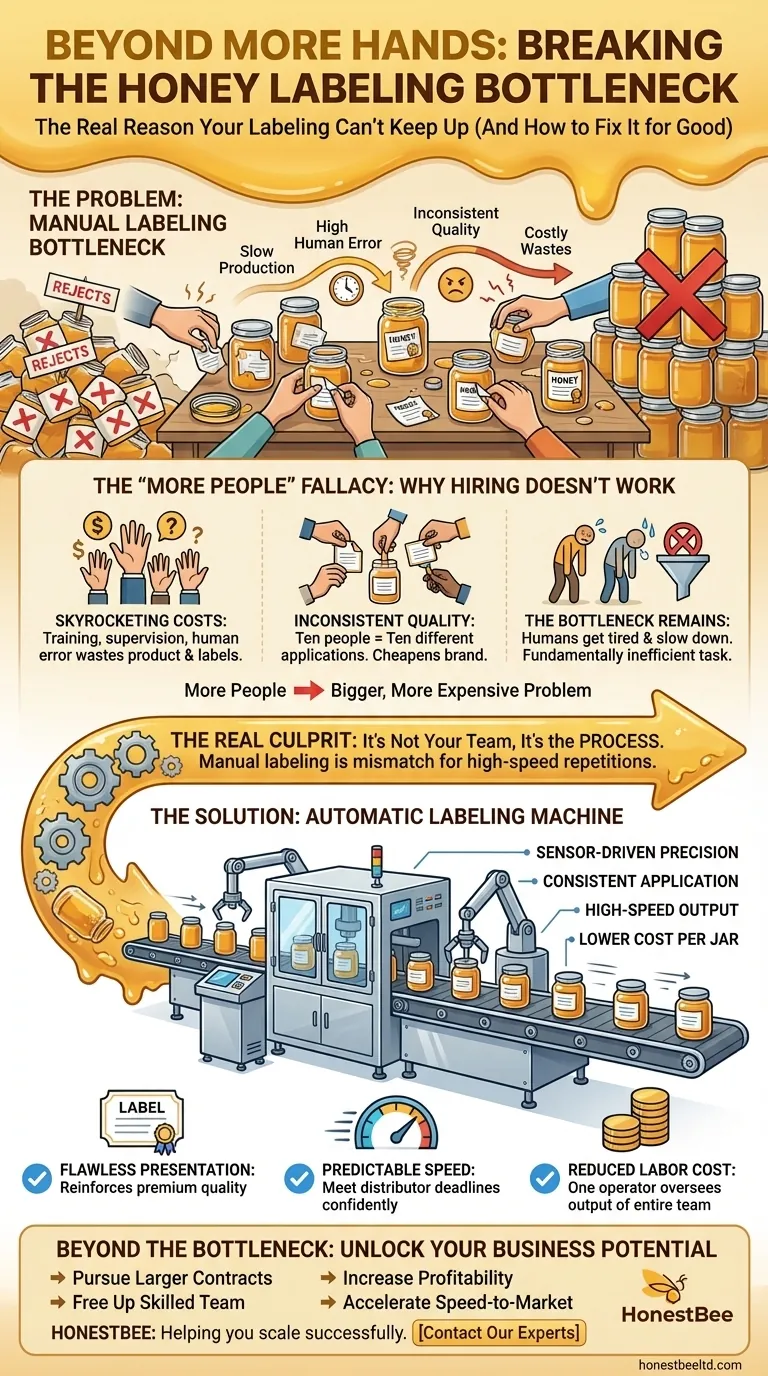
The "More People" Fallacy: Why Hiring Your Way Out Doesn't Work
When faced with this labeling bottleneck, the most common reaction is to throw more people at the problem. You might hire temporary staff for the busy season or pull skilled workers from other important tasks to form an impromptu labeling crew.
On the surface, it seems logical. More hands should mean more work gets done. But this approach almost always fails to deliver the expected results. Here’s why:
- Skyrocketing Costs: You’re not just paying more salaries. You're paying for training, supervision, and the inevitable human errors that lead to wasted labels and wasted product. Your cost-per-jar creeps up, eroding the margin on your premium honey.
- Inconsistent Quality: No matter how well you train them, ten different people will apply labels in ten slightly different ways. This inconsistency cheapens your brand's appearance. A premium product in a jar with a crooked, bubbly label sends a conflicting message to customers and distributors.
- The Bottleneck Remains: Humans get tired. They need breaks. Their speed fluctuates. Simply adding more people doesn’t change the fundamentally inefficient nature of the task. You might see a small bump in output, but you haven't created a scalable, predictable process. You've just created a larger, more expensive version of the same problem.
These "solutions" are merely short-term patches that mask a deeper issue. They treat the symptom—the backlog of jars—but completely ignore the root cause.
The Real Culprit: It’s Not Your Team, It’s the Task Itself
Here is the simple truth: The problem isn't your people; it's the process.
Manual labeling is a task that is fundamentally mismatched with human strengths. Our hands are brilliant for complex, varied jobs that require dexterity and problem-solving. They are not designed for thousands of identical, high-speed repetitions. This is the domain of machines.
A machine built for labeling doesn't get tired, lose focus, or have a "bad day." Its purpose is to perform a single, repetitive action with mechanical precision, over and over again. It can apply a label to the exact same spot, with the exact same pressure, at a speed a human could never safely or sustainably match.
This is why hiring more people fails. You are adding more sources of natural human variation and fatigue into a process that demands absolute consistency and speed. You're trying to solve a mechanical problem with a biological solution, and it’s a losing battle.
From Manual Flaw to Mechanical Precision: The Right Tool for the Job
To truly break through the labeling bottleneck, you need to stop fighting the nature of the task and start using the right tool for it. You need a solution designed from the ground up to deliver what the process demands: speed, accuracy, and relentless consistency.
This is precisely what an automatic labeling machine provides. It’s not just a piece of equipment; it's the physical answer to the root cause of your frustration.
- It Solves for Inconsistency: By using sensors and precise mechanical applicators, an automatic labeler ensures every single jar is labeled perfectly. Your brand presentation becomes flawless, reinforcing the premium quality of the honey inside.
- It Solves for Speed: It operates at a constant, high speed that transforms your bottleneck into a free-flowing part of your production line. You can now confidently predict your output and meet distributor deadlines without burning out your team.
- It Solves for Cost: While one operator oversees the machine, the work of an entire team is completed automatically. Your direct labor cost per jar plummets, freeing up capital to invest in other areas of your business.
Beyond the Bottleneck: What Will You Do When Labeling Is No Longer a Problem?
Once you remove the labeling bottleneck, something powerful happens. You stop spending your time and resources managing a problem and start focusing on growth. The potential that was once capped by your labeling capacity is now unlocked.
Think about what becomes possible:
- Pursue Larger Contracts: You can confidently say "yes" to that large order from a regional or national retail chain, knowing your production can handle the volume.
- Free Your Best People: Your skilled team members, once stuck at the labeling table, can now focus on higher-value work—improving hive health, developing new infused honey varieties, or building stronger relationships with distributors.
- Increase Profitability: With lower labor costs and zero waste from bad labels, your margins improve on every single jar you sell.
- Accelerate Speed-to-Market: Get seasonal and specialty batches bottled, labeled, and shipped in days, not weeks, capturing peak market demand.
Solving the labeling problem isn't just about efficiency; it's about giving your business the freedom to reach its true potential.
As HONESTBEE, we supply commercial apiaries and distributors with the tools they need to scale successfully. We've seen firsthand how a strategic investment in automation can fundamentally change a business's trajectory. If you're tired of fighting the sticky bottleneck and ready to build a more resilient and profitable operation, our team is here to help you find the right solution for your specific needs. Contact Our Experts to discuss how you can turn your biggest production headache into a competitive advantage.
Visual Guide
Related Products
- Fully Automatic Honey Filling Packaging Machine for Processing Line
- Precision Automated Packaging Turntable Honey Spoon Filling Sealing Packing Machine
- Automatic Single-Dose Snap & Squeeze Honey Sachets Packing Machine
- Honey Stick Filler Vertical Paste Sachet Packing Machine for Honey Sachets
- Double Nozzle Small Honey Filling Machine Honey Sachet Packing Packaging Equipment
Related Articles
- The Bottleneck and the Bottom Line: A Systems Approach to Choosing Your Honey Filling Machine
- Are Manual Honey Filling Methods Bottlenecking Your Apiary's Growth?
- The Unseen Cost of Manual Honey Filling: A Case for Automation
- The Bottleneck and the Balance Sheet: A Strategic Guide to Honey Filling Machines
- The Bottleneck in a Bottle: Why Manual Honey Filling Limits Your Apiary's Growth