The Two Competing Fears in Every Workshop
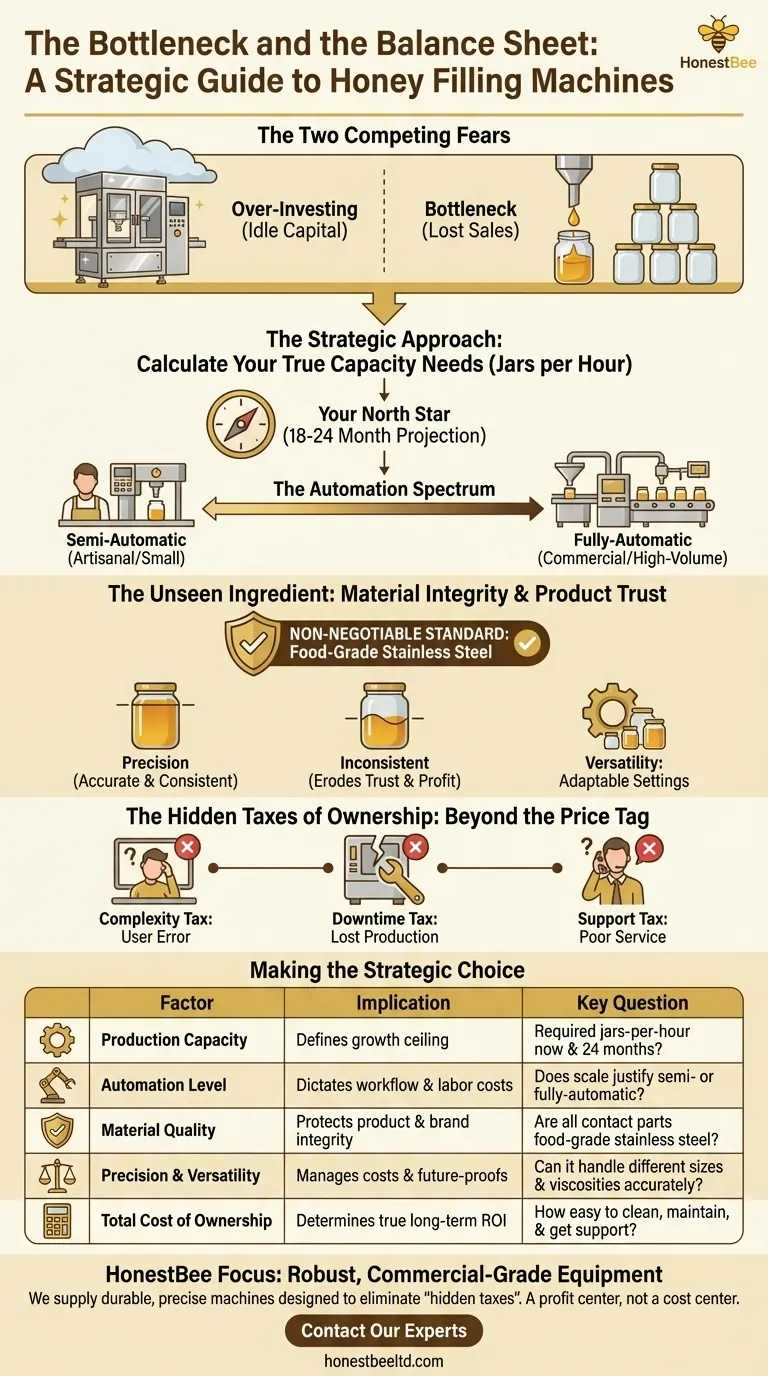
Every growing honey producer stands at a crossroads, caught between two competing fears. The first is the fear of over-investing—of a gleaming, oversized machine sitting idle, a monument to ambition that outpaced reality. The second, more visceral fear, is that of the bottleneck.
It’s the feeling of watching a single, slow nozzle drip golden honey into a jar while a pallet of empty containers waits, and a customer’s deadline looms. This isn't just an operational problem; it's a strategic one. The machine you choose is not merely a tool; it's the heart of your operation, dictating your capacity for growth and the integrity of your product.
The Psychology of Scale: Matching Ambition with Reality
The most fundamental error is a mismatch between machinery and scale. It's a psychological trap. We either buy for the business we have today, fearing the capital outlay, or we buy for the empire we dream of tomorrow, risking precious resources.
The right approach is a calculated one.
Calculate Your True Capacity Needs
Before you look at a single machine, calculate your required throughput. Not in vague terms, but in specific units: jars per hour. Project this figure for the next 18-24 months. This single number acts as your North Star, guiding you through the noise of technical specifications.
The Automation Spectrum
This number will immediately place you on the automation spectrum:
-
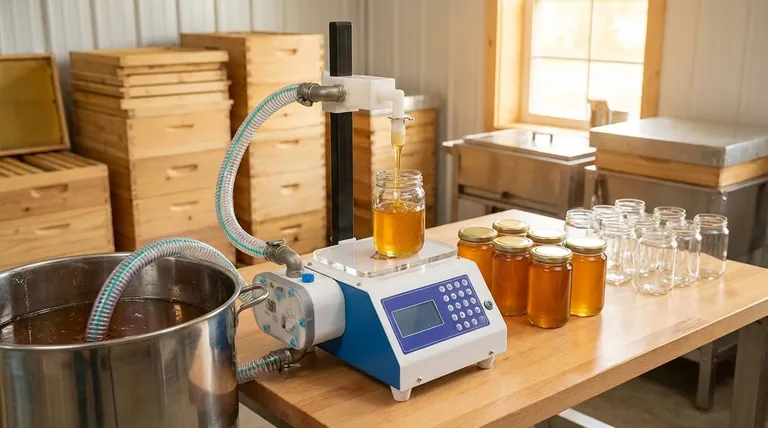
Semi-Automatic Systems: These are the perfect partners for artisanal and small-to-medium operations. An operator manages the containers, but the machine handles the precise filling. It’s a force multiplier, amplifying a human’s effort without the complexity of a fully integrated line.
-
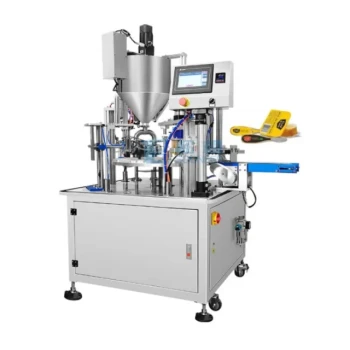
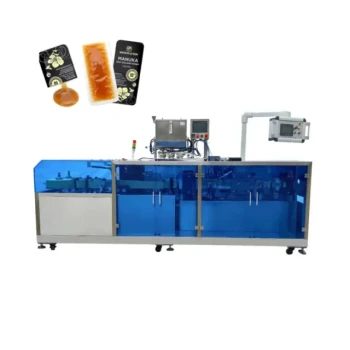
Fully-Automatic Systems: Built for the demands of commercial apiaries and high-volume distributors. These systems are ecosystems—feeding, filling, capping, and labeling with minimal human touch. The investment is significant, but so is the capacity it unlocks.
The Unseen Ingredient: Material Integrity and Product Trust
A honey filling machine does more than move liquid from a tank to a jar. It makes a promise. It promises that the honey inside the jar is as pure as it was in the hive.
The Non-Negotiable Standard of Stainless Steel
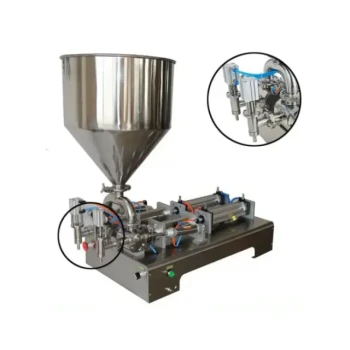
Any part of the machine that touches your honey must be made of food-grade stainless steel. This isn't a feature; it's a baseline requirement. It prevents corrosion and contamination, safeguarding both your product and your reputation. A machine built from inferior materials doesn't just break down; it breaks trust with your customers.
Precision as a Form of Respect
Filling accuracy is about more than minimizing waste. It’s a form of respect for your customer and your balance sheet.
Consistent under-filling erodes consumer trust. Consistent over-filling is a slow, silent drain on your profits. A high-quality machine delivers the exact same volume, every single time. It should also be versatile, with adjustable settings to handle different jar sizes and honey viscosities without a complete re-tooling. This adaptability is freedom.
The Hidden Taxes of Ownership: Beyond the Price Tag
The initial price of a machine is just the down payment. The total cost of ownership is paid over years in cleaning, maintenance, downtime, and training.
Think of these as hidden taxes:
- The Complexity Tax: A machine with a convoluted operating system requires extensive training and invites user error. Simplicity is an asset.
- The Downtime Tax: How easy is the machine to disassemble and clean? How quickly can you get spare parts? Every hour the machine is down for cleaning or repair is an hour your business isn't running.
- The Support Tax: When a critical component fails, the quality of your supplier’s after-sales support becomes the most important feature you own.
A machine that is cheap to buy but expensive to own is a liability disguised as a bargain.
Making the Strategic Choice
Choosing the right machine is an exercise in strategic clarity. It requires an honest assessment of where you are and a realistic vision for where you are going.
| Factor | Strategic Implication | Key Question to Ask |
|---|---|---|
| Production Capacity | Defines your growth ceiling. | What is my required jars-per-hour, now and in 24 months? |
| Automation Level | Dictates workflow and labor costs. | Does my scale justify a semi-automatic or fully-automatic system? |
| Material Quality | Protects your product and brand integrity. | Are all contact parts made of food-grade stainless steel? |
| Precision & Versatility | Manages costs and future-proofs your operation. | Can it handle my different jar sizes and honey viscosities accurately? |
| Total Cost of Ownership | Determines the true long-term ROI. | How easy is it to clean, maintain, and get support for this machine? |
For commercial apiaries and wholesale distributors, these questions carry immense weight. Your operations don't tolerate bottlenecks, and your partners demand reliability. You need equipment built not just for filling, but for relentless, high-volume production.
At HONESTBEE, we focus exclusively on this segment. We supply robust, commercial-grade beekeeping equipment designed to eliminate these "hidden taxes." Our honey filling machines are engineered for durability, precision, and ease of maintenance, ensuring they are a profit center, not a cost center. We understand the strategic calculus behind the purchase because we work with businesses whose success depends on it.
If you are ready to invest in equipment that matches your ambition, we can help you specify the right solution for your scale. Contact Our Experts
Visual Guide
Related Products
- Precision Durable Efficient HONESTBEE Rotary Honey Filling Machine
- Semi Automatic Small Honey Bottle Filling Machine Honey Filler
- Economy Small Honey Filling Machine Honey Bottle Filler Packaging Machine
- Fully Automatic Honey Filling Packaging Machine for Processing Line
- Commercial Rotary Honey Filling Machine for Production
Related Articles
- How to Choose Between Semi-Automatic and Fully Automatic Honey Filling Machines
- The Bottleneck in a Bottle: Why Manual Honey Filling Limits Your Apiary's Growth
- The Viscosity Principle: How a Honey Filling Machine Masters More Than Just Honey
- The Sticky Truth: Why Your Honey Filling Fails and How to Fix It for Good
- The Mechanics of Trust: Why Your Honey Filling Process is Your Brand's First Handshake