A Failure of Design, Not Intent
Imagine opening a hive in late autumn. You expect the reassuring hum of a colony preparing for winter. Instead, you find a silent, sticky tragedy. Thousands of your bees are dead, drowned in the very syrup you provided to save them.
This isn't just bad luck. It's a failure of design.
The equipment we use to support our bees isn't passive. A feeder, in particular, is a piece of life-support infrastructure. Its design can either foster a colony's resilience or create the conditions for its collapse.
The Allure of the Simple Solution: The Entrance Feeder
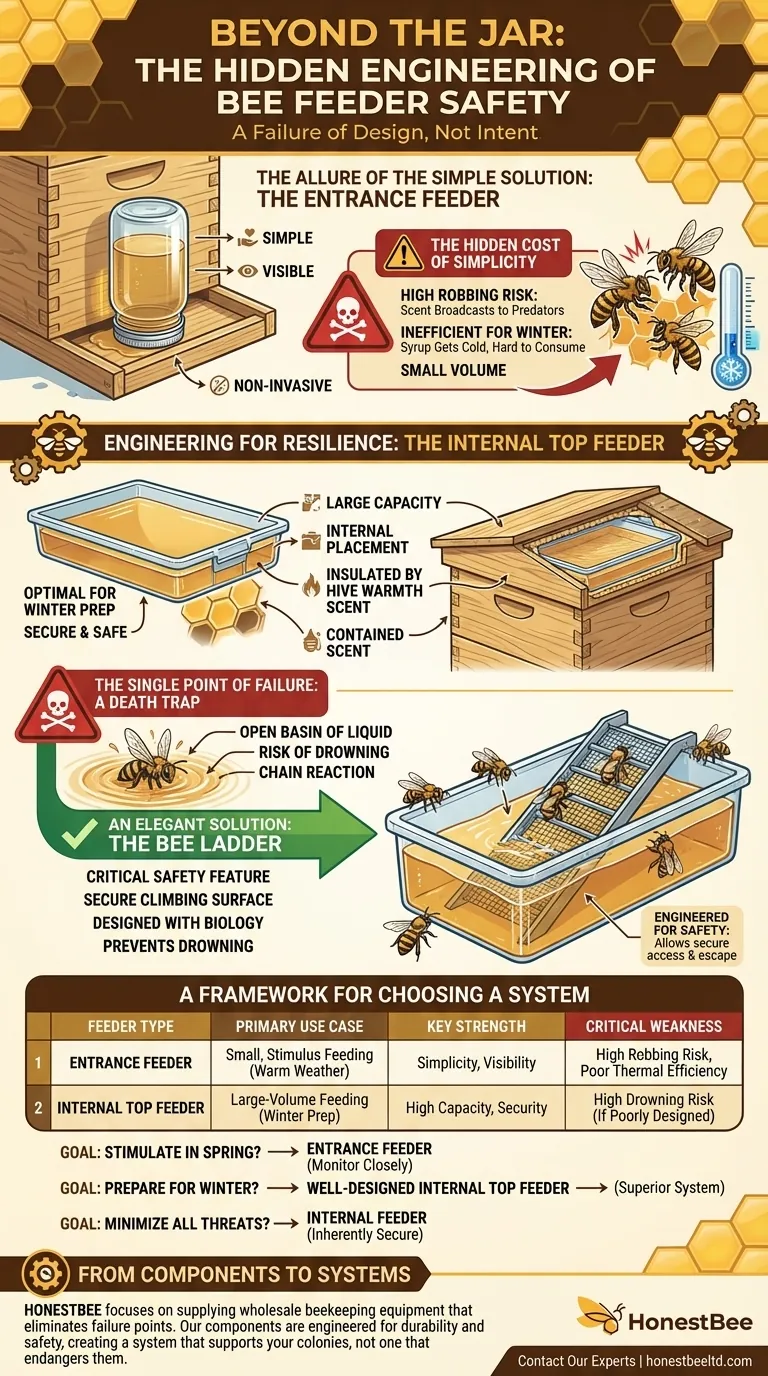
The entrance feeder, often a simple glass jar inverted over a small tray, is the most common entry point for new beekeepers. Its appeal is rooted in a powerful psychological bias: we prefer simple, visible solutions.
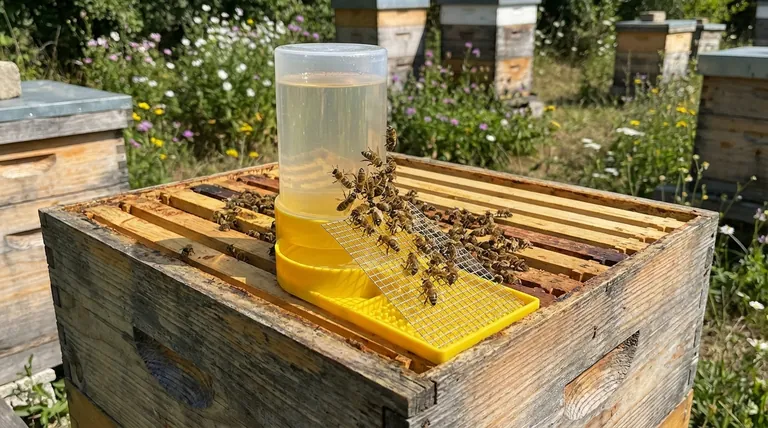
You can see the syrup level from a distance. You don't have to open the hive to refill it. It feels clean, non-invasive, and easy. It works on a simple principle of vacuum pressure, allowing bees to sip syrup through small holes without it pouring out.
The Hidden Cost of Simplicity
But this convenience comes at a steep price. An entrance feeder is an open invitation posted on the hive's front door.
It broadcasts the scent of sugar syrup to every bee in the area, creating a high-stakes environment for robbing. Stronger neighboring colonies can quickly overwhelm a weaker one, stripping its resources and killing its queen.
Furthermore, its small volume and external placement make it horribly inefficient for the most critical feeding period: preparing for winter. The syrup gets cold, making it harder for bees to consume, at the very moment they need calories the most.
Engineering for Resilience: The Internal Top Feeder
A far more robust system is the internal top feeder. This is not just a container, but an integrated component of the hive architecture.
Placed directly on top of the hive boxes and under the main cover, it becomes part of the colony's insulated living space. The bees' own warmth keeps the large reservoir of syrup at an optimal temperature. Because it's inside, the scent is contained, dramatically reducing the threat of robbing.
The Single Point of Failure
However, a top feeder presents its own stark engineering challenge: an open basin of liquid is a death trap for bees. A bee that falls into the syrup will struggle, attract others to its distress, and create a chain reaction of death.
This is the feeder's single point of catastrophic failure.
An Elegant Solution to a Deadly Problem
The solution is not to avoid top feeders, but to design them correctly. The critical feature is a "ladder" or screen, typically made of hardware cloth.
This simple component completely transforms the system. It provides a textured surface for bees to securely climb down, drink, and climb back out. It is a profound example of designing with the bees' own biology, not against it.
A well-designed top feeder must also be "bee-tight," ensuring bees can only access the syrup via this safe ladder, preventing them from finding a way into the main reservoir to drown.
A Framework for Choosing a System
The right feeder is not a matter of preference but a strategic choice based on the season and your specific goal. It's about managing risk.
| Feeder Type | Primary Use Case | Key Strength | Critical Weakness |
|---|---|---|---|
| Entrance Feeder | Small, stimulus feeding in warm weather. | Simplicity and visibility. | High robbing risk; poor thermal efficiency. |
| Internal Top Feeder | Large-volume feeding for winter prep. | High capacity and security. | High drowning risk if poorly designed. |
Your decision process should be clear:
- Goal: Stimulate a small colony in spring? An entrance feeder can work, but must be monitored closely for robbing.
- Goal: Prepare a colony for winter? A well-designed internal top feeder is the superior, safer, and more effective system.
- Goal: Minimize all external threats? An internal feeder is inherently more secure.
From Components to Systems
The difference between a thriving commercial apiary and one that constantly battles crises lies in the quality of its systems. A feeder isn't just a jar or a box; it's a component in a larger system of colony health.
A warped wooden base on an entrance feeder can break the vacuum seal. A poorly fitted screen in a top feeder can create a gap for bees to drown. These are not minor defects; they are systemic vulnerabilities. At HONESTBEE, we focus on supplying wholesale beekeeping equipment that eliminates these failure points. Our components are engineered for durability and safety, ensuring that whether you are building entrance or internal top feeders, you are creating a system that supports your colonies, not one that endangers them.
For commercial apiaries and distributors who understand that reliable equipment is the foundation of a successful operation, we provide the robust solutions needed. Contact Our Experts
Visual Guide
Related Products
- Rapid Bee Feeder White Plastic 2L Round Top Feeder for 8 or 10-Frame Bee Hives
- HONESTBEE Entrance Bee Feeder Professional Hive Nutrition Solution for Beekeeping
- White Plastic 0.5L Beekeeping Entrance Feeder for Bees
- HONESTBEE Entrance Bee Feeder Efficient Hive Front Liquid Feeding Solution for Beekeeping
- HONESTBEE Professional Entrance Bee Feeder Hive Nutrition Solution
Related Articles
- How to Choose Between Frame and Gravity Feeders for Healthy Honey Bee Colonies
- How to Choose the Right Bee Feeder for Your Hive’s Health and Efficiency
- Design, Drowning, and the Deceptively Simple Bee Feeder
- The Weight of Winter: A Systems Approach to Pre-Season Bee Feeding
- How to Accelerate Bee Colony Growth with Science-Backed Feeding Strategies