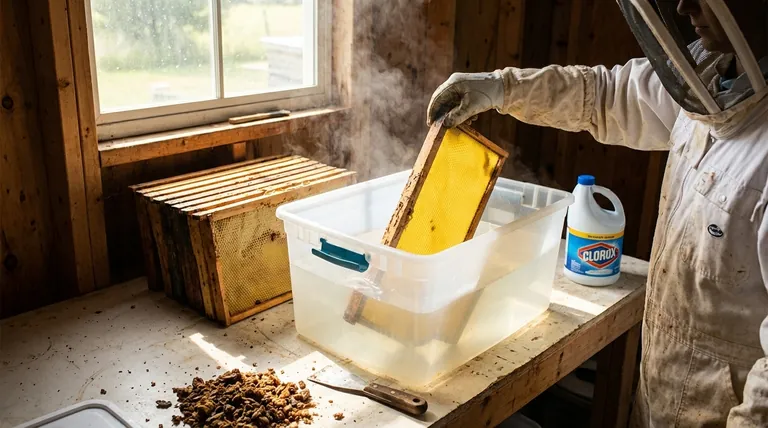
The Beekeeper's Fallacy
In a beekeeper's workshop, there's a stack of used frames. To the naked eye, they look perfect. The wood is sound, the foundation intact. After a thorough scraping to remove old wax and propolis, they seem ready for a new colony.
This is a powerful illusion.
The greatest threats to a honeybee colony are rarely the ones we can see. The desire to be efficient and reuse valuable equipment is a strong psychological pull. But it's based on a fallacy: the belief that if something looks clean, it is safe. The real war for hive health is fought at a microscopic level, against an enemy that leaves no visible trace.
The Anatomy of an Invisible Threat
A physically clean frame can still be a biological time bomb. Two primary antagonists survive the scraper, waiting silently in the wood grain and foundation crevices.
1. The Biological Ghosts
Used frames can host a gallery of pathogens: bacteria like Paenibacillus larvae (in its vegetative state), fungal spores from chalkbrood, and various viral particles. These organisms are the ghosts of the previous colony. They linger on surfaces, capable of reactivating and infecting a new, healthy colony, triggering a cascade of disease that could have been easily prevented.
2. The Trojan Horse Eggs
Pests like wax moths and small hive beetles are masters of infiltration. They lay their tiny, resilient eggs in the smallest cracks. These eggs are nearly invisible and can easily withstand a simple physical cleaning. Placing a frame with these eggs into a new hive is like delivering a Trojan horse directly past the guards. An infestation doesn't just happen; it's often introduced.
Chemical Warfare: The Science of Sanitization
To fight an invisible enemy, you need a weapon that operates at the same scale. This is where a simple bleach solution becomes a sophisticated tool of biosecurity.
The active ingredient, sodium hypochlorite, is a powerful oxidizing agent. It doesn't just "clean"—it wages chemical warfare. It attacks the very structure of microorganisms, violently denaturing their proteins and tearing apart their cell walls. This chemical action is brutally effective, rendering pathogens inert and destroying the viability of pest eggs.
It transforms a simple bath into a necessary act of chemical sterilization.
A Protocol for Precision
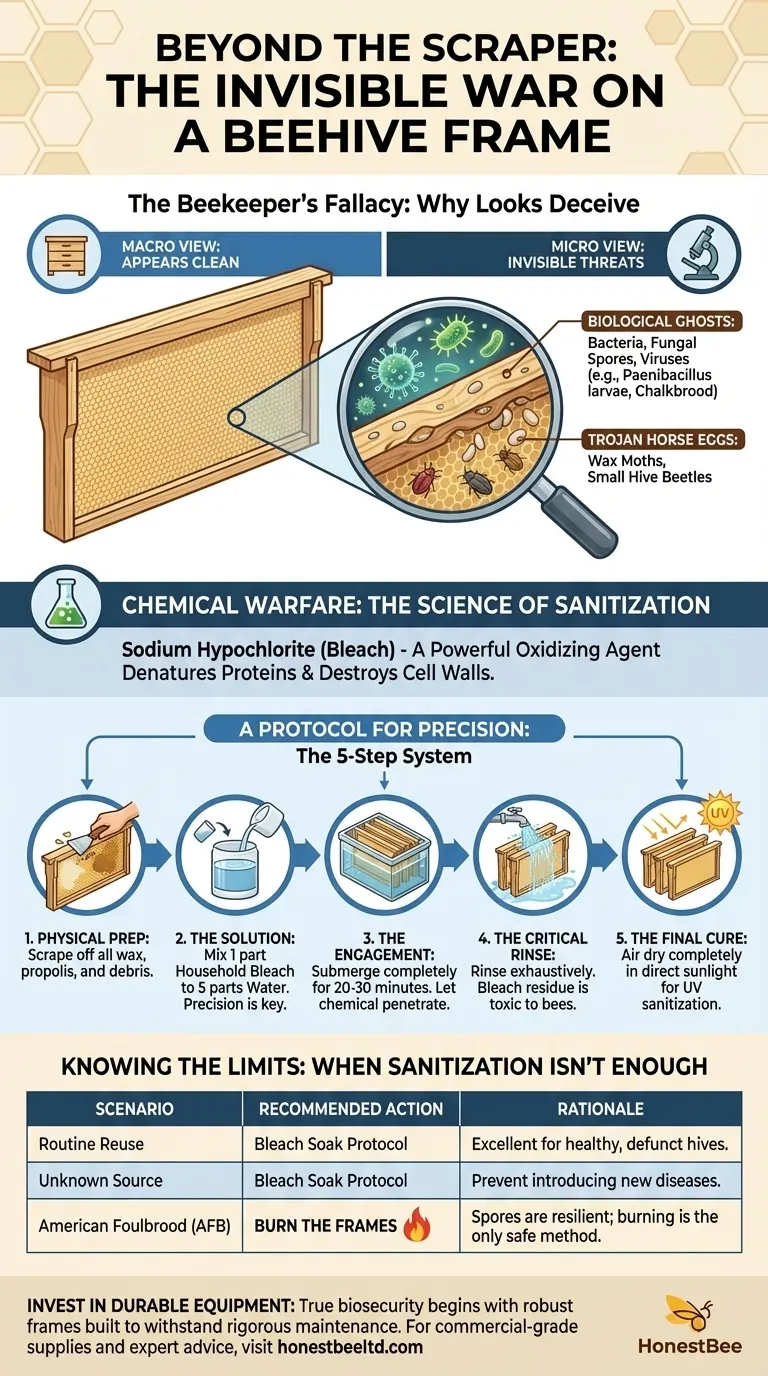
Effective sanitization isn't about guesswork; it's a protocol where every step matters. Missing one can neutralize the entire effort or, worse, harm your bees.
-
Step 1: The Physical Prep. First, thoroughly scrape the frames of all visible wax, propolis, and debris. The chemical solution needs access to the bare surfaces to be effective.
-
Step 2: The Solution. In a container large enough for full submersion, create a solution of one part household bleach to five parts water. Precision here is key.
-
Step 3: The Engagement. Submerge the frames completely for 20-30 minutes. This duration gives the sodium hypochlorite enough time to penetrate and neutralize the hidden threats.
-
Step 4: The Critical Rinse. This is the most important step for your bees' safety. After soaking, you must rinse the frames exhaustively with clean water. Any bleach residue is highly toxic to bees. A failure here will poison the very colony you're trying to protect.
-
Step 5: The Final Cure. Place the rinsed frames in a well-ventilated area, preferably in direct sunlight. Allow them to air dry completely. The sun's UV rays provide a final layer of sanitization, and drying ensures any trace amounts of chlorine gas have dissipated.
Knowing the Limits: When Sanitization Isn't Enough
This protocol is a powerful tool for routine biosecurity, but it is not a silver bullet. Understanding its limitations is the mark of a responsible apiarist.
| Scenario | Recommended Action | Rationale |
|---|---|---|
| Routine Reuse | Bleach Soak Protocol | Excellent for frames from healthy, defunct hives. |
| Unknown Source | Bleach Soak Protocol | A non-negotiable step to prevent introducing new diseases. |
| American Foulbrood (AFB) | Burn the Frames | AFB spores are incredibly resilient. Burning is the only safe method to prevent its devastating spread. |
Furthermore, bleach is corrosive. Over time, repeated soaks will degrade the wood and metal components of your frames. This is an unavoidable cost of good hygiene. It highlights the importance of starting with robust, high-quality equipment that can withstand the rigors of these essential maintenance cycles.
Investing in durable frames isn't about aesthetics; it's about building a foundation that supports a long-term, professional approach to hive health. True biosecurity is a system, and it begins with equipment built for the reality of the work. For commercial-grade supplies designed to withstand the demands of modern beekeeping, including essential sanitization protocols, Contact Our Experts.
Visual Guide
Related Products
- Wooden Bee Hive Frames for Beekeeping and Wholesale
- Assembled Wooden Bee Frames with Plastic Foundation for Durability and Convenience by HONESTBEE
- Precision Stainless Steel Frame Cleaner for Hive Grooves and Corners
- Plastic Bee Frame Beekeeping Hive Frames for Wholesale
- Assembled Wooden Bee Frames with Beeswax Foundation Ready to Use by HONESTBEE
Related Articles
- Wooden vs. Plastic Bee Hive Frames: Balancing Sustainability and Practicality
- Assembled vs. Unassembled Frames: A Beekeeper’s Time-Value Analysis
- The Beekeeper's Trade-Off: Engineering Efficiency vs. Honoring Instinct
- How to Choose Beehive Frames: Balancing Bee Health, Honey Yield, and Beekeeper Convenience
- Beyond the Scrape: A Risk Management Framework for Cleaning Beehive Frames




