The Unseen Architecture of a Kingdom
Imagine a wild honeybee colony. It’s a marvel of chaotic, organic construction. Wax comb, a perfect geometry of hexagons, fuses to the ceiling and walls of its cavity, creating a single, inseparable structure. For early beekeepers, accessing this world meant destruction. Harvesting honey was an act of plunder.
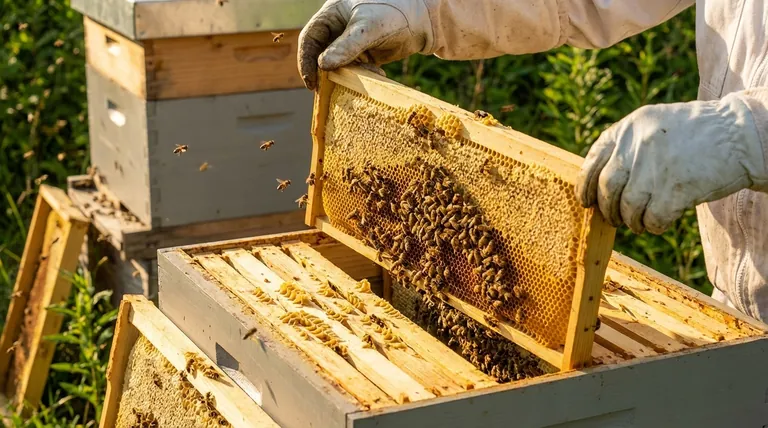
Now picture a modern commercial apiary. The hives are orderly stacks of boxes. Inside, the combs are arranged like files in a cabinet—perfectly parallel, individually removable. This transformation from chaos to order wasn't achieved by force. It was the result of a profound insight into bee psychology, codified in a simple wooden rectangle: the bee frame.
The Langstroth Revelation: A Dialogue with Nature
Before the mid-19th century, beekeepers operated with a fundamental disconnect from their colonies. To see the queen or check for disease, they had to tear the hive apart, an act that could set the colony back for weeks or even prove fatal.
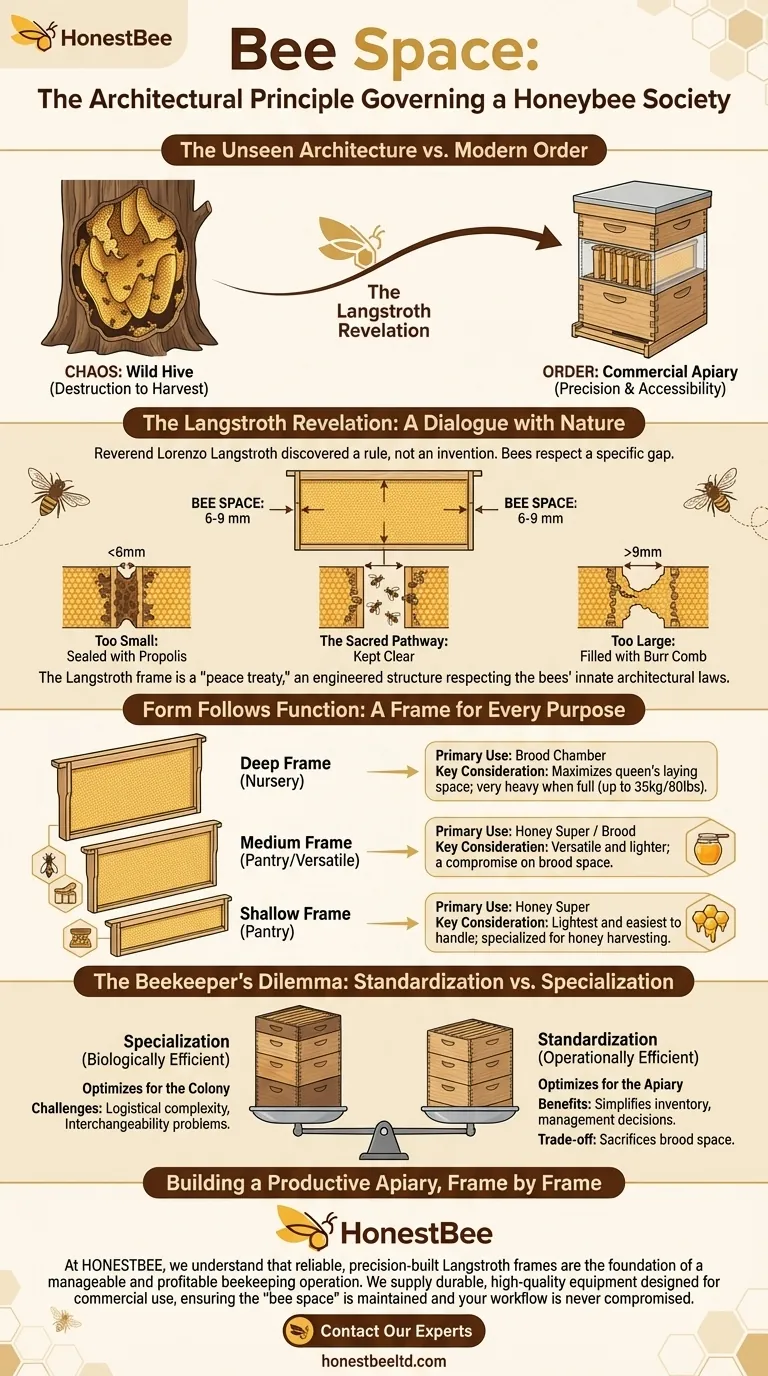
The revolution came from Reverend Lorenzo Langstroth, who didn't invent a box so much as he discovered a rule. He observed that bees consistently leave a specific gap between their combs—a space ranging from 6 to 9 millimeters.
This is the "bee space."
Any gap smaller than this, bees will seal with propolis (a resinous glue). Any gap larger, they will fill with new comb. But this specific in-between dimension is treated as a sacred pathway, a corridor to be kept clear.
The Langstroth frame is the physical embodiment of this principle. It is engineered to hang inside the hive box, creating this precise bee space on all sides. It is less an invention and more of a peace treaty—an agreement where humans provide a structure that respects the bees' innate architectural laws, and in return, the bees build their society in a way that is accessible to us.
Form Follows Function: A Frame for Every Purpose
This modular system allows for specialized roles within the hive, mirroring the colony's own division of labor. The frames, though simple, are designed with specific functions in mind.
The Nursery: Deep Frames
The lower, larger boxes of the hive form the brood chamber—the colony's nursery. Here, the queen lays thousands of eggs a day. She requires a large, unbroken canvas to maintain her laying patterns. Deep frames provide this expansive space, allowing for a strong, contiguous brood nest, which is the engine of the colony's population.
The Pantry: Medium & Shallow Frames
Above the brood chamber sit the "honey supers," where surplus honey is stored. These boxes use medium or shallow frames. The logic here is purely ergonomic. A deep frame, dense with honey, can weigh over 35 kg (80 lbs). Lighter medium and shallow frames make the work of harvesting honey physically manageable, preventing beekeeper fatigue and injury.
The Beekeeper's Dilemma: Standardization vs. Specialization
This specialization introduces a classic operational trade-off. Using different frame sizes for the brood chamber and honey supers is biologically efficient but creates logistical complexity.
- The Weight Factor: The sheer weight of deep frames is a significant physical challenge. Some beekeepers opt to use medium frames for everything, sacrificing brood space for a more manageable, standardized system.
- The Interchangeability Problem: With a mixed-size setup, you cannot move a frame of honey from a super down to the brood box to feed the colony, nor can you move a frame of brood up to encourage expansion. A single-size system simplifies equipment inventory and management decisions.
This choice reflects a core tension in any large-scale operation: do you optimize for the biological unit (the colony) or the operational unit (the apiary)?
| Frame Type | Primary Use Case | Key Consideration |
|---|---|---|
| Deep Frame | Brood Chamber | Maximizes queen's laying space; very heavy when full. |
| Medium Frame | Honey Super / Brood | Versatile and lighter; a compromise on brood space. |
| Shallow Frame | Honey Super | Lightest and easiest to handle; specialized for honey. |
Building a Productive Apiary, Frame by Frame
For a commercial apiary, the bee frame is not just a piece of equipment; it is the fundamental unit of work. Every inspection, every harvest, every disease check hinges on the quality and consistency of these frames. Poorly constructed frames that break or warp don't just cause frustration—they disrupt the hive, damage comb, and reduce operational efficiency.
Scaling an apiary means scaling your reliance on this engineered space. At HONESTBEE, we understand that reliable, precision-built Langstroth frames are the foundation of a manageable and profitable beekeeping operation. We supply durable, high-quality beekeeping equipment designed for the rigors of commercial use, ensuring the "bee space" is maintained and your workflow is never compromised.
The humble bee frame represents a perfect intersection of biology and engineering—a simple tool that allows us to partner with one of nature's most complex societies. To build your operation on a foundation of quality and efficiency, Contact Our Experts.
Visual Guide
Related Products
- JZBZ Langstroth Queen Rearing Frame for Beekeeping
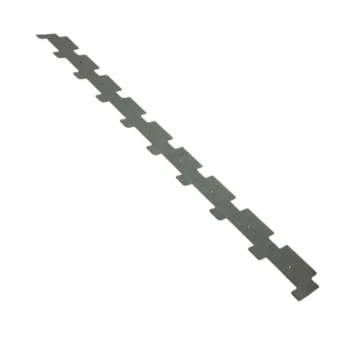
- Heavy Duty Castellated Iron Frame Spacer for Honey Supers
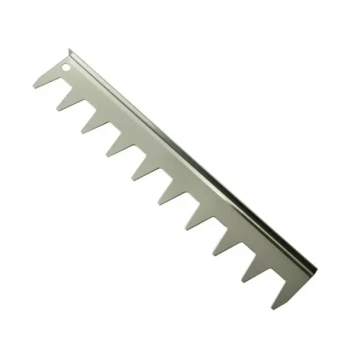
- Stainless Steel 9 Frame Hive Spacer Durable Precise for Commercial Beekeeping
- Wooden Bee Hive Frames for Beekeeping and Wholesale
- Durable Plastic Frame Spacer
Related Articles
- Assembled vs. Unassembled Frames: A Beekeeper’s Time-Value Analysis
- Are Your Beekeeping Frames Holding You Back? Unpacking the Hidden Trade-offs in Hive Management
- Tired of Sagging Comb? The Hidden Cost of "Cheap" Beekeeping Frames
- How Specialized Frames Revolutionize Queen Rearing Success
- How Beekeepers Can Maximize Queen-Rearing Success with the JZBZ System