The Architecture of Anxiety
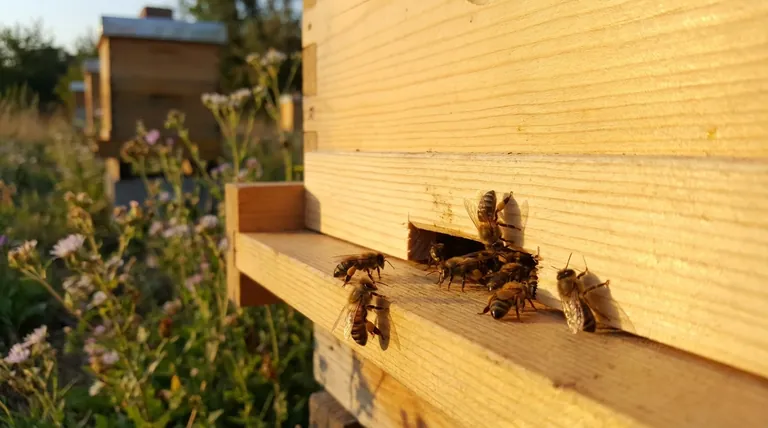
Picture a honey bee colony in late summer. Foragers return heavy with nectar, but they are not alone. Yellow jackets dart at the entrance, testing the guards. Robber bees from a neighboring hive, drawn by the scent of honey, probe for any weakness.
For the bees, the hive entrance is not just a doorway. It is the single greatest point of vulnerability, the primary interface between their organized society and a world of threats. A wide, undefended opening is a source of constant, collective stress for the superorganism.
Managing a colony isn't just about managing honey production; it's about managing this stress.
Designing for Instinct, Not Just Access
A beekeeper’s instinct might be to provide a large, accommodating entrance. More space equals more traffic, which should equal more honey. But this human logic overlooks millions of years of bee evolution.
A simple block of wood can narrow an entrance. But a precisely engineered management tool does something more. It aligns with the colony's own defensive instincts. This is where modern equipment design, grounded in biology, makes a tangible difference.
The 'Seeley' Entrance: Engineering for Peace of Mind
The most profound feature of a modern entrance reducer is one inspired by nature itself. Honey bee biologist Dr. Thomas Seeley, in his extensive research on feral colonies, discovered that bees don't choose nests with sprawling entrances.
They consistently choose homes with tiny, defensible holes—often just over a square inch.
This isn't an arbitrary preference. A small entrance is a force multiplier for the guard bees. It creates a chokepoint where a few guards can effectively repel a much larger force of intruders. By replicating this "Seeley" entrance, we are not imposing a design on the bees; we are giving them back the security they would choose for themselves.
Adaptability as a Management Philosophy
Of course, a hive's needs are not static. The fortress required during a robbing frenzy becomes a bottleneck during a heavy nectar flow.
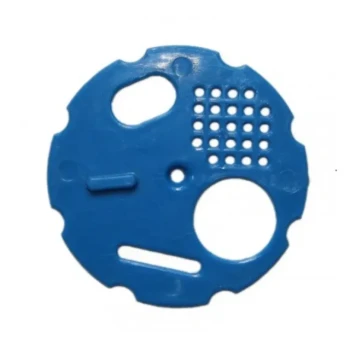
This is why versatility is the second pillar of intelligent design. A professional entrance reducer must be adaptable, offering different opening sizes to match the season and the colony's strength.
- Universal Fit: Designed for standard 8 and 10-frame Langstroth hives, it becomes a standardized tool across an entire apiary.
- Variable Openings: It provides options for every scenario—from the minimal "Seeley" opening for a new nucleus colony to a wider slot for maximum ventilation on a hot summer day.
The Inescapable Trade-Off: Security vs. Throughput
Effective beekeeping is about making informed decisions. The entrance reducer is a tool that forces you to weigh a critical trade-off: security or efficiency? The right answer changes throughout the year.
Your decision should be guided by the colony's state and the external environment.
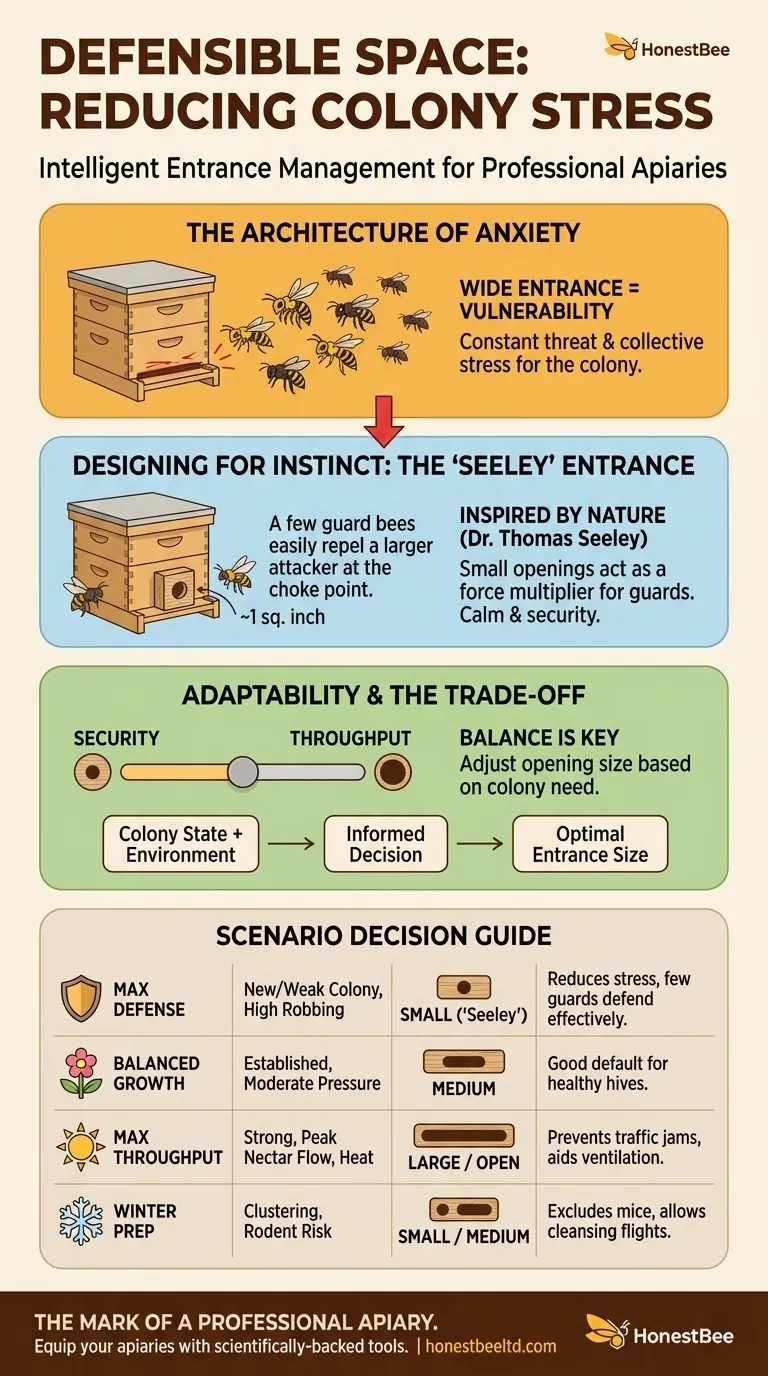
| Scenario | Colony Condition | External Pressure | Recommended Entrance | Rationale |
|---|---|---|---|---|
| Maximum Defense | New, weak, or small | High robbing or pest risk | Small ("Seeley") | Reduces stress, allows few guards to defend effectively. |
| Balanced Growth | Established, growing | Moderate | Medium | A good default for a healthy hive in spring. |
| Maximum Throughput | Strong, populous | Peak nectar flow, hot weather | Large / Open | Prevents traffic jams and aids hive ventilation. |
| Winter Preparedness | Clustering for winter | Rodent risk | Small / Medium | Prevents mice entry while allowing cleansing flights. |
The Mark of a Professional Apiary
Actively managing the hive entrance is a sign of a deeper understanding of bee biology. It’s an acknowledgment that our role is to provide tools that reduce stress and allow the colony to allocate its energy where it matters most: raising brood, fighting disease, and gathering resources.
This philosophy—equipping bees with scientifically-backed tools—is the foundation of successful commercial beekeeping. At HONESTBEE, we supply commercial apiaries and distributors with equipment designed not just for durability, but for the biological realities of a thriving honey bee colony.
Strengthening your operation starts with recognizing that even the smallest piece of equipment can have the largest impact on colony health. If you are ready to equip your apiaries with tools that align with the natural instincts of your bees, Contact Our Experts.
Visual Guide
Related Products
- Steel Round Disc Entrance Reducer for Flexzion Bee Hive Nuc Box Gate
- Beehive Entrance Reducer Guardian Metal Hive Entrance for Bees
- Professional Hive Front Entrance Bee Feeder
- Multi-Functional Rotary Hive Entrance Disc for Beekeeping
- HONESTBEE Entrance Bee Feeder Efficient Hive Front Liquid Feeding Solution for Beekeeping
Related Articles
- Strategic Entrance Reducer Management: From Hive Defense to Colony Growth Optimization
- A Question of Access: Why the Hive Entrance is a Beekeeper's Most Critical Control Point
- Managing Vulnerability: The Strategic Trade-offs of a Hive Entrance Reducer
- More Than a Block of Wood: How the Hive Entrance Reducer Governs a Colony's Fate
- The Bottleneck Principle: Why Reducing a Hive Entrance is Critical Winter Engineering