The Unseen Battle in Every Jar
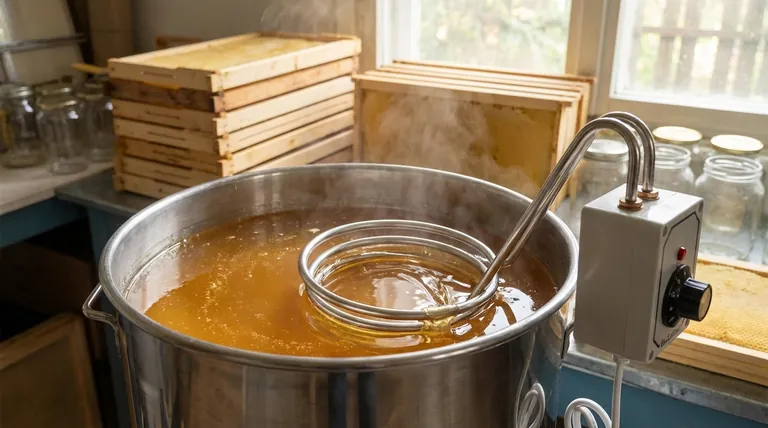
Picture this: a stainless steel tank filled with fresh, golden honey, straight from the extractor. It’s pure, fragrant, and still holds the warmth of the hive. It is also incredibly thick, a stubborn liquid that resists movement.
The beekeeper faces a fundamental dilemma. To bottle this honey is to move it. To move it efficiently is to make it flow. And the simplest way to make it flow is to apply heat.
This decision—to heat or not to heat—is not a simple matter of right or wrong. It's a strategic choice between two different definitions of a perfect product: one that values operational elegance and consistency, and another that prioritizes the preservation of honey in its most natural, unaltered state.
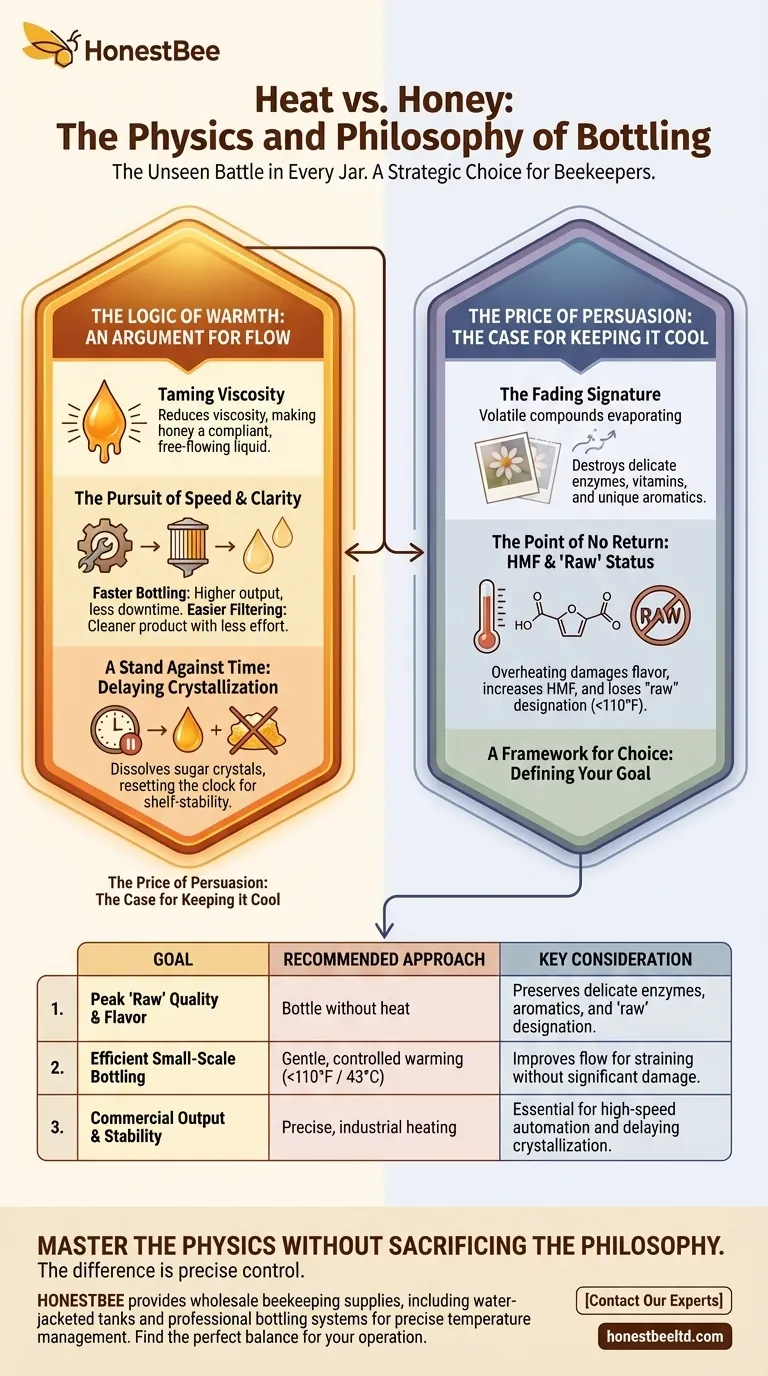
The Logic of Warmth: An Argument for Flow
In any fluid dynamic system, from rivers to pipelines, the goal is to reduce friction and encourage movement. Honey bottling is no different. Heating is simply a tool of persuasion.
Taming Viscosity
Honey’s resistance to pouring is called viscosity. It’s a physical property that makes it slow, heavy, and difficult to manage. A gentle warmth dramatically reduces this viscosity, transforming the honey from a thick, sluggish mass into a compliant, free-flowing liquid.
This isn't about cooking the honey; it's about relaxing it just enough to cooperate.
The Pursuit of Speed and Clarity
A lower viscosity has immediate, practical benefits for any beekeeping operation.
- Faster Bottling: Warmed honey moves quickly through pumps, pipes, and filler nozzles. For operations using anything from simple gravity bottlers to high-speed automatic filling machines, this translates directly to higher output and less downtime.
- Easier Filtering: Straining honey removes hive debris and fine beeswax particles. Thinner honey passes through filters with far less resistance, resulting in a clearer product with less effort and pressure.
A Stand Against Time: Delaying Crystallization
Nearly all pure honey will eventually crystallize. Heating dissolves the microscopic sugar crystals that act as seeds for this process. By doing so, you effectively reset the clock, keeping the honey in its liquid, shelf-stable form for much longer—a critical factor in a competitive retail environment.
The Price of Persuasion: The Case for Keeping it Cool
While warmth solves physical problems, it can introduce biological and chemical ones. The very soul of the honey—its unique character—is incredibly sensitive.
The Fading Signature
Honey is more than just sugar. It's a complex solution of natural enzymes, vitamins, and volatile aromatic compounds. These are the elements that give a specific varietal its distinct flavor and scent.
Excessive heat destroys these delicate compounds. It's like overexposing a photograph; the main subject is still visible, but the nuance, depth, and subtle details are permanently lost.
The Point of No Return: HMF and "Raw" Status
Overheating does more than just mute the flavor. It can actively damage it, causing the honey to darken and develop a burnt, caramelized taste.
Chemically, it also raises levels of Hydroxymethylfurfural (HMF), a compound widely used as a marker for heat damage or prolonged storage.
For many consumers, the most valuable designation is "raw." To qualify, honey must not be heated past the temperatures naturally occurring in a beehive (typically under 110°F or 43°C). Bottling without any heat is the only guaranteed way to protect this premium status.
A Framework for Choice: Defining Your Goal
The right approach depends entirely on your operational goals and your brand promise. The choice is a balance between purity, pragmatism, and production.
| Goal | Recommended Approach | Key Consideration |
|---|---|---|
| Peak "Raw" Quality & Flavor | Bottle without heat | Preserves delicate enzymes, aromatics, and the "raw" designation. |
| Efficient Small-Scale Bottling | Gentle, controlled warming (<110°F / 43°C) | Improves flow for straining without significant damage. |
| Commercial Output & Stability | Precise, industrial heating | Essential for high-speed automation and delaying crystallization. |
The problem isn't heat itself, but the lack of control. The difference between gently warming honey and damaging it can be just a few degrees.
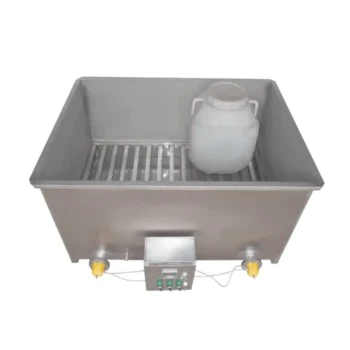
This is where professional equipment becomes the key to executing your strategy flawlessly. Whether your commercial apiary or distribution business prizes pristine raw honey or demands the efficiency of high-volume bottling, the right tools give you control over the process. HONESTBEE provides wholesale beekeeping supplies, including water-jacketed tanks and professional bottling systems, engineered for precise temperature management. We help you master the physics of flow without sacrificing the philosophy of your product.
Find the perfect balance for your operation. Contact Our Experts
Visual Guide
Related Products
- Manual Honey Filling Machine Bottling Machine for Honey
- Double Nozzle Small Honey Filling Machine Honey Sachet Packing Packaging Equipment
- Economy Small Honey Filling Machine Honey Bottle Filler Packaging Machine
- Honey Gate Valve with Ergonomic Ball Handle Plastic Bee Honey Tap for Beekeeping Bottling and Honey Extractor Equipment
- Precision Durable Efficient HONESTBEE Rotary Honey Filling Machine
Related Articles
- Your Honey Bottleneck Isn't the Filler. It's Everything Else.
- The Bottleneck in a Bottle: Why Manual Honey Filling Limits Your Apiary's Growth
- The Flow, The Fill, and The Future: A Honey Bottler's Guide to Scale
- How to Choose the Best Honey Filling Machine for Your Production Needs
- The Bottleneck and the Bottle: A Systems Approach to Honey Filling