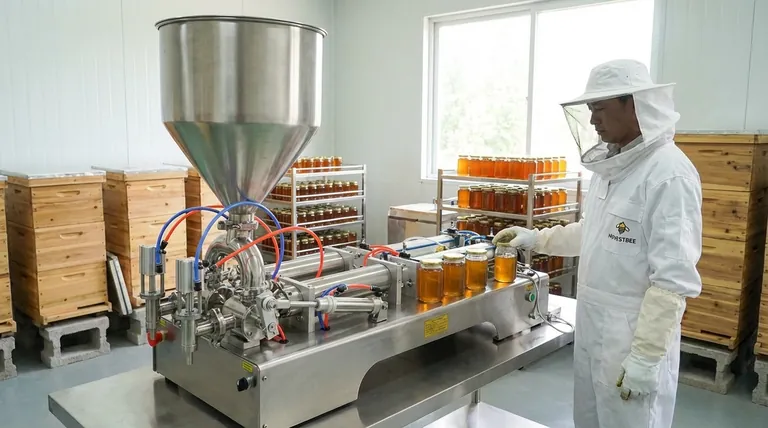
An apiary's success story often hides a quiet bottleneck. The hives are thriving, the honey is exquisite, and local demand is strong. Then, the first big distributor order arrives—a request for thousands of jars. Suddenly, the bottleneck isn't the bees; it's the owner and a small team, standing over a workbench, painstakingly filling each jar by hand or with a basic dispenser.
This moment is a crossroads. The transition from artisan to commercial producer isn't just about more hives; it's about mastering the physics of flow and the psychology of scale. Your choice of a honey filling machine is the physical manifestation of that decision.
Two Philosophies of Production
The choice between a semi-automatic and a fully automatic honey filling machine is not about which is "better." It's a choice between two fundamentally different operational philosophies: one centered on the operator, the other on the system.
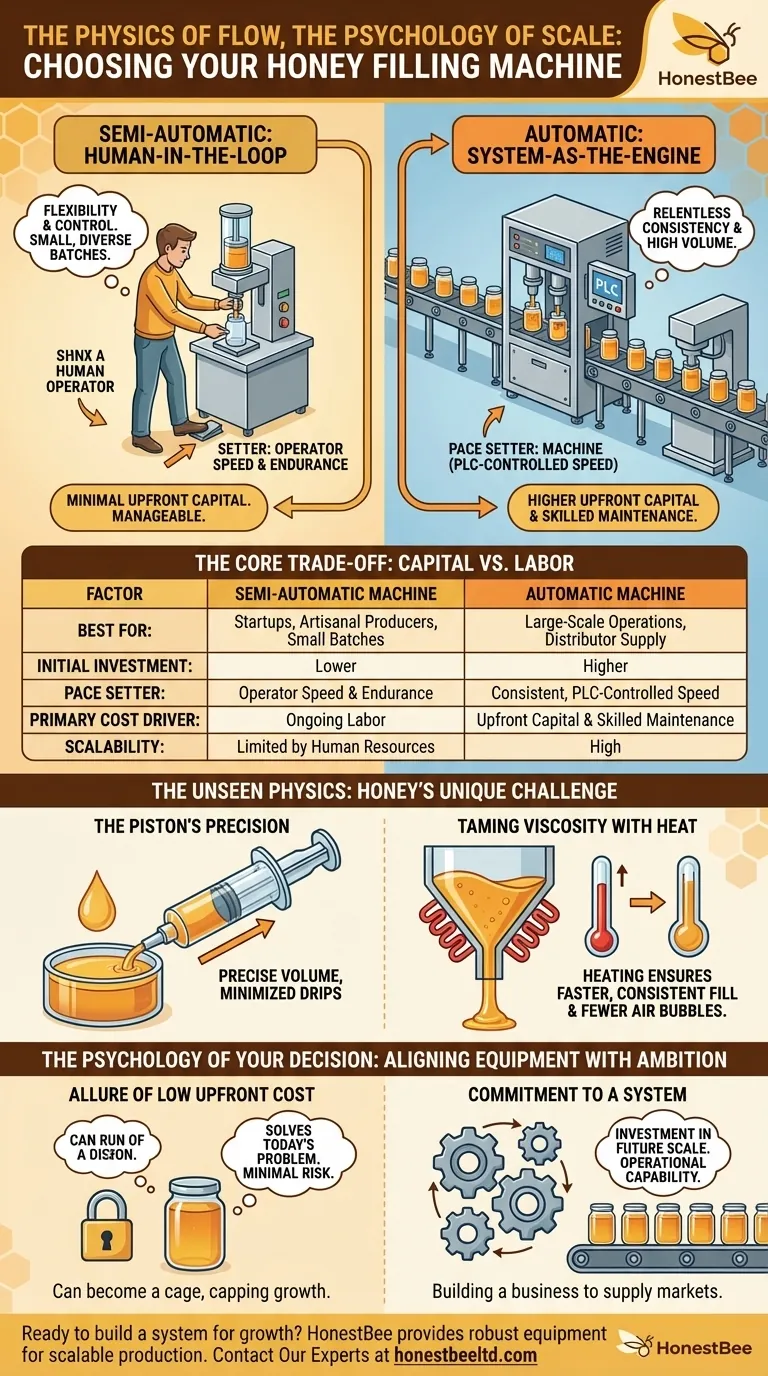
The Semi-Automatic Path: Human-in-the-Loop
A semi-automatic machine places the operator at the heart of the process. They place the jar, press a pedal to initiate the fill, and remove the finished product. The machine guarantees an accurate volume, but the production rate—the rhythm of the operation—is dictated entirely by the person.
This is a system built on flexibility and control. It's perfect for managing small, diverse batches with minimal upfront capital. It feels manageable because it is.
The Automatic Path: System-as-the-Engine
A fully automatic machine builds the operator out of the core loop. A conveyor moves containers, a Programmable Logic Controller (PLC) triggers the fill, and the jar moves on to capping and labeling without a human touch.
Here, the machine sets the pace. It is a commitment to a system designed for relentless consistency and high volume. It requires surrendering manual control to achieve an entirely new level of output.
The Core Trade-Off: Capital vs. Labor
Your decision ultimately hinges on a classic business calculation: balancing initial investment against long-term operational costs.
| Factor | Semi-Automatic Machine | Automatic Machine |
|---|---|---|
| Best For | Startups, Artisanal Producers, Small Batches | Large-Scale Operations, Distributor Supply |
| Initial Investment | Lower | Higher |
| Pace Setter | Operator Speed & Endurance | Consistent, PLC-Controlled Speed |
| Primary Cost Driver | Ongoing Labor | Upfront Capital & Skilled Maintenance |
| Scalability | Limited by Human Resources | High |
The Unseen Physics: Why Honey is a Unique Challenge
To appreciate the engineering, you must appreciate the medium. Honey is not like water. Its viscosity—its resistance to flow—is the central technical challenge that both types of machines are designed to solve with elegance.
The Piston's Precision
Most quality honey fillers use a piston mechanism. It operates like a perfectly calibrated syringe, drawing a precise volume of honey into a cylinder and then dispensing it cleanly. This method is exceptionally accurate and minimizes drips, which is crucial for a product as sticky and valuable as honey.
Taming Viscosity with Heat
Honey's viscosity is highly sensitive to temperature. A few degrees can be the difference between a thick, slow-moving sludge and a smooth, cooperative liquid. This is why professional-grade machines, like those supplied by HONESTBEE, integrate heating systems into the hopper and flow path. Warming the honey ensures a faster, more consistent fill with fewer air bubbles, protecting both efficiency and product quality.
The Psychology of Your Decision
The spec sheet tells you what a machine does. Your business plan should tell you what you need. The choice is as much about your ambition as it is about your budget.
The Allure of Low Upfront Cost
The low price of a semi-automatic machine is seductive. It solves today's problem with minimal financial risk. However, this safety can become a cage. The machine that helped you start can become the very reason you can't accept a larger purchase order, capping your growth potential. It prioritizes present-day capital over future-state opportunity.
The Commitment to a System
Investing in an automatic line is a significant capital commitment. It requires not just money, but a belief in your future scale. It comes with "hidden" costs—professional installation, maintenance, and the need for more skilled technicians. But these aren't just costs; they are investments in a new operational capability. It is a clear statement that you are building a business to supply markets, not just a local farm stand.
This decision is about aligning your equipment with your ambition. At HONESTBEE, we focus on supplying commercial apiaries and distributors with robust equipment because we understand this strategic crossroads. We provide the machinery that transforms a successful apiary into a scalable production powerhouse.
We help you navigate the trade-offs between capital, labor, and speed, ensuring your investment serves your goals today and for years to come. If you're ready to move beyond the bottleneck and build a system for growth, Contact Our Experts.
Visual Guide
Related Products
- Precision Durable Efficient HONESTBEE Rotary Honey Filling Machine
- Semi Automatic Small Honey Bottle Filling Machine Honey Filler
- Economy Small Honey Filling Machine Honey Bottle Filler Packaging Machine
- Commercial Rotary Honey Filling Machine for Production
- Fully Automatic Honey Filling Packaging Machine for Processing Line
Related Articles
- How to Choose Between Semi-Automatic and Fully Automatic Honey Filling Machines
- The Bottleneck in a Bottle: Why Manual Honey Filling Limits Your Apiary's Growth
- The Viscosity Principle: How a Honey Filling Machine Masters More Than Just Honey
- The Sticky Truth: Why Your Honey Filling Fails and How to Fix It for Good
- The Mechanics of Trust: Why Your Honey Filling Process is Your Brand's First Handshake
















