The Psychology of a Winter Hive
A honeybee colony in July is a bustling metropolis—expansive, confident, and preoccupied with growth. Its thousands of foragers operate with relentless energy, extending the colony's influence far and wide.
A colony in January is a fortress under siege.
The population has contracted, the collective mood has shifted from expansion to survival, and the world has shrunk to the tight, warm space of the winter cluster. This psychological shift is mirrored by a physical one. The bees are slower, their energy is finite, and their primary focus is singular: generating enough heat to protect the queen and survive until spring.
Understanding this shift is the key to effective winter management. The colony is not just cold; it is fundamentally vulnerable.
A War on Two Fronts
During winter, the colony faces two relentless, systemic threats that prey on its contracted, defensive state.
The Siege: Intruders at the Gate
To a field mouse seeking shelter from the cold, a beehive is a five-star resort. It’s warm, insulated, and stocked with an abundant food source—honey.
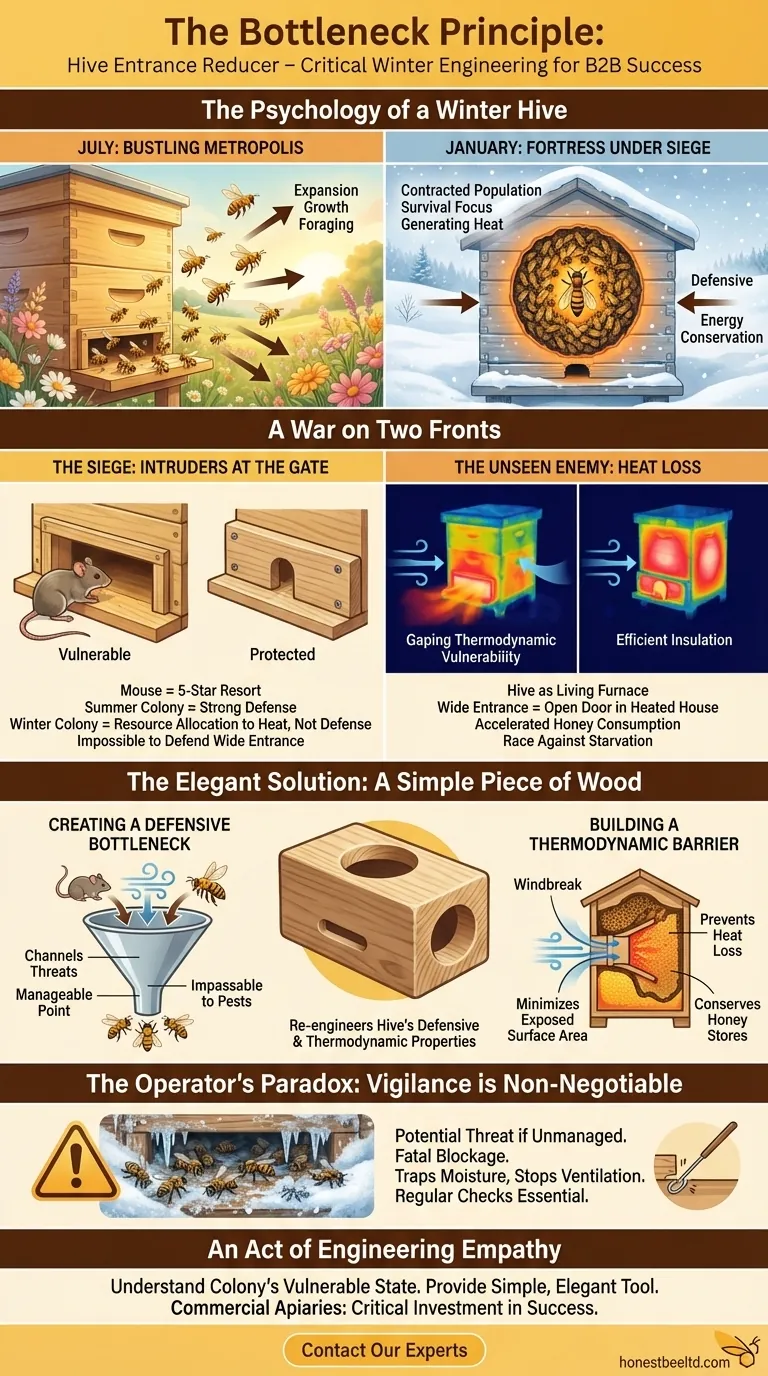
A summer colony, with its legions of guard bees, would make short work of such an intruder. But the winter colony cannot afford that fight. Its members are clustered for warmth, slow-moving, and conserving every calorie. Defending a wide-open, three-inch entrance is an impossible task. It’s a resource allocation problem where all available energy must be directed toward the furnace, not the fortress walls.
The Unseen Enemy: Heat Loss
The winter cluster is a marvel of biological engineering—a living furnace that generates heat by vibrating flight muscles. This furnace, however, is only as effective as its insulation.
A wide hive entrance is a gaping thermodynamic vulnerability. It’s an open door in a heated house, allowing frigid winds to pour in and precious warmth to escape. This forces the bees to burn through their finite honey stores at an accelerated rate, turning the long winter into a desperate race against starvation.
The Elegant Solution: A Simple Piece of Wood
The solution to both these existential threats is not complex technology but a brilliant, simple piece of engineering: the entrance reducer.
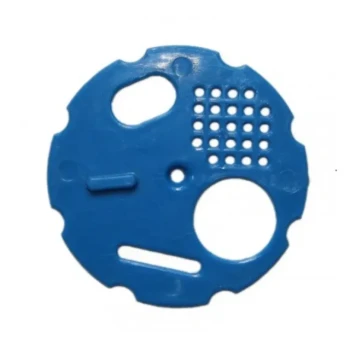
This small cleat of wood or high-density plastic doesn't just shrink the doorway; it fundamentally re-engineers the hive's defensive and thermodynamic properties.
Creating a Defensive Bottleneck
By reducing a wide opening to a small, one-inch hole, the reducer creates a chokepoint. This simple act transforms the defensive equation.
- It channels any potential threat to a single, manageable point.
- It allows a mere handful of slow, cold-impaired guards to successfully defend the entire colony.
- It presents an impassable barrier to pests like mice.
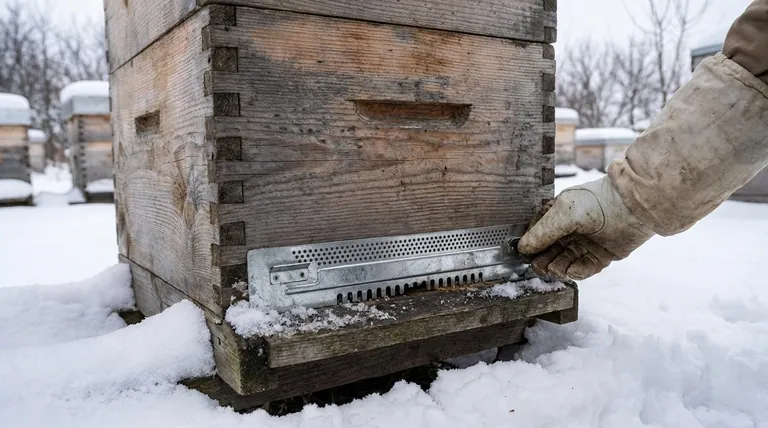
For commercial operations where colony loss has significant financial impact, this defensive upgrade is non-negotiable. Professional-grade entrance reducers, often paired with metal mouse guards, transform a vulnerable entrance into an impenetrable gate.
Building a Thermodynamic Barrier
The reducer also acts as a windbreak, blocking the direct flow of cold air. It doesn’t add heat, but more importantly, it prevents the loss of the heat the bees work so hard to generate.
It minimizes the surface area exposed to the elements, a core principle of insulation. This allows the colony to maintain its critical core temperature with far less energy expenditure, conserving the honey stores needed to fuel its revival in the spring.
The Operator's Paradox: Vigilance is Non-Negotiable
This simple engineering solution introduces a new, critical responsibility for the beekeeper. The very feature that protects the hive can become a threat if left unmanaged.
The small opening can become clogged with dead bees, ice, or snow. A complete blockage is fatal. It traps moisture, prevents vital ventilation, and stops the bees from taking essential "cleansing flights" on warmer winter days. The goal is to reduce drafts, not to create a hermetically sealed container.
A quick, regular check with a piece of wire or a stick to clear the entrance is a small price to pay for the immense security it provides.
An Act of Engineering Empathy
Ultimately, installing an entrance reducer is more than a seasonal chore. It is an act of engineering empathy—an intervention based on understanding the colony's vulnerable winter state. It acknowledges the physical and psychological reality of the hive and provides a simple, elegant tool to help it fight its battles.
For commercial apiaries, where the survival of every colony is vital to the bottom line, relying on robust, professionally designed equipment is essential. Ensuring your hives are properly fortified isn't just good practice; it's a critical investment in next year's success. To ensure your colonies have the best defense this winter, Contact Our Experts.
Visual Guide
Related Products
- Steel Round Disc Entrance Reducer for Flexzion Bee Hive Nuc Box Gate
- Beehive Entrance Reducer Guardian Metal Hive Entrance for Bees
- Professional Hive Front Entrance Bee Feeder
- Multi-Functional Rotary Hive Entrance Disc for Beekeeping
- HONESTBEE Entrance Bee Feeder Efficient Hive Front Liquid Feeding Solution for Beekeeping
Related Articles
- Strategic Entrance Reducer Management: From Hive Defense to Colony Growth Optimization
- Mastering Entrance Reducers: Seasonal Strategies for Hive Defense and Health
- How Entrance Reducers Protect Beehives Through Seasonal Extremes
- A Question of Access: Why the Hive Entrance is a Beekeeper's Most Critical Control Point
- Defensible Space: How a Simple Tool Reduces a Bee Colony's Collective Stress