The Beekeeper's Dilemma
A returning forager bee, her legs heavy with vibrant orange pollen, is a picture of success. For the colony, it's protein—the essential fuel for raising the next generation. For the commercial beekeeper, it's a valuable, marketable product.
The challenge lies in the intersection of these two realities. How do you harvest this resource without undermining the very system that produces it?
This isn't just a question of tools; it's a question of system design. A pollen trap is not an accessory. It is a modification to the hive's core architecture. A poorly designed one creates stress, reduces productivity, and can even endanger the colony. A well-designed one becomes a seamless, integrated component that respects the bees' natural behavior.
The Core Architecture of an Effective System
Success isn't found in a single feature, but in the harmony of several core principles. Think of it less as a trap and more as a carefully negotiated contract with the colony.
The One-Way Contract: Egress vs. Ingress
The fundamental mechanism is a brilliant piece of behavioral engineering.
- Unrestricted Exit: Foraging bees must be able to leave the hive without any impediment. Any friction here causes confusion and stress, disrupting the colony's workflow.
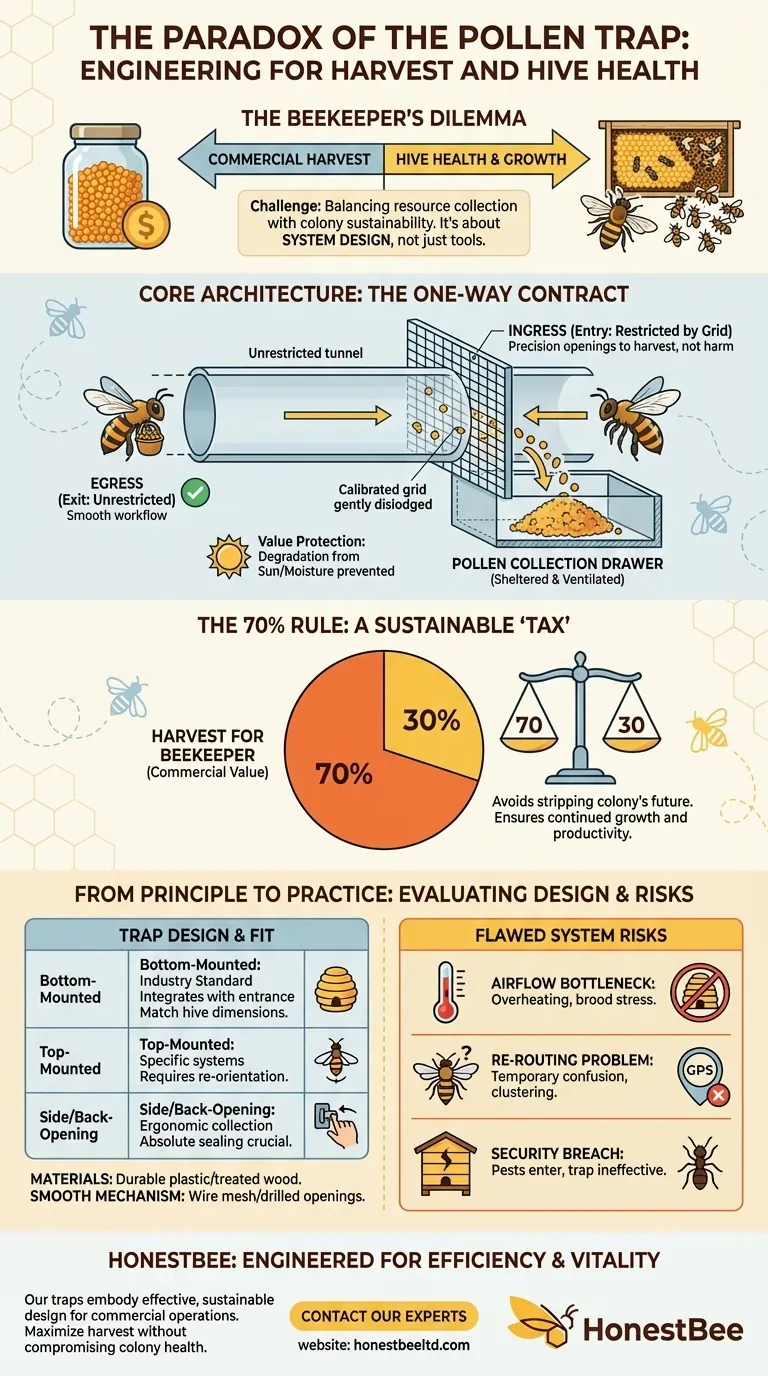
- Restricted Entry: Upon return, foragers are guided through a screen or grid. The openings are calibrated with precision: just large enough for the bee, but just small enough to gently scrape the pollen pellets from her hind legs.
This one-way system respects the bee's primary drive while achieving the collection goal.
The Psychology of the 70% Rule
A trap that collects 100% of incoming pollen is a failure. It's an act of stripping the colony of its future. It is a psychological miscalculation, assuming the hive is a machine rather than a living organism.
The most effective traps operate at an efficiency of 60% to 80%.
This isn't an arbitrary number. It represents a sustainable "tax." The beekeeper gets a substantial harvest, but a vital portion—20% to 40%—still reaches the brood. This ensures the colony can continue its cycle of growth and replenishment, securing future productivity.
Protecting Value After the Harvest
The work isn't done once the pollen falls. Freshly collected pollen is vulnerable. It can be degraded by sunlight, ruined by moisture, or contaminated by debris.
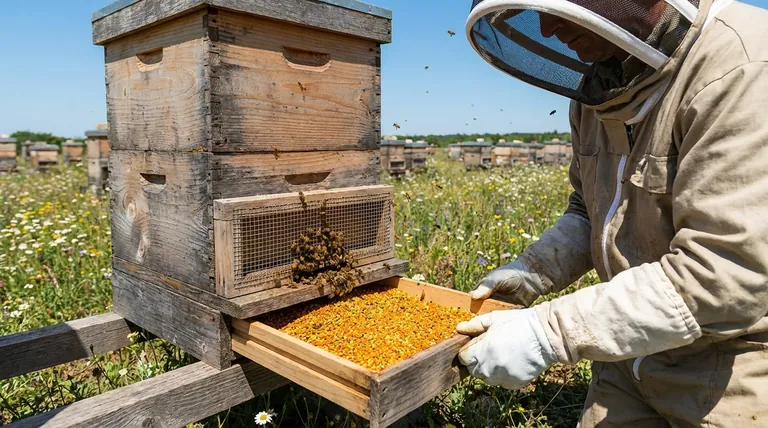
A superior trap includes a collection drawer that is sheltered and well-ventilated. This feature is not a luxury; it is an essential component for preserving the nutritional and economic value of the final product.
From Principle to Practice: Evaluating Trap Design
The physical manifestation of these principles determines a trap's utility, especially at a commercial scale where efficiency and standardization are paramount.
The Interface: Fit and Material
How the trap integrates with your existing equipment is critical. An improper fit is a systemic flaw.
| Trap Type | Common Application | Key Consideration |
|---|---|---|
| Bottom-Mounted | The industry standard; integrates with the hive's natural entrance. | Must match hive body dimensions perfectly to prevent bypasses. |
| Top-Mounted | Used in specific management systems. | Requires a multi-week bee re-orientation period. |
| Side/Back-Opening | Offers ergonomic benefits for collection. | Sealing must be absolute to ensure it's the sole entry point. |
Materials like durable, non-warping plastic or treated wood ensure longevity. The stripping mechanism—whether wire mesh or drilled openings—must be smooth to avoid harming the bees.
The Human Factor: Usability at Scale
For a hobbyist with two hives, a cumbersome design is an annoyance. For a commercial apiary with 2,000 hives, it's a catastrophic operational bottleneck.
The best traps are designed for the beekeeper. They can be engaged and disengaged with minimal effort. This allows for intermittent collection—running the trap for a few days, then turning it off to let the colony fully replenish its own stores. This simple feature provides a powerful management lever for maintaining colony health over the long term.
The Hidden Costs of a Flawed System
Implementing any hive modification involves risk. A beekeeper's job is to mitigate it through intelligent management and superior equipment.
- The Airflow Bottleneck: A pollen trap fundamentally alters ventilation. Installing one on a hot day can restrict airflow, leading to overheating, brood stress, and bearding. It's a classic example of a good intention leading to a poor outcome if the environmental context is ignored.
- The Re-Routing Problem: Bees operate on an incredibly precise internal GPS. A new entrance configuration is a major disruption. They need a few hours, or sometimes days, to rewrite their mental maps. During this adjustment, expect temporary confusion and clustering.
- The Security Breach: For a trap to work, all other entrances must be sealed. A single crack in a hive body or a gap under the cover becomes a bypass route, rendering the trap ineffective and potentially creating a new entry point for pests.
At HONESTBEE, we understand that for commercial apiaries and distributors, equipment is not just a cost—it's the foundation of your operational efficiency and colony health. Our pollen traps are engineered to embody these core principles of effective, sustainable design, ensuring you can maximize your harvest without compromising the vitality of your most valuable assets.
To equip your operation with durable, high-performance beekeeping supplies built for professionals, Contact Our Experts.
Visual Guide
Related Products
- Removable Plastic Pollen Trap With Ventilated Tray for Bees Pollen Collector
- 30 cm Plastic Entrance Hole Bee Pollen Trap and Collector
- Plastic Bee Pollen Trap Strips Comb Catcher Collector
- High-Efficiency Diamond Maze Bee Escape for Clearing Supers
- Professional Bucket Style Wasp and Moth Pheromone Trap
Related Articles
- The Interface Problem: How Pollen Trap Design Shapes Colony Behavior and Harvest Quality
- How to Install Pollen Traps Without Stressing Your Hive: A Beekeeper’s Guide
- Beyond Honey: The Strategic Calculus of the Pollen Trap
- How Pollen Traps Transform Beekeeping: From Hive Health to Additional Income
- Redirecting the Flow: The Behavioral Science of a Pollen Trap