A thriving honeybee colony is a marvel of decentralized command. Thousands of individuals work in near-perfect concert, guided by complex chemical signals and environmental cues. Yet, for all its resilience, the entire system hinges on one single, irreplaceable bee: the queen.
The commercial beekeeper understands this better than anyone. Your entire operation—its productivity, stability, and profitability—is built upon the health of your queens. It’s a paradox of the apiary: a robust, distributed system with a single point of failure.
And sometimes, the most catastrophic failure comes not from disease or predators, but from a simple, well-intentioned tool used at the wrong time. The pollen trap.
A Mechanical Mismatch of Existential Proportions
We often focus on the biological risks to a hive, but a critical mechanical risk is just as deadly. The conflict between a queen and a pollen trap is absolute and unforgiving.
The Elegant Brutality of the Pollen Trap
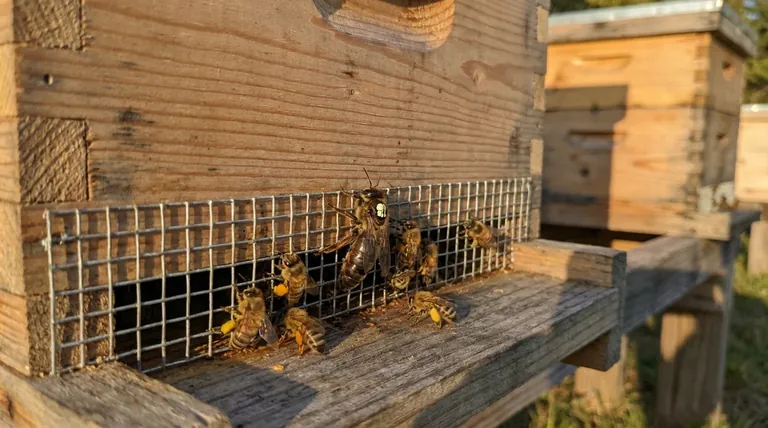
A pollen trap is a model of efficiency. It is a simple, effective filter placed at the hive entrance. Returning foragers are forced through a mesh screen, sized just right to gently scrape the valuable pollen pellets from their legs into a collection tray.
It’s a harvesting tool that leverages the hive's own productivity. But its design is predicated on the anatomy of a worker bee. And that is the crucial detail.
The Queen's Essential Journeys
A queen rarely leaves the hive. Her life is spent in the dark, laying up to 2,000 eggs a day. She only undertakes two journeys in her entire life, both of which are essential for the colony's survival and propagation:
- The Mating Flight: As a virgin queen, she must fly out to mate with drones in mid-air before she can begin laying fertile eggs. This is the single most important event in establishing a new, viable colony leader.
- The Swarm: As a mature queen, she will leave with half the colony in a swarm to establish a new nest. This is the superorganism's natural method of reproduction.
These are not casual trips. They are high-stakes, life-or-death missions for the future of the colony's genetic line.
An Unforgiving Barrier
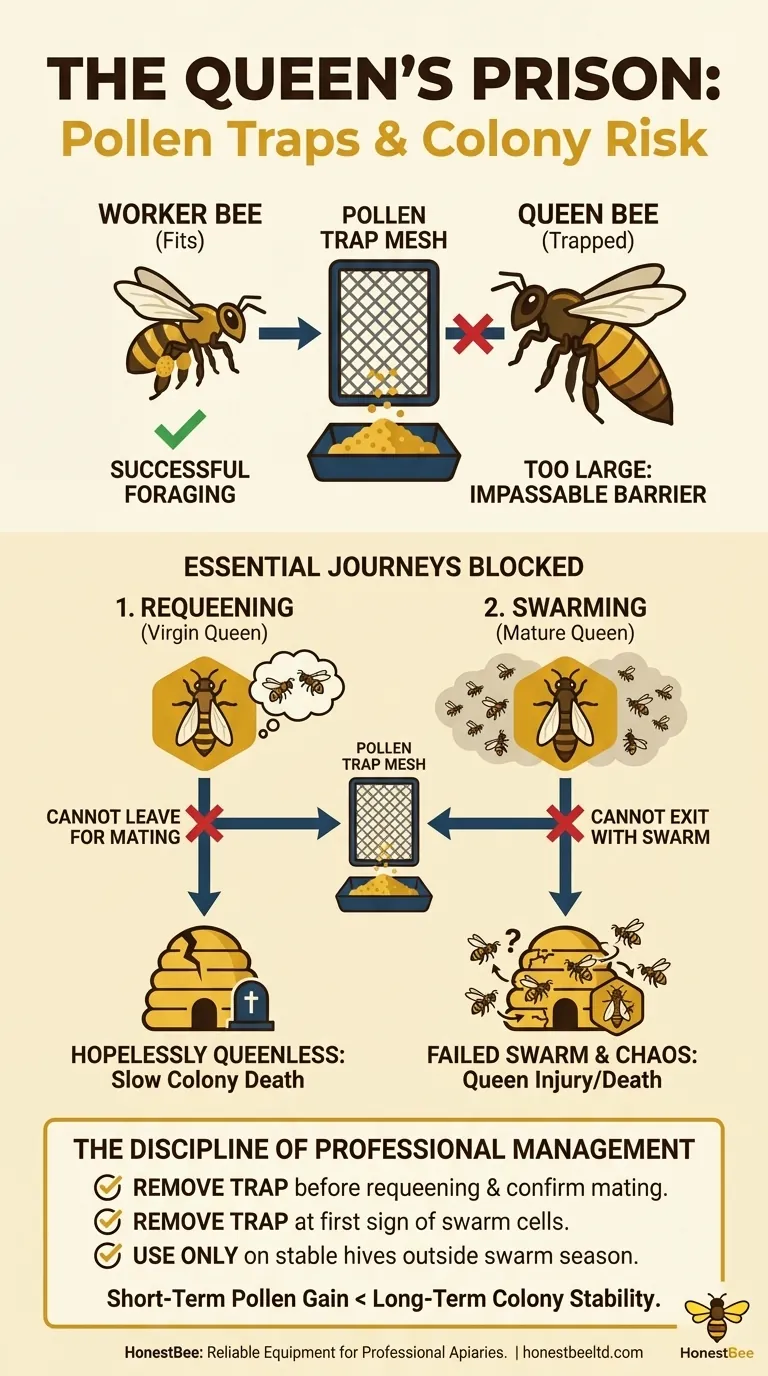
Here lies the mechanical conflict. A queen, especially a mated, egg-laying one, is significantly larger in the abdomen than a worker bee.
She cannot fit through the pollen trap's mesh.
What was designed as a gentle harvester for the worker becomes an impassable prison wall for the queen. It’s a simple, binary reality of physics that directly interferes with the most vital functions of the hive.
Two Paths to a Queenless Colony
Forgetting to remove a pollen trap isn't a minor oversight. It's setting a trigger that can lead to the slow or chaotic death of the colony. The outcome depends on which of the queen's essential journeys is blocked.
The Silent Death of a Virgin Queen
When you requeen a hive, you are placing all your bets on a new virgin queen. The colony patiently waits for her to mature, embark on her mating flight, and return to secure their future.
If a pollen trap is on, she is trapped. She will try to leave and fail. The colony waits. Days turn into weeks. But the biological window for her to mate successfully is small. After it closes, she is useless.
The result is one of the most tragic states in beekeeping: a hopelessly queenless hive. The colony has a queen, but one that can never lay fertile eggs. It will slowly dwindle and die, a ghost of a once-thriving workforce.
The Chaos of a Failed Swarm
Swarming is an explosive, purposeful event. The air hums with the energy of thousands of bees, united in their mission to reproduce the colony. The old queen is at their center.
But if a pollen trap blocks the entrance, she cannot leave with them. The swarm issues forth, a great cloud of bees, only to realize their queen is not among them.
Confusion reigns. They return to the hive, a disoriented and agitated mass. This process might repeat, stressing the colony immensely. In the chaos at the entrance, the trapped queen can be injured, rejected, or even "balled" and killed by her own frantic workers. The swarm fails, and you may lose your proven, productive queen in the process.
| Scenario | Risk with Pollen Trap On | Consequence |
|---|---|---|
| Requeening | Virgin queen cannot leave for her mating flight. | Colony becomes hopelessly queenless and dies. |
| Swarming | Old queen is trapped inside during the swarm's exit. | Failed swarm, potential queen injury/death, hive chaos. |
| The Takeaway | The trap's mesh is an impassable barrier for a queen. | Short-term pollen gain is never worth losing a colony. |
The Psychology of a Costly Mistake
Why does this happen? It’s a classic cognitive bias. We tend to prioritize tangible, immediate gains over abstract, future risks.
The pollen in the collection tray is a visible, measurable reward. It feels productive. The risk of a swarm or the need for a virgin queen's mating flight feels distant and uncertain... until it's too late.
Professional beekeeping is the practice of overcoming these biases. It requires the discipline to value long-term colony stability over short-term yield. The potential loss—an entire production unit—vastly outweighs the minor gain from a few days of pollen collection.
The Discipline of Professional Hive Management
The solution isn't to abandon pollen traps. They are valuable tools for supplementing feed or creating a new revenue stream. The solution is to use them with strict, non-negotiable discipline.
- When Requeening: Remove the trap before the new queen is due to emerge. Do not reinstall it until you have visually confirmed she is mated and has a healthy, consistent laying pattern.
- When Managing Swarms: Remove the trap at the very first sign of swarm cells. This gives you the flexibility to either manage the swarm or perform a split without interference.
- For Pollen Collection: Only install a trap on a strong, stable hive with a proven, laying queen, well outside of the primary swarm season.
For commercial apiaries and equipment distributors, success is built on reliable systems and professional-grade equipment that supports disciplined management. A single point of failure can jeopardize an entire season's work. Mitigating these risks is not just good beekeeping; it's good business.
HONESTBEE supplies the durable, reliable equipment that commercial operations depend on. We understand that the right tool, used with precision and foresight, is the foundation of a profitable apiary. We provide the hardware that allows you to execute your management strategy without compromise.
Don’t let a simple mistake undermine your investment. Equip your operation for stability and success. Contact Our Experts
Visual Guide
Related Products
- Removable Plastic Pollen Trap With Ventilated Tray for Bees Pollen Collector
- 30 cm Plastic Entrance Hole Bee Pollen Trap and Collector
- Plastic Bee Pollen Trap Strips Comb Catcher Collector
- High-Efficiency Diamond Maze Bee Escape for Clearing Supers
- Professional Bucket Style Wasp and Moth Pheromone Trap
Related Articles
- The Interface Problem: How Pollen Trap Design Shapes Colony Behavior and Harvest Quality
- How to Install Pollen Traps Without Stressing Your Hive: A Beekeeper’s Guide
- The Paradox of the Pollen Trap: Engineering for Harvest and Hive Health
- Beyond Honey: The Strategic Calculus of the Pollen Trap
- How Pollen Traps Transform Beekeeping: From Hive Health to Additional Income