The Unseen Architecture of the Hive
Every beekeeper is, at their core, an architect. They don't design the building, but they provide the scaffolding and the blueprint upon which a complex, living society will build its home.
The central question in this architecture is one of control versus trust. Do we provide a rigid, pre-stamped blueprint—the foundation—to ensure a predictable, orderly city? Or do we provide a simple starting point and trust the colony's millennia of instinct to build what it needs?
This isn't just a technical choice; it's a philosophical one that defines the relationship between the keeper and the kept.
The Psychology of Foundation
A standard wax or plastic foundation is an elegant solution to a very human problem: the desire for predictability. It’s a grid plan for the hive.
By imposing a uniform hexagonal pattern, foundation guarantees that bees build straight, manageable combs within the confines of a single frame. This brilliant piece of engineering solves two critical issues for large-scale operations: it prevents "cross-combing" (where bees weld multiple frames together), and it provides the structural integrity needed to withstand the violent force of a centrifugal honey extractor.
It is, in essence, a risk-mitigation strategy. It sacrifices the bee's autonomy for the manager's efficiency.
When Bees Become Their Own Architects
Removing the foundation is like removing the grid plan. It hands architectural control back to the colony, and their methods are profoundly efficient.
The Freedom of the Festoon
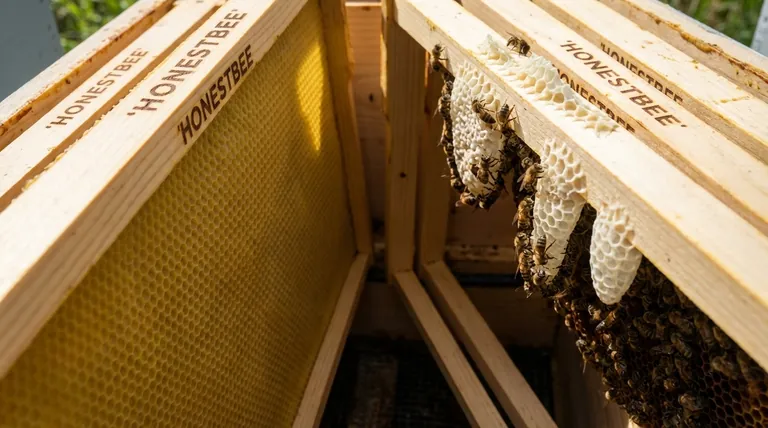
To produce wax and build comb, bees cling to each other, forming a living, breathing chain of bodies called a festoon. A sheet of foundation splits this chain, forcing them to build inefficiently from two separate surfaces.
On a foundationless frame, they form a single, unified festoon, building one continuous sheet of comb right through the middle. It is a marvel of biological engineering—a perfect expression of collective energy.
A Custom-Built Home
Without a pre-set pattern, bees build precisely what the colony requires at that moment. They can construct smaller cells for raising brood, larger cells for drone rearing, or deep cells for storing a bumper crop of honey. The hive becomes a dynamic structure, zoned and re-zoned according to its immediate needs, not a predetermined template.
The Tangible Payoff: Purity and Profit
Trusting the bees' instincts yields more than just a philosophically satisfying outcome. It produces a superior product and a more streamlined operation.
The Unrivaled Quality of Comb Honey
This is the killer application for foundationless frames. Because there is no central plastic or thick wax mid-rib, harvesting comb honey is a simple, clean affair. A knife glides through the pure beeswax, yielding perfect, immaculate sections of honey still sealed in its natural container.
For the beekeeper selling a premium, natural product, foundationless is not just an option; it's a competitive advantage.
An Investment in Simplicity
Eliminating foundation sheets reduces initial costs, an important factor for any commercial operation. But more importantly, it simplifies the workflow. Frames are prepared with nothing more than a simple wooden guide, a thin strip of starter wax, or a taut wire—a subtle suggestion, not a command.
Managing Freedom: The Necessary Trade-offs
This freedom, however, is not without its challenges. It requires a different management style—one that anticipates and guides rather than dictates.
The Specter of Cross-Comb
The primary risk is that bees, left entirely to their own devices, may build their comb across multiple frames, creating a tangled, unworkable mess. This makes hive inspections impossible without destroying the comb. Careful monitoring and the use of simple starter guides are essential to keep the bees building true.
The Delicate Art of Extraction
Foundationless comb is inherently more fragile. Subjecting it to a high-speed extractor without care can cause a "blowout," destroying the comb.
Success requires two things:
- Patience: Start the extractor slowly, letting the initial weight of the honey sling out before increasing the speed.
- Best Practices: Ensure the comb is fully attached to all four sides of the frame for maximum support. Alternatively, the "crush and strain" method is a low-tech but highly effective way to harvest both honey and wax.
A Framework for Your Philosophy
The choice between foundation and foundationless is a choice of objective. There is no single right answer, only the right answer for your apiary.
- For high-volume liquid honey production: The durability and predictability of traditional foundation are unmatched for efficient, high-speed extraction.
- For natural beekeeping: Foundationless frames are the purest expression of hive autonomy, allowing bees to function as they would in the wild.
- For premium comb honey: Foundationless frames are the superior choice, producing a cleaner, more marketable product with unparalleled ease.
For commercial apiaries dedicated to producing premium comb honey or managing their hives along more natural principles, the right equipment isn't just a component—it's a commitment. At HONESTBEE, we provide the robust, high-quality foundationless frames and supplies that turn this philosophy into a profitable reality.
To explore how the right equipment can align with your beekeeping goals, Contact Our Experts.
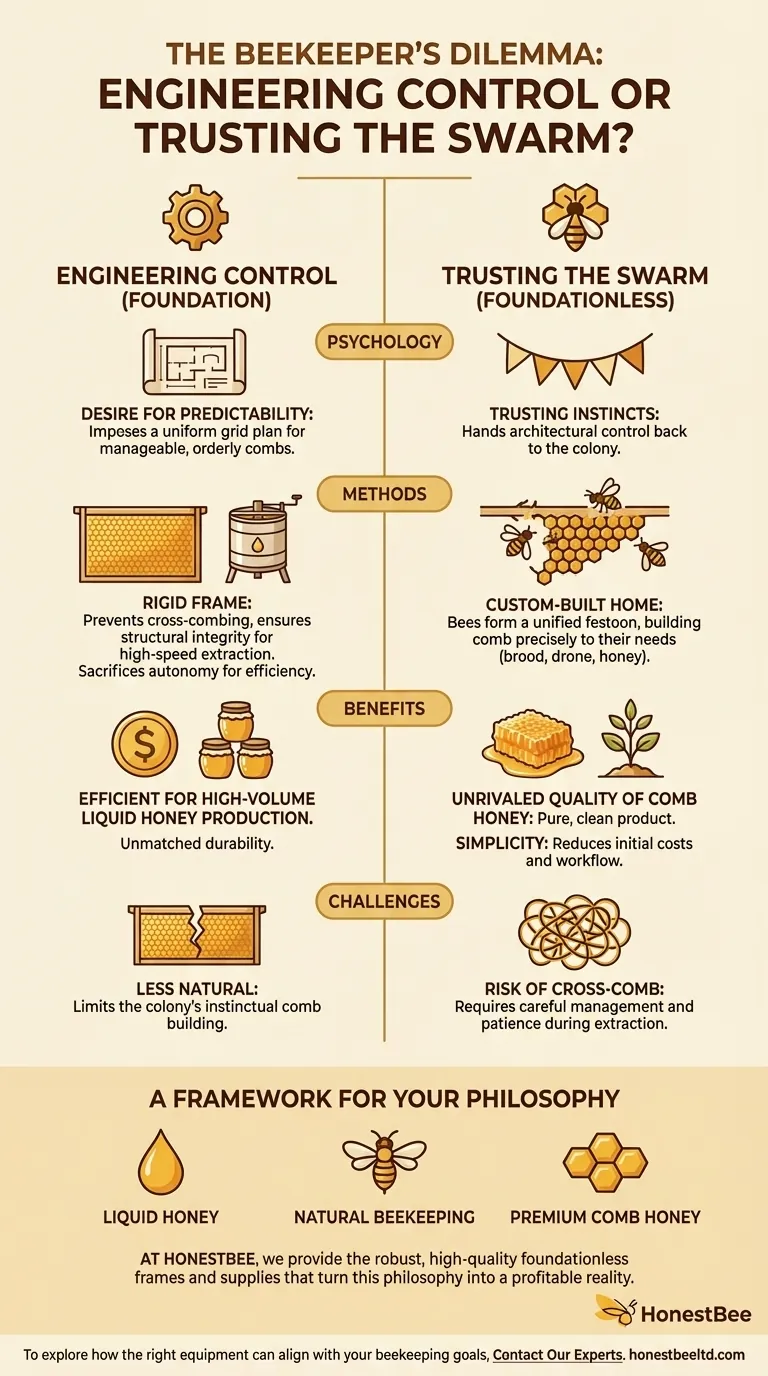
Visual Guide
Related Products
- Assembled Wooden Bee Frames with Plastic Foundation for Durability and Convenience by HONESTBEE
- HONESTBEE Wired and Assembled Wooden Bee Frames Foundation for a Thriving Hive
- Assembled Wooden Bee Frames with Beeswax Foundation Ready to Use by HONESTBEE
- Plastic Bee Frame Beekeeping Hive Frames for Wholesale
- Wooden Bee Hive Frames for Beekeeping and Wholesale
Related Articles
- How to Clear Bees from Frames Without Compromising Honey Quality or Colony Health
- Beyond the Scrape: A Systemic Approach to Bee Frame Management
- The Pragmatic Hive: Engineering Resilience with Wood Frames and Plastic Foundation
- Why Wooden Beehive Frames Outperform Alternatives: Science, Sustainability, and Beekeeper Experiences
- Why Your Plastic Frames Are Warping—And Costing You More Than You Think






