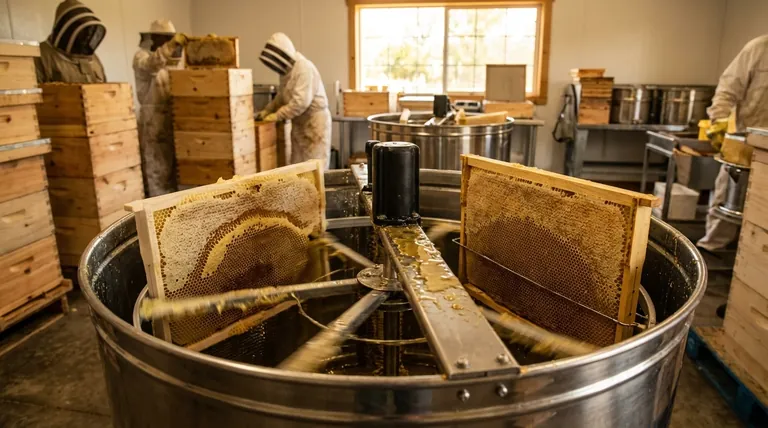
It’s the peak of the harvest, the most critical time of your season. Your extractor is humming, the air is thick with the smell of fresh honey, and your team is working at full speed. Then, the process grinds to a halt. You pull a frame from the extractor, and it’s hopelessly warped—a twisted piece of plastic that won’t sit flat, can’t be reused, and certainly can’t go back into a hive.
Another one for the scrap pile. The workflow is broken, and frustration begins to build. If this scene feels familiar, you are not alone.
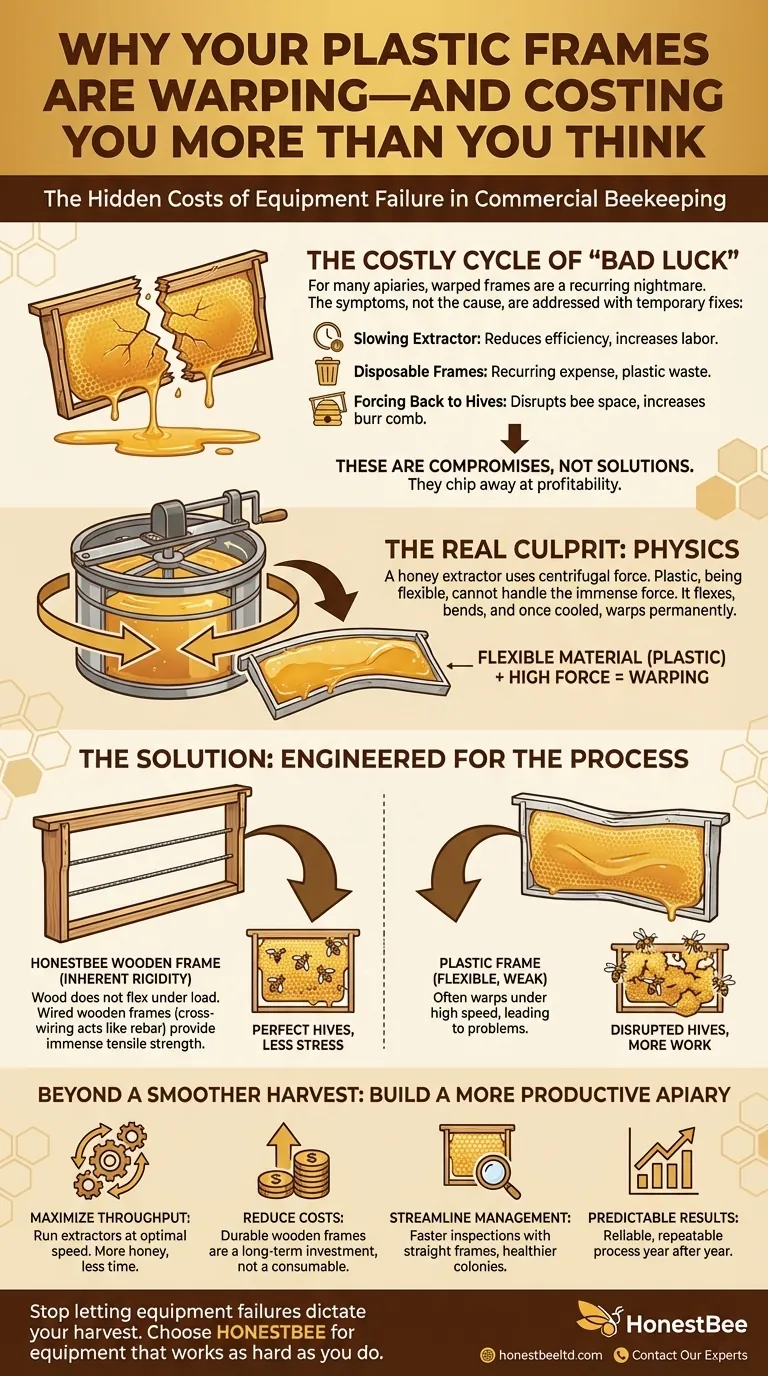
The Costly Cycle of "Bad Luck"
For many commercial apiaries, warped and broken frames are simply accepted as a "cost of doing business." Beekeepers often blame the extractor speed, the ambient temperature, or just a bad batch of equipment.
In response, they develop workarounds that only address the symptoms, not the cause:
- Slowing down the extractor: This reduces the chance of warping but dramatically cuts into your efficiency, extending harvest times and increasing labor costs.
- Treating frames as disposable: Many operators simply buy stacks of new plastic frames each season, accepting the recurring expense and the growing pile of plastic waste.
- Forcing warped frames back into hives: This is perhaps the most damaging "fix." A warped frame disrupts the carefully managed bee space, prompting the colony to build burr comb. This makes future hive inspections more difficult, more disruptive, and more stressful for your bees.
These aren't solutions; they are compromises. And they all chip away at your profitability. The constant replacement costs, the lost efficiency, and the long-term problems with hive management all stem from a single, misunderstood issue.
The Real Culprit: It's Not Bad Luck, It's Physics
The failure of your frames has nothing to do with luck. It is a predictable result of applying immense physical force to a material not designed to withstand it.
The Force Inside Your Extractor
A honey extractor works by using centrifugal force. As the drum spins, it slings the heavy, viscous honey outward, away from the comb. The frame's one and only job at this moment is to serve as a rigid backbone, holding the delicate wax comb together against this powerful force.
Plastic, by its nature, is a flexible material. When a heavy, honey-filled plastic frame is spun at high speed, the force is often too much for it to handle. It flexes, it bends, and once it cools, it often holds that warped shape permanently.
This is the root of the problem. Slowing down your extractor is like trying to fix a flat tire by driving slower—it doesn't solve the fundamental mismatch between the tool and the task.
The Right Tool for the Force: Solving the Problem at its Core
To truly solve this problem, you don't need a gentler process; you need equipment that is engineered to withstand the process. You need a frame that is inherently rigid, incredibly durable, and capable of maintaining its precise shape, harvest after harvest.
This is why, for decades, high-quality, wired wooden frames have been the unspoken standard for serious commercial operations. They are not just a traditional choice; they are a choice born from a deep understanding of the physics at play.
- Inherent Rigidity: Wood does not flex and warp under load like plastic does. It provides the solid structure necessary to resist the forces of extraction.
- The Power of Wiring: Cross-wiring, a standard practice with wooden frames, acts like rebar in concrete. It provides immense tensile strength, ensuring the wax foundation is fully supported and preventing any distortion, even during the most aggressive spins.
Our HONESTBEE wooden frames are not just a product; they are the embodiment of this solution. We build them to perform, understanding that your honey harvest is a high-stakes industrial process where equipment failure is not an option. They are designed from the ground up to solve the core problem of warping, making your harvest more predictable, efficient, and profitable.
Beyond a Smoother Harvest: Building a More Productive Apiary
When you stop fighting with your equipment, you unlock new potential for your entire operation. By eliminating the chronic issue of warped frames, you can:
- Maximize Throughput: Run your extractors at their optimal speed, confident that your frames can handle the force. Process more honey in less time with the same crew.
- Drastically Reduce Equipment Costs: Stop treating frames as a consumable. Invest in durable wooden frames that provide a reliable return for years, not just a single season.
- Streamline Hive Management: With straight frames and clean comb, your hive inspections become faster, less disruptive, and more effective, leading to healthier and more productive colonies.
- Achieve Predictable Results: Turn your harvest from a game of chance into a reliable, repeatable process you can count on, year after year.
Stop letting equipment failures dictate the pace and profitability of your harvest. It's time to solve the problem at its root and equip your apiary for success. We specialize in supplying commercial beekeepers and distributors with equipment that works as hard as you do. Let's discuss the specific challenges of your operation and how the right tools can transform your productivity. Contact Our Experts to build a more resilient and profitable apiary.
Visual Guide
Related Products
- Assembled Wooden Bee Frames with Plastic Foundation for Durability and Convenience by HONESTBEE
- Plastic Bee Frame Beekeeping Hive Frames for Wholesale
- 3.5L Plastic Beehive Frame Feeder Deep Frame Water Feeder for In Hive Use
- Ergonomic Plastic Frame Spacer Tool for Rapid Hive Management Beekeeping
- Food Grade Plastic bee Foundation for Bee Frames
Related Articles
- How to Clear Bees from Frames Without Compromising Honey Quality or Colony Health
- Beyond the Scrape: A Systemic Approach to Bee Frame Management
- The Pragmatic Hive: Engineering Resilience with Wood Frames and Plastic Foundation
- Why Wooden Beehive Frames Outperform Alternatives: Science, Sustainability, and Beekeeper Experiences
- Wooden vs. Plastic Bee Hive Frames: Balancing Sustainability and Practicality