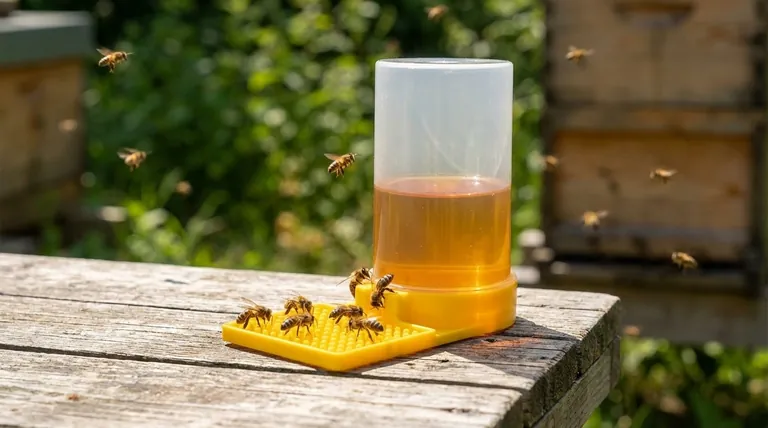
The Psychology of a Simple Mistake
In beekeeping, as in medicine, the first rule is to do no harm. Every intervention, no matter how well-intentioned, carries risk. The decision to feed a colony is born from a desire to support it through dearth or winter, an act of stewardship.
Yet, this simple act of providing sugar syrup can turn into a benevolent trap. The very tool designed to save a colony can inadvertently become its greatest threat. This isn't a failure of intention, but a failure of engineering—and a misunderstanding of risk.
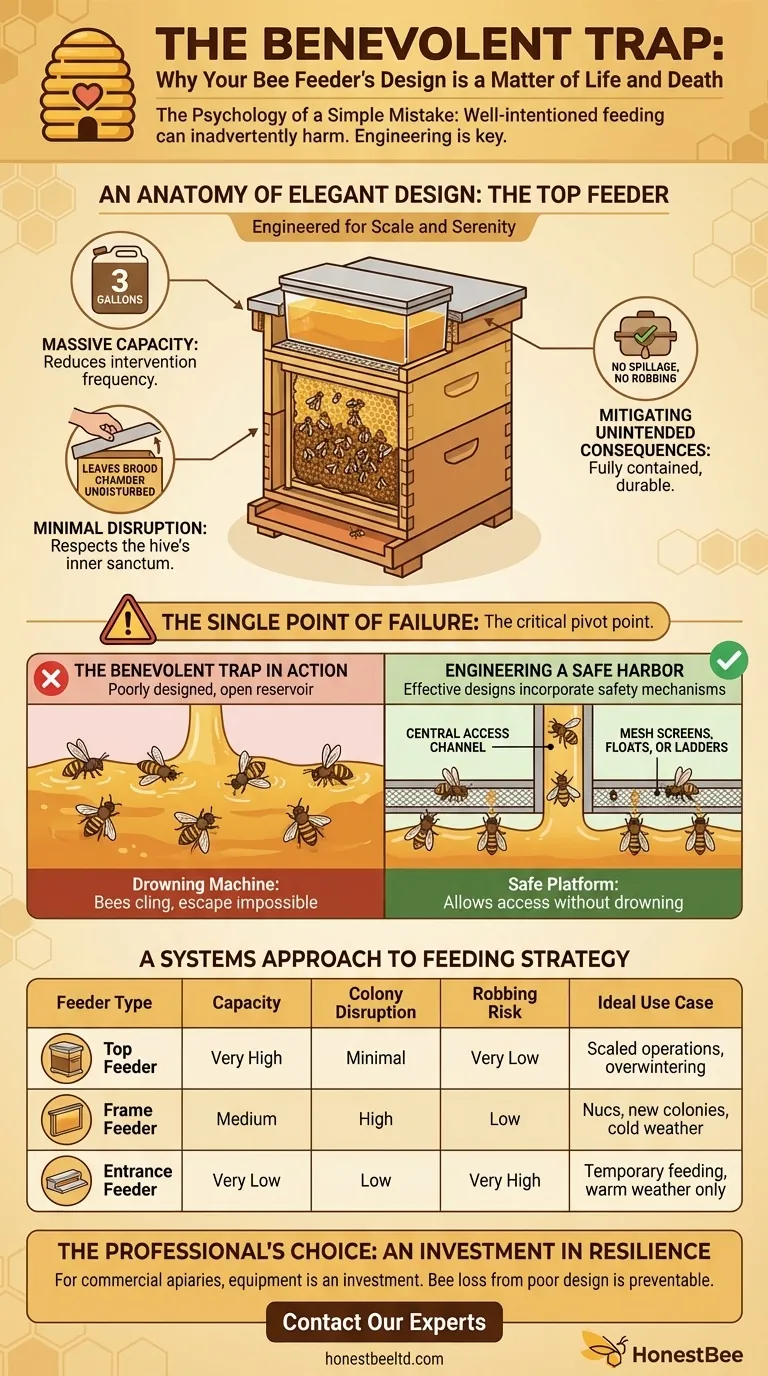
An Anatomy of Elegant Design: The Top Feeder
At first glance, a top feeder is a simple basin. But a well-designed one is a sophisticated tool that solves multiple systemic problems at once, balancing the needs of the beekeeper with the delicate realities of the hive.
Engineered for Scale and Serenity
Commercial beekeeping is an operation of scale. The primary advantage of a top feeder is its massive capacity—often holding up to three gallons of syrup. This is not just about convenience; it's about reducing the frequency of intervention.
Refilling requires only lifting the outer covers, leaving the brood chamber and the colony's core completely undisturbed. This respect for the hive's inner sanctum minimizes stress, a critical factor in colony health. It’s an elegant solution that values both human labor and hive tranquility.
Mitigating Unintended Consequences
Spilled syrup is more than a sticky mess; it's an open invitation for disaster. It can trigger "robbing," where bees from competing hives attack, leading to chaos and massive bee loss.
Because top feeders are fully contained within the hive, the risk of spillage is virtually eliminated. This closed-system design also makes them far more durable and less prone to leaks from temperature shifts, a common failure point in external gravity feeders.
The Single Point of Failure
For all its advantages, the top feeder's design contains a single, critical pivot point between being a life-sustaining tool and a mass-drowning machine.
The Benevolent Trap in Action
Imagine a simple, open reservoir of syrup. For a bee, it's an irresistible source of energy. But if it falls in, the sticky liquid clings to its wings and body. Escape becomes impossible. One bee drowns, then ten, then a hundred. The feeder, meant to nourish, has become a passive executioner.
This is the catastrophic failure of a poorly designed feeder. It preys on the bees' instincts, turning their search for food into a fatal encounter.
Engineering a Safe Harbor
The difference between a safe feeder and a dangerous one lies in simple, yet brilliant, engineering. Effective designs incorporate mechanisms that allow bees to access the syrup without ever touching the open liquid.
Look for features like:
- A central access channel that allows bees to climb up from the brood box.
- Protective elements like mesh screens, floats, or ladders that create a safe platform from which the bees can drink.
These are not optional add-ons; they are the essential safety systems that acknowledge and mitigate the inherent risk.
A Systems Approach to Feeding Strategy
The right tool depends on the job. To appreciate the top feeder's role, especially in a commercial context, it helps to compare it to the alternatives.
| Feeder Type | Capacity | Colony Disruption | Robbing Risk | Ideal Use Case |
|---|---|---|---|---|
| Top Feeder | Very High | Minimal | Very Low | Scaled operations, overwintering |
| Frame Feeder | Medium | High | Low | Nucs, new colonies, cold weather |
| Entrance Feeder | Very Low | Low | Very High | Temporary feeding, warm weather only |
An entrance feeder is easy but invites conflict. A frame feeder keeps food close but requires invasive inspections.
A high-quality top feeder is a bet on superior engineering. It is designed for the professional who needs to manage risk, minimize labor, and maximize colony stability across dozens or hundreds of hives.
The Professional's Choice: An Investment in Resilience
For commercial apiaries and equipment distributors, every piece of equipment is an investment. A tool that fails isn't just an inconvenience; it's a direct threat to productivity and livestock. Bee loss from a poorly designed feeder is an entirely preventable expense.
Investing in the right equipment is investing in the resilience of your operation. At HONESTBEE, we supply commercial-grade top feeders engineered not just for capacity, but for the unwavering safety and stability of your colonies. Our wholesale focus ensures that professionals have access to the durable, reliable, and intelligently designed tools that their business depends on.
When your livelihood relies on the health of your hives, choosing equipment with proven safety engineering is the only logical choice. Contact Our Experts
Visual Guide
Related Products
- Rapid Bee Feeder White Plastic 2L Round Top Feeder for 8 or 10-Frame Bee Hives
- HONESTBEE Entrance Bee Feeder Professional Hive Nutrition Solution for Beekeeping
- White Plastic 0.5L Beekeeping Entrance Feeder for Bees
- HONESTBEE Entrance Bee Feeder Efficient Hive Front Liquid Feeding Solution for Beekeeping
- HONESTBEE Professional Entrance Bee Feeder Hive Nutrition Solution
Related Articles
- How to Choose Between Frame and Gravity Feeders for Healthy Honey Bee Colonies
- How to Choose the Right Bee Feeder for Your Hive’s Health and Efficiency
- Design, Drowning, and the Deceptively Simple Bee Feeder
- The Weight of Winter: A Systems Approach to Pre-Season Bee Feeding
- Beyond the Jar: The Hidden Engineering of Bee Feeder Safety



















