The Unseen Border War
An apiary on a calm afternoon seems like a peaceful place. But beneath the gentle hum lies a world of fierce economics and high-stakes security. A single mistake—a leaky, exposed sugar feeder—can turn that peace into a scene of carnage.
This isn't just about feeding bees. It's about strategic resupply. The core principle of feeder placement is not about your convenience; it's about the colony's survival. Your goal is to provide resources to your bees only, without signaling to outsiders that your fortress is weak and its stores are ripe for plunder.
The Scent of Sugar, The Signal for War
The most critical factor in placing a feeder is understanding the psychological trigger of its contents. Sugar syrup and pollen are two entirely different resources in the mind of a bee, and they provoke dramatically different behaviors.
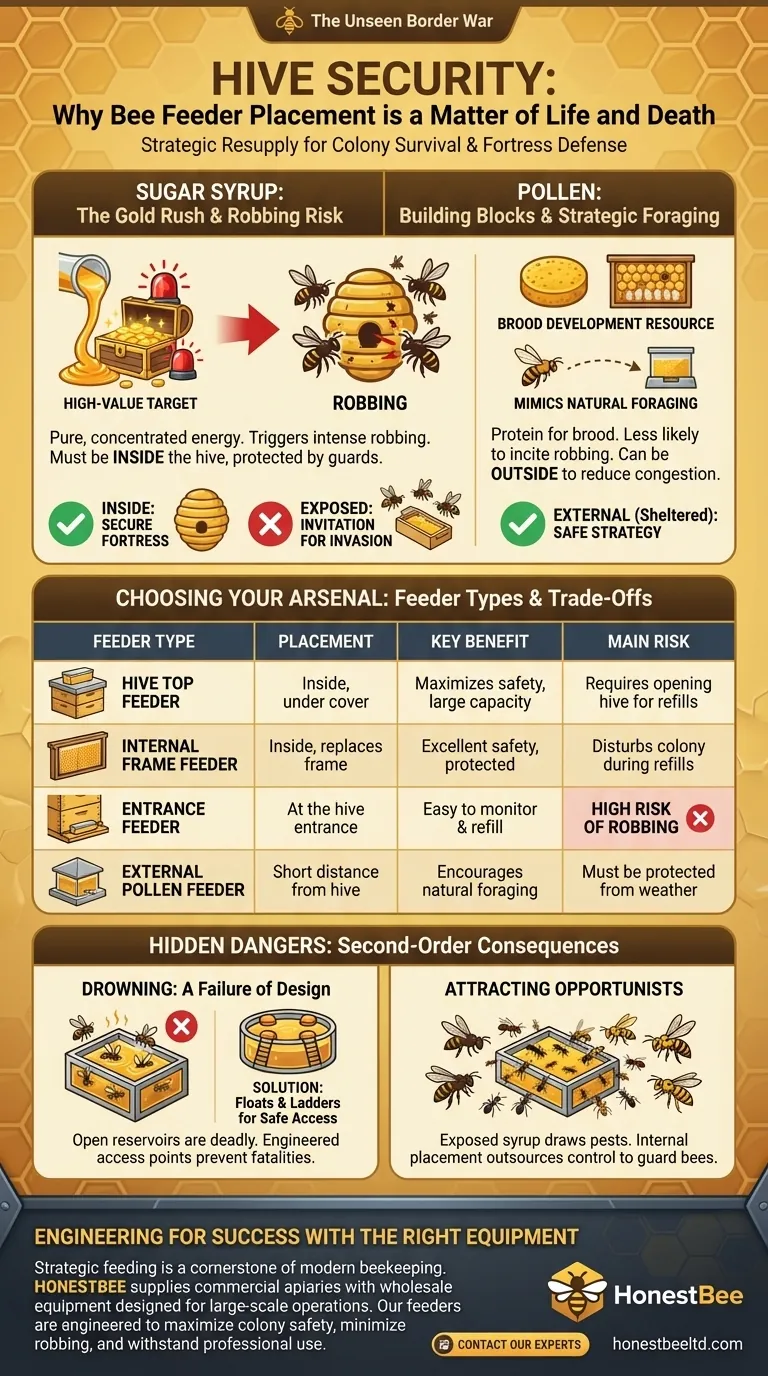
Sugar Syrup: A High-Value Target
Sugar syrup is pure, concentrated energy. For a foraging bee, discovering an unprotected source is like finding a briefcase full of cash. It triggers an intense, overwhelming response.
This leads to "robbing," a brutal but rational act where a strong colony mobilizes to attack a weaker one and steal its resources. The scent of exposed syrup is an invitation for invasion.
For this reason, syrup feeders must be placed inside the hive or attached so securely that only the resident bees can access them. The resource must remain within the fortress walls, protected by the colony’s guard bees.
Pollen: A Different Kind of Resource
Pollen is a protein, a building block for raising brood. It’s essential, but it doesn’t create the same frantic gold rush as pure sugar.
Many beekeepers place pollen feeders a short distance away from their hives. This placement serves two functions:
- It mimics natural foraging, encouraging bees to fly out and search.
- It reduces congestion at the hive entrance, improving airflow and making inspections easier.
Because pollen is less likely to incite robbing, this external placement is a safe and effective strategy, provided the feeder is sheltered from wind and rain.
Choosing Your Arsenal: A Beekeeper's Trade-Offs
Different feeders are simply different tools for managing risk. Each represents a trade-off between security, convenience, and colony disruption.
The Fortress Model: Hive Top & Internal Frame Feeders
These are your maximum-security options.
- Hive Top Feeders: Sit on top of the hive boxes, under the main cover.
- Internal Frame Feeders: Replace a standard frame, placing the syrup deep inside the cluster.
Both designs keep the syrup entirely within the hive's defensible space. The scent is contained, and outsiders have no access. The trade-off? You must open the hive to monitor and refill them, causing a minor disturbance. It's a small operational cost for a massive security benefit.
The Border Outpost: Entrance Feeders
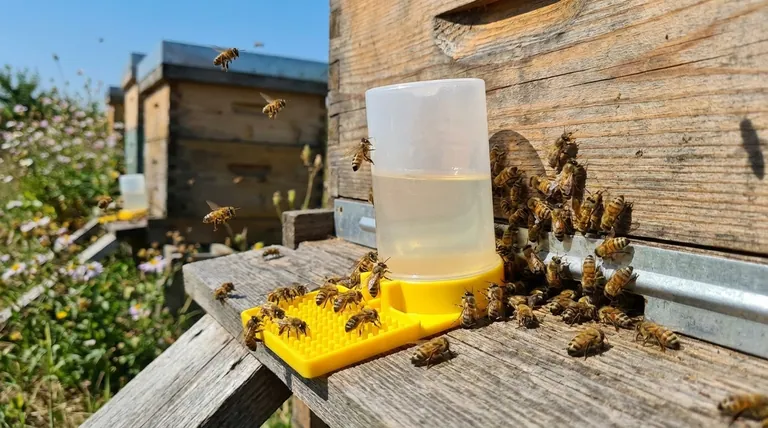
Entrance feeders (or Boardman feeders) are the epitome of convenience. You can see the syrup level at a glance from yards away.
But they are the highest risk. By placing the syrup directly at the hive's entrance, you are broadcasting its scent to every passing forager. This can easily trigger a robbing frenzy that overwhelms a small colony. Using an entrance feeder on a new or weak hive is like putting the bank's vault on the front sidewalk. They should only be considered for very strong hives that can easily defend their territory.
| Feeder Type | Ideal Placement | Key Benefit | Main Risk |
|---|---|---|---|
| Hive Top Feeder | Inside hive, under cover | Maximizes safety, large capacity | Requires opening hive for refills |
| Internal Frame Feeder | Inside hive, replaces frame | Excellent safety, protected | Disturbs colony during refills |
| Entrance Feeder | At the hive entrance | Easy to monitor and refill | High risk of robbing |
| External Pollen Feeder | Short distance from hive | Encourages natural foraging | Must be protected from weather |
The Hidden Dangers: Second-Order Consequences
Beyond robbing, poor feeder design and placement create other systemic risks.
Drowning: A Failure of Design
Bees can and will drown in open reservoirs of syrup. This isn't just a tragic accident; it's a failure of engineering. A well-designed feeder anticipates this behavior.
Feeders equipped with floats, textured surfaces, or built-in ladders provide safe access points, allowing bees to drink without the risk of falling in. It's an elegant solution to a deadly problem.
Attracting Opportunists
Exposed syrup doesn't just attract other honeybees. It draws ants, wasps, and yellow jackets, creating a perimeter of pests that can harass and weaken your colony. Keeping the feeder inside the hive outsources pest control to the hive's own dedicated security force: the guard bees.
Engineering for Success with the Right Equipment
Strategic feeding is a cornerstone of modern beekeeping, especially for commercial operations managing hundreds or thousands of hives. The success of this strategy depends entirely on the quality and design of your equipment. A feeder that leaks, breaks, or fails to protect your colony is a liability, not an asset.
HONESTBEE supplies commercial apiaries and distributors with wholesale beekeeping equipment designed for the realities of large-scale operations. Our feeders are engineered to maximize colony safety, minimize robbing, and withstand the rigors of professional use. We understand that for our partners, beekeeping isn't a hobby—it's a complex logistical operation where every component matters.
Strengthening the health of your hives and the efficiency of your business starts with reliable, intelligently designed equipment. Contact Our Experts
Visual Guide
Related Products
- Rapid Bee Feeder White Plastic 2L Round Top Feeder for 8 or 10-Frame Bee Hives
- HONESTBEE Entrance Bee Feeder Professional Hive Nutrition Solution for Beekeeping
- White Plastic 0.5L Beekeeping Entrance Feeder for Bees
- HONESTBEE Entrance Bee Feeder Efficient Hive Front Liquid Feeding Solution for Beekeeping
- HONESTBEE Professional Entrance Bee Feeder Hive Nutrition Solution
Related Articles
- How to Choose Between Frame and Gravity Feeders for Healthy Honey Bee Colonies
- How to Choose the Right Bee Feeder for Your Hive’s Health and Efficiency
- Design, Drowning, and the Deceptively Simple Bee Feeder
- The Weight of Winter: A Systems Approach to Pre-Season Bee Feeding
- Beyond the Jar: The Hidden Engineering of Bee Feeder Safety



















