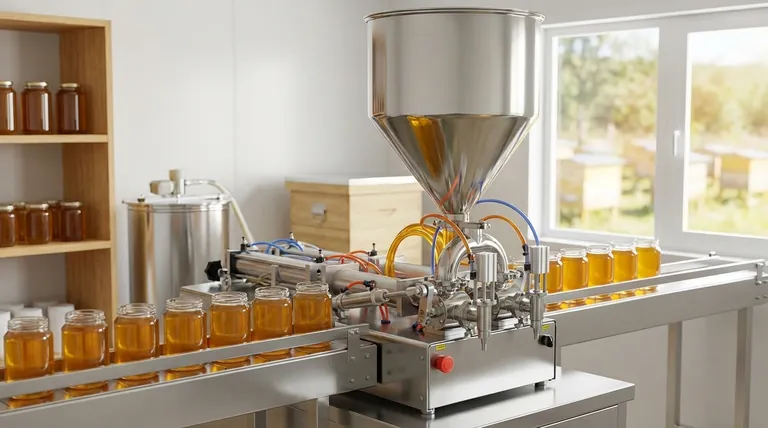
The Last-Mile Problem in a Jar of Honey
Imagine a beekeeper who has spent a season nurturing their hives. The honey is finally harvested—a perfect, golden expression of a specific time and place. It's pure, raw, and valuable.
But in the packaging room, that value begins to erode. One jar is filled to the brim, the next is noticeably lower. A customer at the farmer's market picks up two jars, weighs them in their hands, and puts the lighter one back. They may not say anything, but a seed of doubt is planted.
This isn't a failure of beekeeping. It's a failure of mechanics. And it highlights a fundamental truth: your filling process is the final handshake with your customer. It’s a physical promise of consistency and quality.
The Physics of a Promise: How Fillers Work
A honey filling machine is not just a dispenser. It's an instrument of precision, designed to master the unique challenge of a viscous liquid. Its goal is to make every single jar an identical representation of your brand's standards.
The Piston: A Metronome for Viscosity
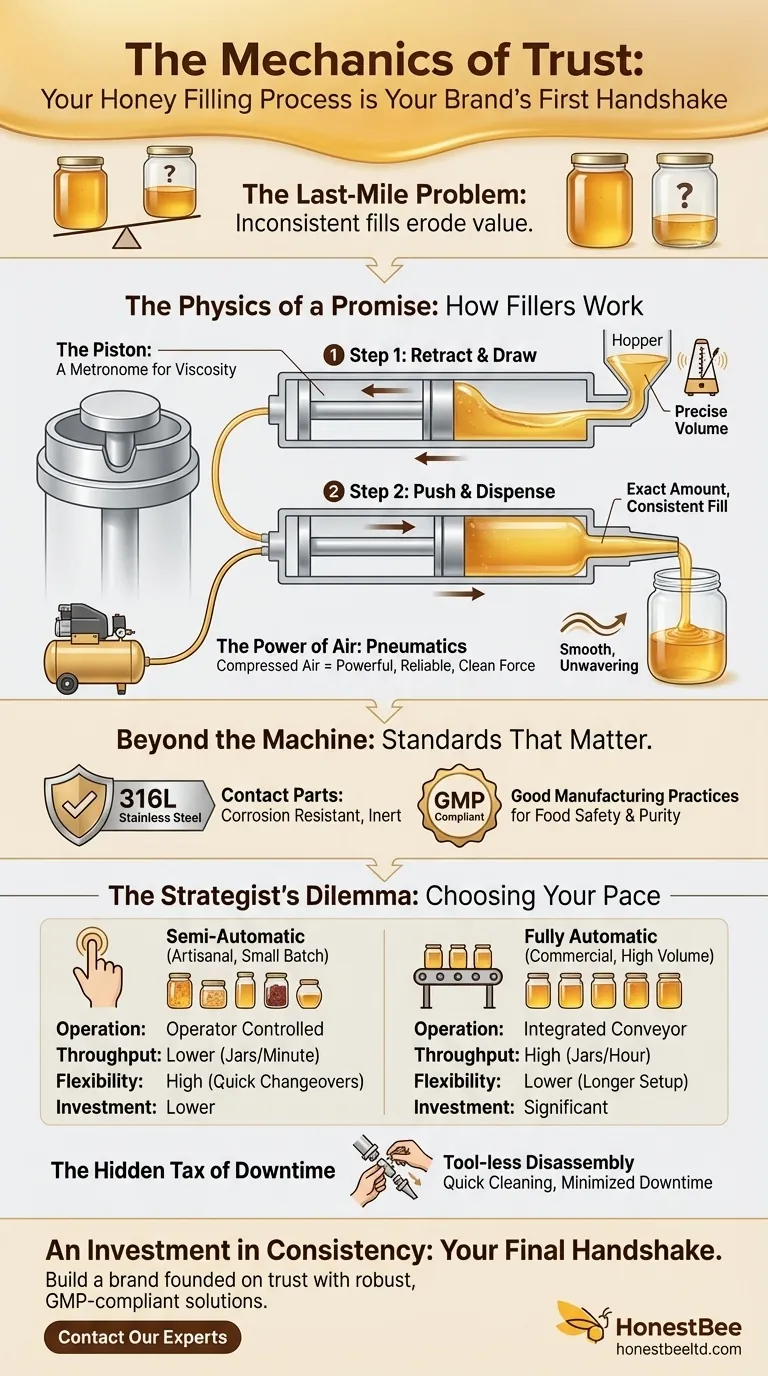
At the heart of most honey fillers is a piston. The mechanism is brilliantly simple, like a perfectly calibrated syringe.
- A piston retracts, drawing a precise, predetermined volume of honey from a hopper into a cylinder.
- The piston then pushes forward, dispensing that exact volume into a jar.
The distance the piston travels is adjustable, giving you absolute control over the fill volume. This isn't just about filling jars; it's about establishing a rhythm of consistency, a mechanical heartbeat that ensures every customer gets exactly what they paid for.
The Power of Air: Pneumatics as the Workhorse
The force needed to move a thick liquid like honey is significant and must be consistent. This is where pneumatics come in. Many high-performance fillers use compressed air to drive the piston.
This system is powerful, incredibly reliable, and clean—a critical advantage in food production. The pneumatic force is smooth and unwavering, eliminating the inconsistencies of manual filling and ensuring the "metronome" never misses a beat.
Beyond the Machine: The Standards That Matter
A machine’s performance is defined by more than just its mechanical action. For a food product, the materials and design standards are non-negotiable components of your brand's integrity.
Materials Science and Customer Safety
Every part of the machine that touches your honey is a "contact part." In professional-grade equipment, these are made from 316L stainless steel. This isn't an arbitrary choice; it's a specific grade chosen for its high resistance to corrosion and its inert nature. It won't react with your honey or impart any unwanted flavors.
This commitment to materials is a core principle of Good Manufacturing Practices (GMP). A GMP-compliant machine is a prerequisite for any commercial operation that takes food safety and product purity seriously. It's an investment in your customers' well-being.
The Strategist's Dilemma: Choosing Your Operational Pace
The right machine is not the one with the most features; it's the one that aligns with your business strategy. This involves balancing speed, flexibility, and capital.
| Feature | Semi-Automatic Filler | Fully Automatic Filler |
|---|---|---|
| Best For | Small batches, artisanal apiaries, diverse product lines | High-volume production, commercial distribution |
| Operation | Operator places container & activates fill | Integrated with a conveyor for end-to-end automation |
| Throughput | Lower, measured in jars per minute | High, measured in jars per hour |
| Flexibility | Quick changeovers for different jar sizes or honey types | Longer setup and cleaning times, built for scale |
| Investment | Lower initial cost | Significant capital investment |
The Hidden Tax of Downtime
One of the most overlooked costs in production is downtime. A complex machine can take hours to disassemble, clean, and reassemble between batches of different honey varietals.
Look for equipment designed for "tool-less" disassembly. This feature allows an operator to break down the contact parts by hand, drastically reducing cleaning time. It keeps your operation agile and minimizes the hidden tax on your productivity.
An Investment in Consistency
Choosing a filling machine is a strategic decision about the future of your apiary.
- For the artisanal beekeeper scaling up, a semi-automatic pneumatic filler offers professional-grade precision without a prohibitive upfront cost. It provides the flexibility to handle diverse honey types and jar sizes.
- For the established commercial apiary, a fully automatic line is the path to scaling. It minimizes labor costs and maximizes throughput, making large distribution contracts feasible.
At HONESTBEE, we supply robust, GMP-compliant filling equipment specifically for commercial apiaries and beekeeping equipment distributors. We understand that for honey producers, a filling machine is more than just hardware; it's the final link in a chain of quality that begins in the hive. Our wholesale focus ensures you receive industrial-grade solutions built for the unique demands of honey production.
To build a brand founded on trust, every detail matters—especially the last one. Let us help you ensure your final handshake is firm, confident, and perfectly consistent every time. Contact Our Experts
Visual Guide
Related Products
- Precision Durable Efficient HONESTBEE Rotary Honey Filling Machine
- Semi Automatic Small Honey Bottle Filling Machine Honey Filler
- Economy Small Honey Filling Machine Honey Bottle Filler Packaging Machine
- Commercial Rotary Honey Filling Machine for Production
- Fully Automatic Honey Filling Packaging Machine for Processing Line
Related Articles
- How to Choose Between Semi-Automatic and Fully Automatic Honey Filling Machines
- The Bottleneck in a Bottle: Why Manual Honey Filling Limits Your Apiary's Growth
- The Viscosity Principle: How a Honey Filling Machine Masters More Than Just Honey
- The Sticky Truth: Why Your Honey Filling Fails and How to Fix It for Good
- The Flow, The Fill, and The Future: A Honey Bottler's Guide to Scale
















