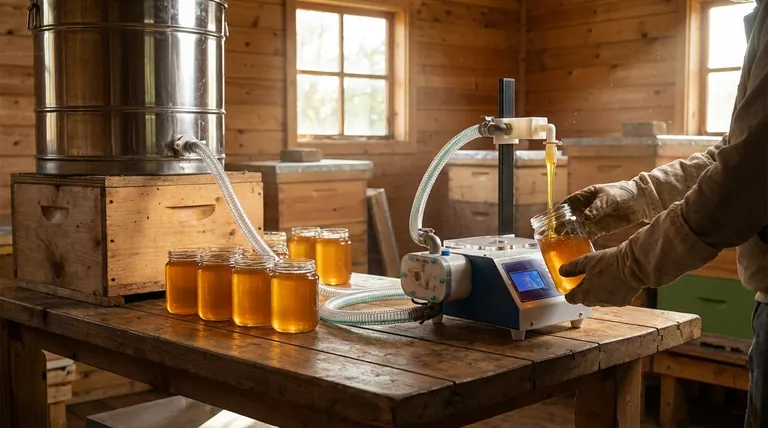
The Bottleneck is Never Just a Machine
An apiary's success story often hides an unglamorous truth. It’s not found in the blooming fields or the buzzing hives, but in a small, sticky room where growth comes to a halt.
It's the room where a family, working late into the night, hand-fills jars one by one. The orders are piling up, retailers are waiting, but production can't keep pace. Every filled jar is a small victory; every empty one on the pallet is a reminder of a ceiling they are hitting.
This moment isn't a simple equipment problem. It's a strategic crossroads. The decision you make here—about how you move honey from a tank into a jar—will define the future of your operation.
Speed, Precision, or Simplicity: You Can Only Pick One
The choice between honey filling systems is a psychological one, often masked by technical specifications. It forces you to confront a difficult question: What is the single most important metric for your success right now?
Your answer dictates your machine. Each design is a masterclass in trade-offs, engineered to be brilliant at one thing, often at the expense of another.
The Velocity Engine: The Pump-Based System
At its heart, a pump-based filler is an engine for high-velocity production. It uses a dedicated pump to actively drive honey, creating a continuous, high-speed stream.
This isn't a tool for batch work; it's the core of an integrated, automated production line. The constant, predictable flow is designed to match the pace of conveyors, cappers, and labelers. It is built for one purpose: maximum throughput.
Choosing a pump system is a declaration that your primary objective is to meet the relentless demands of a large supply chain. It’s the right choice when the cost of not producing at scale is greater than the cost of the machine itself.
The Craftsman's Caliper: The Piston Filler
A piston filler operates with the soul of a watchmaker. It’s not about flow; it's about a single, perfect measurement.
A piston retracts, drawing an exact volume of honey into a cylinder, and then dispenses it. The process is deliberate, mechanical, and stunningly accurate. This is the system for premium, high-value honey where every gram matters, or for operations that need the flexibility to fill a wide array of container sizes with unwavering consistency.
Opting for a piston filler is a commitment to per-unit precision over raw speed. It’s the choice for a brand built on quality control and the promise that what's on the label is exactly what's in the jar.
The Honest Start: The Gravity Filler
The gravity filler is the simplest expression of the task. It uses the planet's own pull to move honey from an overhead tank into a container. It has few moving parts, is incredibly reliable, and carries the lowest financial barrier to entry.
Its virtue is its simplicity. For a startup or small-scale apiary, it provides a means of production without the overwhelming cost or complexity of more advanced systems.
However, its reliance on gravity means the flow rate can slow as the tank empties, introducing small inconsistencies. It is a workhorse for those starting their journey, but it is not an engine for massive scale.
The Hidden Cost of Misalignment
The greatest mistake isn't buying a "bad" machine, but buying a machine that is misaligned with your operational philosophy.
- A startup investing in a pump system too early will be crushed by its cost and complexity.
- A growing business that clings to a gravity filler for too long will be suffocated by its own success, unable to meet demand.
- A high-volume operation that chooses a piston filler for its accuracy will create a new, more precise bottleneck, sacrificing the throughput it desperately needs.
The true cost is the friction created when your equipment fights your business goals.
Aligning Machinery with Ambition
To make the right choice, you must ignore the noise and define your one true north. The table below isn't a feature comparison; it's a map of operational priorities.
| Feature | Pump-Based System | Piston Filler | Gravity Filler |
|---|---|---|---|
| Primary Strength | High-speed, continuous flow | High dosing accuracy | Simplicity & low cost |
| Best For | Large-scale, automated production | Premium products, varied container sizes | Small-scale, manual operations |
| Key Trade-off | Higher cost & complexity | Slower throughput | Slower, less consistent flow |
| Operational Goal | Maximize Throughput | Maximize Precision | Minimize Initial Investment |
This choice is a reflection of your ambition. Are you building an empire of volume, a boutique of precision, or the solid foundation for a future endeavor?
At HONESTBEE, we supply the robust equipment that turns ambition into reality. We understand that for commercial apiaries and distributors, choosing a filler is about selecting the right engine for growth.
To align your machinery with your vision, Contact Our Experts.
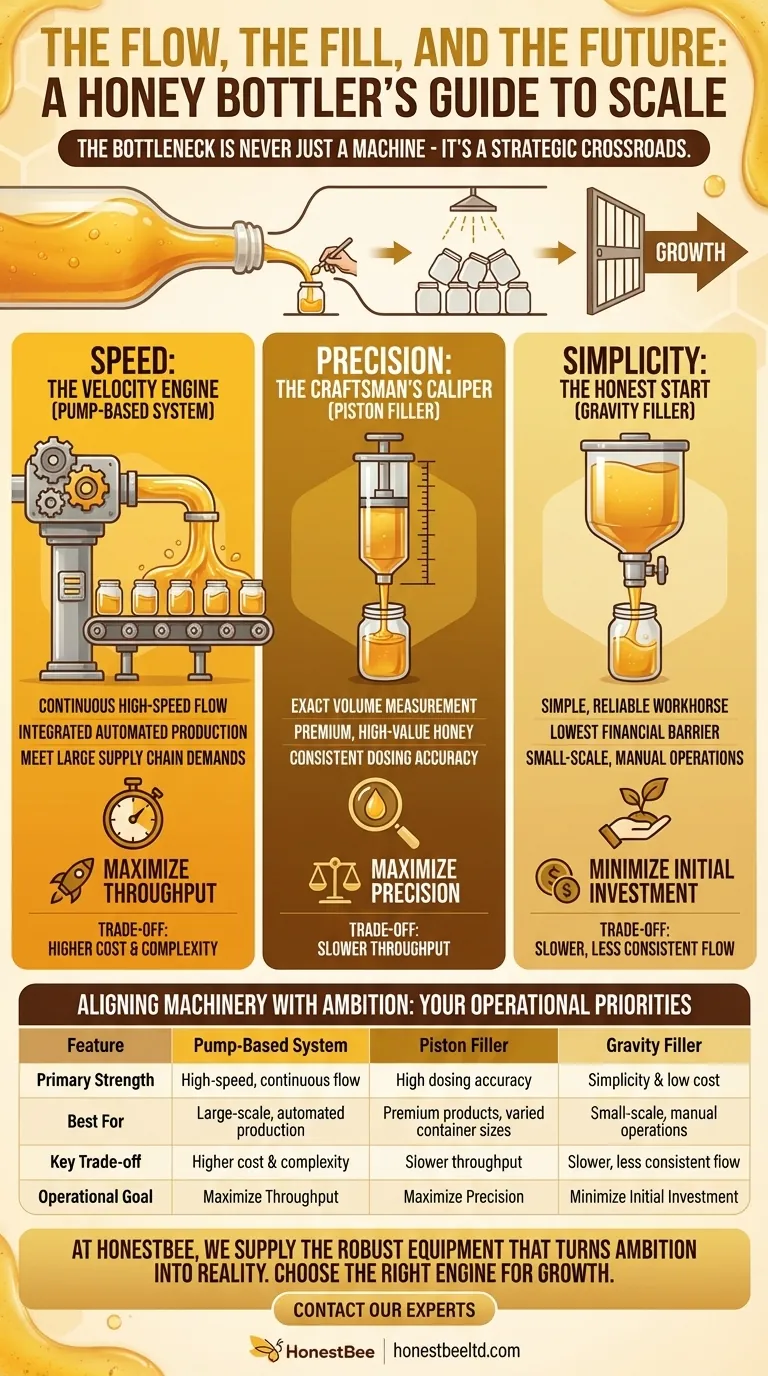
Visual Guide
Related Products
- Precision Durable Efficient HONESTBEE Rotary Honey Filling Machine
- Semi Automatic Small Honey Bottle Filling Machine Honey Filler
- Economy Small Honey Filling Machine Honey Bottle Filler Packaging Machine
- Commercial Rotary Honey Filling Machine for Production
- Fully Automatic Honey Filling Packaging Machine for Processing Line
Related Articles
- How to Choose Between Semi-Automatic and Fully Automatic Honey Filling Machines
- The Bottleneck in a Bottle: Why Manual Honey Filling Limits Your Apiary's Growth
- The Viscosity Principle: How a Honey Filling Machine Masters More Than Just Honey
- The Sticky Truth: Why Your Honey Filling Fails and How to Fix It for Good
- The Mechanics of Trust: Why Your Honey Filling Process is Your Brand's First Handshake
















