The Illusion of Simplicity
A single steel screw fastens the disc to the hive. The installation is trivial, taking less than a minute.
This simplicity is a beautiful deception. It masks the tool's real complexity, which lies not in its attachment but in its application. The entrance disc is a powerful lever that amplifies a beekeeper’s decisions. Used with foresight, it can protect a colony from disaster. Used carelessly, it can be the cause of one.
The real challenge isn't mounting the hardware; it's mastering the four-part logic of a dynamic system.
A Control System, Not Just an Entrance
Think of the entrance disc as the primary control interface for the hive's logistics and security. It is the gatekeeper, the traffic controller, and the ventilation specialist, all in one rotating device.
Its function is to give the beekeeper precise, situational control over who and what crosses the threshold. This control is the difference between a thriving colony and a struggling one, especially for nucleus colonies or during the volatile shifts of the seasons.
The Four Modes of Control
Each rotation of the disc engages a different strategic mode. Understanding the why behind each setting is what separates an amateur from a professional.
-
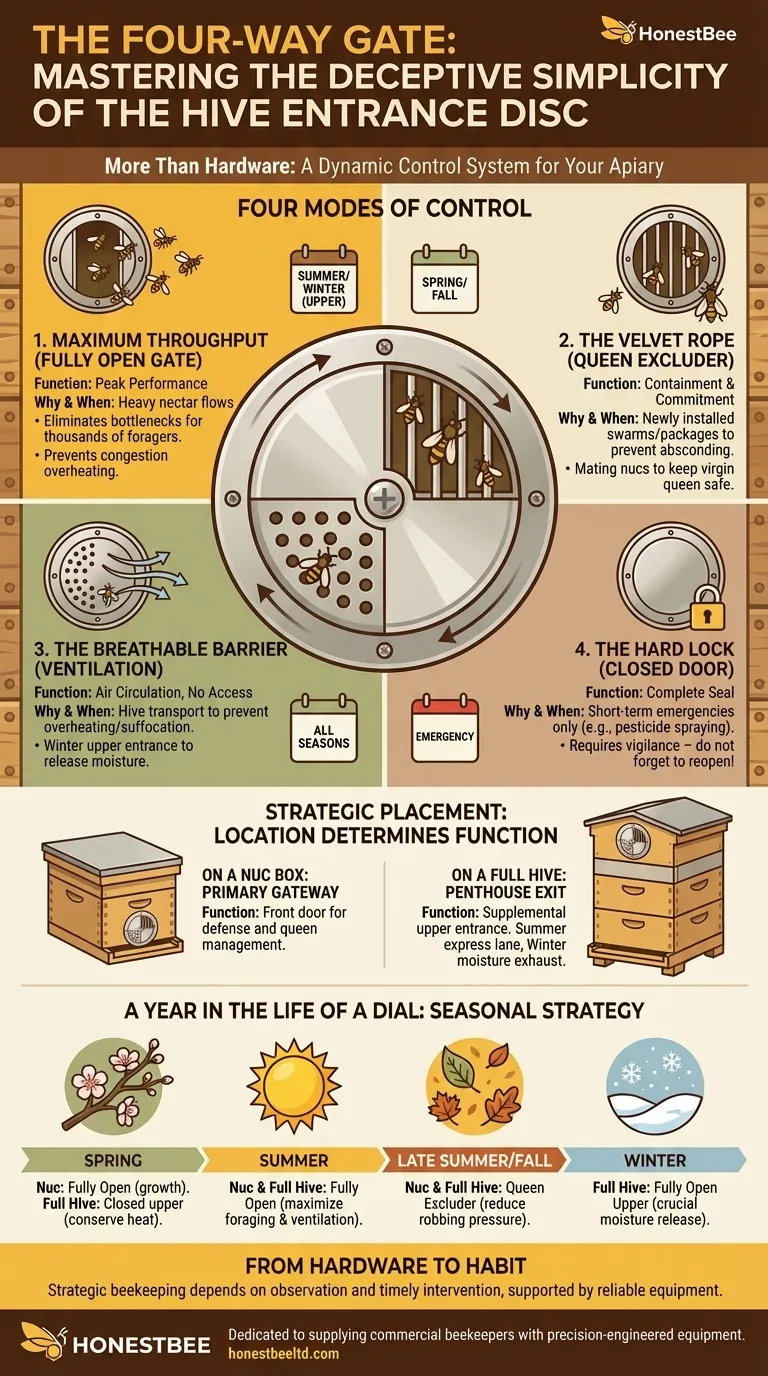
Maximum Throughput (The Fully Open Gate) This large opening is for peak performance. During a heavy nectar flow, a populous colony operates like a bustling airport. Thousands of foragers are leaving and returning every minute. This setting eliminates bottlenecks, maximizing the efficiency of the foraging workforce and preventing overheating from congestion.
-
The Velvet Rope (The Queen Excluder) This setting allows worker bees to pass but restricts the larger queen and drones. It’s a tool of containment and commitment. For a newly installed swarm or package, it ensures the queen doesn’t abscond before the colony has established itself. In a mating nuc, it keeps the valuable virgin queen safely inside until she is ready for her mating flight.
-
The Breathable Barrier (Ventilation) A pattern of small holes allows air to circulate but blocks all bees. This mode is critical during high-stress situations. When transporting a hive, it prevents the colony from suffocating and overheating. In the damp cold of winter, as an upper entrance, it allows warm, moisture-laden air to escape, preventing condensation from fatally dripping onto the cluster below.
-
The Hard Lock (The Closed Door) This setting completely seals the hive. Its use is rare and surgical, reserved for short-term emergencies like protecting the colony from nearby pesticide spraying. The psychological trap here is immense; forgetting to reopen this gate, especially on a warm day, is a death sentence for the colony. It demands vigilance.
Strategic Placement: Location Determines Function
Where you place the disc fundamentally changes its role. The same piece of steel serves two entirely different strategic purposes based on its location.
On a Nuc Box: The Primary Gateway
For a small nucleus colony, the disc is the front door. It serves as the primary and only entrance, making its correct management essential for the young colony's survival. It helps the small population defend against robbers and allows the beekeeper to manage the queen's movements precisely.
On a Full Hive: The Penthouse Exit
On a full-sized hive, the disc should never be the primary entrance. Instead, it is installed as a supplemental upper entrance. Here, its role shifts. In summer, it's an express lane to relieve traffic at the main entrance below. In winter, it becomes the hive's most important exhaust vent, releasing moisture and providing an exit for cleansing flights on warmer days.
A Year in the Life of a Dial
The disc is not a "set and forget" tool. Its setting should reflect the colony's needs throughout the year.
- Spring: On a growing nuc, open it fully to accommodate the expanding workforce. On a large hive, keep the upper entrance closed to conserve heat until the colony is booming.
- Summer: Open it fully on both nucs and full hives to maximize foraging and ventilation during the peak nectar flow.
- Late Summer/Fall: As the nectar flow wanes, robbing pressure from wasps and other bees intensifies. Rotate the disc to the queen excluder setting. The smaller, more defensible opening helps the colony guard its precious winter stores.
- Winter: On a full hive, leave the upper entrance disc fully open. It provides the critical ventilation needed to keep the hive dry and offers an escape path for bees when the bottom entrance is blocked by snow or dead bees.
| Disc Setting | Primary Function | Key Seasonal Use Case |
|---|---|---|
| Fully Open | Maximum bee traffic & ventilation | Summer nectar flows; winter upper entrance |
| Queen Excluder | Confines queen, allows workers | Early spring swarm management; fall robbing prevention |
| Ventilation | Airflow without bee access | Hive transportation (any season) |
| Fully Closed | Seals the entrance | Short-term emergencies (e.g., pesticide spraying) |
From Hardware to Habit
The entrance disc is a simple piece of engineering that demands complex thinking. Its mastery is a microcosm of beekeeping itself: a practice built on observation, foresight, and timely intervention. It teaches us that the smallest components, when understood deeply, provide the greatest control.
Building a resilient, productive apiary depends on this level of strategic thinking, supported by equipment that performs reliably under pressure. HONESTBEE is dedicated to supplying commercial beekeepers and distributors with the durable, precision-engineered equipment needed to implement these strategies effectively. If you value tools designed for thoughtful management, Contact Our Experts
Visual Guide
Related Products
- Multi-Functional Rotary Hive Entrance Disc for Beekeeping
- Steel Round Disc Entrance Reducer for Flexzion Bee Hive Nuc Box Gate
- Beehive Entrance Discs Plastic Bee Entrance Disc for Bee Hives
- Professional Reversible Beehive Hive Entrance
- Multi-Functional Sliding Hive Entrance for Beekeeping
Related Articles
- The Four States of the Hive Entrance: A Gateway or a Fortress?
- How Hive Entrance Size Shapes Bee Health: Balancing Ventilation and Security
- Optimizing Beehive Entrance Discs: When Freedom Boosts Hive Performance
- More Than a Door: The Beehive Entrance Disc as a System Controller
- Calibrating the Gateway: The Critical Engineering of the Hive Entrance