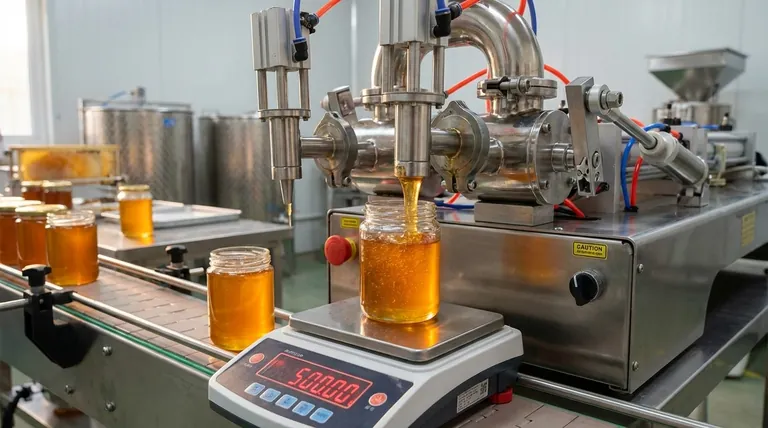
Imagine two jars of honey, sitting side-by-side. Both are from the same batch, filled on the same day. To the naked eye, they are identical. But a high-precision scale reveals a tiny secret: one contains three extra grams of honey.
Three grams. It feels insignificant—a rounding error. A gesture of generosity.
But for a commercial apiary producing 100,000 jars a year, that small act of generosity, repeated over and over by an imprecise machine, amounts to 300 kilograms of lost product. It’s a silent tax on efficiency, paid for by the very product you worked so hard to create.
This is the central challenge of product filling. It’s not a simple mechanical task; it’s a constant negotiation between physics, economics, and psychology.
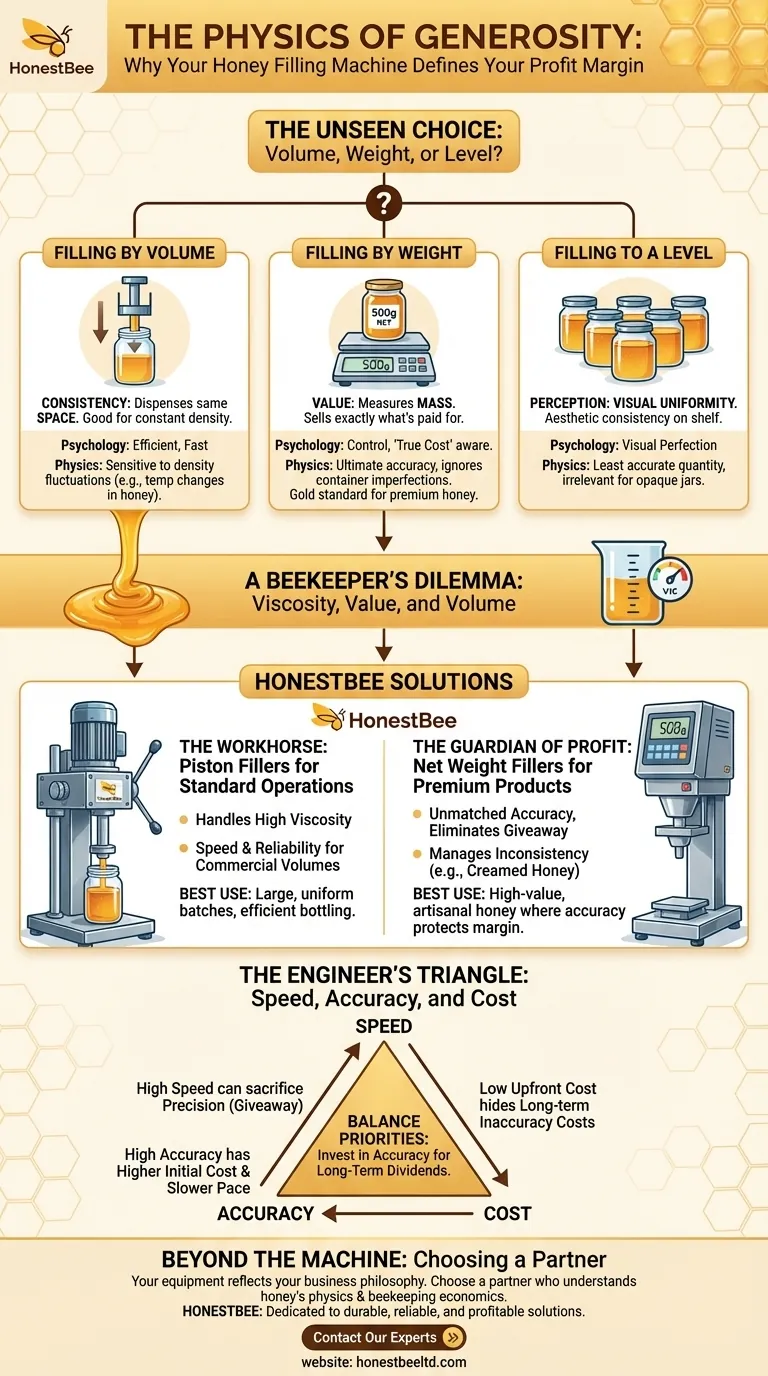
The Unseen Choice: Volume, Weight, or Level?
Before you even look at a machine, you must decide which fundamental principle of measurement you will trust. Every filling system operates on one of three philosophies. Choosing the wrong one is like trying to measure air with a ruler.
Filling by Volume: The Language of Consistency
A volumetric filler dispenses the same space of product every time. A piston filler, the workhorse of the liquid world, uses a cylinder to draw in and push out a precise volume of liquid.
- Psychology: It feels efficient. The cycle is fast, consistent, and mechanically simple.
- Physics: It assumes your product's density is constant. For many products, this is true. But for honey, whose density can fluctuate with temperature and floral source, filling by volume can introduce subtle inaccuracies.
Filling by Weight: The Language of Value
A net weight filler measures the product's mass before it ever enters the container. It is the only method that sells exactly what the customer pays for, gram for gram.
- Psychology: It forces you to confront the true cost of "giveaway." It feels slower but provides an unimpeachable sense of control.
- Physics: It is the ultimate source of truth. It ignores variations in product density and imperfections in the container itself. For a high-value product like premium honey, this is the gold standard.
Filling to a Level: The Language of Perception
A level filler ensures every container appears to be filled to the same height. This is purely for aesthetic consistency on a retail shelf, most often with transparent containers.
- Psychology: It appeals to our desire for visual perfection and uniformity.
- Physics: It's the least accurate method in terms of actual product quantity, as minor variations in container manufacturing can alter the total volume. For opaque jars of honey, it's a largely irrelevant metric.
A Beekeeper’s Dilemma: Viscosity, Value, and Volume
Honey is not like water. It's viscous, its properties change, and it's valuable. This makes choosing the right filling equipment a masterclass in applying the right principles to the right problem.
At HONESTBEE, we supply commercial apiaries, and we see this decision point every day. The right machine isn't the fastest or the cheapest; it's the one that respects the nature of your honey.
The Workhorse: Piston Fillers for Standard Operations
For large-scale, consistent honey processing, a high-quality piston filler is often the perfect balance.
- Handles Viscosity: It has the power to move thick honey cleanly and efficiently.
- Speed & Reliability: It provides the throughput needed for commercial volumes.
- Best Use Case: Ideal for apiaries processing large, uniform batches where the primary goal is efficient, reliable bottling.
The Guardian of Profit: Net Weight Fillers for Premium Products
When you are bottling high-value artisanal or medicinal honey (like Manuka) , every gram matters.
- Unmatched Accuracy: A net weight filler eliminates product giveaway, directly protecting your profit margin.
- Manages Inconsistency: It's perfect for creamed honey, where air can be incorporated during processing, making volumetric filling unreliable.
- Best Use Case: Essential for premium products where the cost of giveaway far outweighs the higher initial investment in the machine.
The Engineer's Triangle: Speed, Accuracy, and Cost
Choosing equipment forces you to balance three competing priorities. Optimizing for one often means sacrificing another.
| Priority | The Psychological Pull | The Economic Reality |
|---|---|---|
| Speed | "We need to bottle faster to meet demand." | High-speed systems can sometimes sacrifice precision, leading to costly giveaway. |
| Accuracy | "We must be precise to the last gram." | Highly accurate machines have a higher initial cost and may run at a slower pace. |
| Flexibility | "We need a machine that can do everything." | A machine designed specifically for honey's viscosity will always outperform a generalist. |
| Cost | "What is the cheapest machine we can buy?" | The upfront price is visible; the long-term cost of inaccuracy is hidden but larger. |
The most common mistake is over-indexing on upfront cost or visible speed, while ignoring the silent, compounding cost of imprecision. A more expensive, more accurate machine isn't a cost center; it's an investment that pays dividends on every single jar you sell.
Beyond the Machine: Choosing a Partner
Ultimately, the right filling equipment is an extension of your business philosophy. It reflects how much you value your product, your efficiency, and your profitability. This decision requires more than just a spec sheet; it requires a partner who understands the unique challenges of your industry.
HONESTBEE is dedicated to supplying commercial apiaries with durable, reliable, and appropriate equipment. We understand the physics of honey and the economics of beekeeping. We help you move beyond the temptation of "fastest" or "cheapest" to find the solution that is truly the most profitable.
The right choice hinges on a deep understanding of your product's properties and your business's goals. If you're ready to align them perfectly, let's talk. Contact Our Experts
Visual Guide
Related Products
- Precision Durable Efficient HONESTBEE Rotary Honey Filling Machine
- Semi Automatic Small Honey Bottle Filling Machine Honey Filler
- Economy Small Honey Filling Machine Honey Bottle Filler Packaging Machine
- Commercial Rotary Honey Filling Machine for Production
- Fully Automatic Honey Filling Packaging Machine for Processing Line
Related Articles
- How to Choose Between Semi-Automatic and Fully Automatic Honey Filling Machines
- The Bottleneck in a Bottle: Why Manual Honey Filling Limits Your Apiary's Growth
- The Viscosity Principle: How a Honey Filling Machine Masters More Than Just Honey
- The Sticky Truth: Why Your Honey Filling Fails and How to Fix It for Good
- The Mechanics of Trust: Why Your Honey Filling Process is Your Brand's First Handshake
















