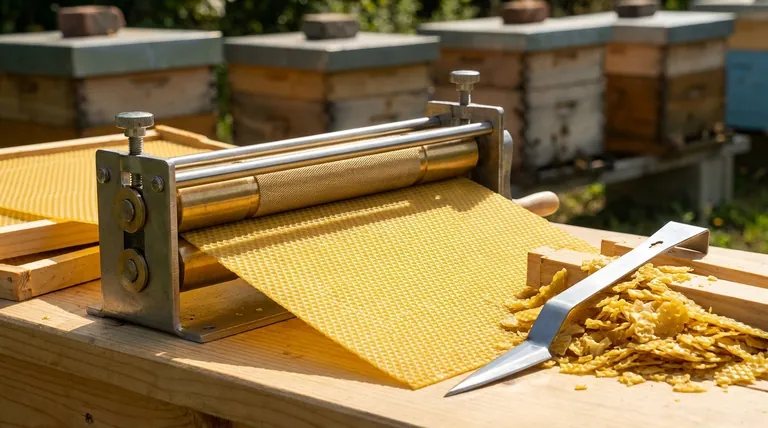
The High Cost of a Single Flake of Wax
To produce one pound of beeswax, a honeybee colony must consume roughly eight pounds of honey. It is one of the most metabolically expensive materials in the natural world, produced flake by tiny flake from the glands of worker bees.
This single fact transforms our perception of a beehive. It's not just a home; it's a meticulously managed economy of energy. Every action is measured against its cost in honey.
And it is this economic reality that reveals the profound importance of a seemingly simple tool: the manual wax roller. It's not just a device for embossing patterns; it's a mechanical handshake, an agreement between beekeeper and bee to conserve the colony's most precious resource.
An Illusion of Simplicity
At first glance, a wax foundation mill is the epitome of simple machinery. A sturdy frame, two engraved rollers, and a hand crank. It feels elemental, almost rustic.
But this simplicity is deceptive. The machine operates at a critical intersection of mechanical engineering and insect psychology. Each component is a solution to a specific problem, and its quality dictates the success of your intervention. Failure isn't just a broken tool; it's a broken promise to your bees.
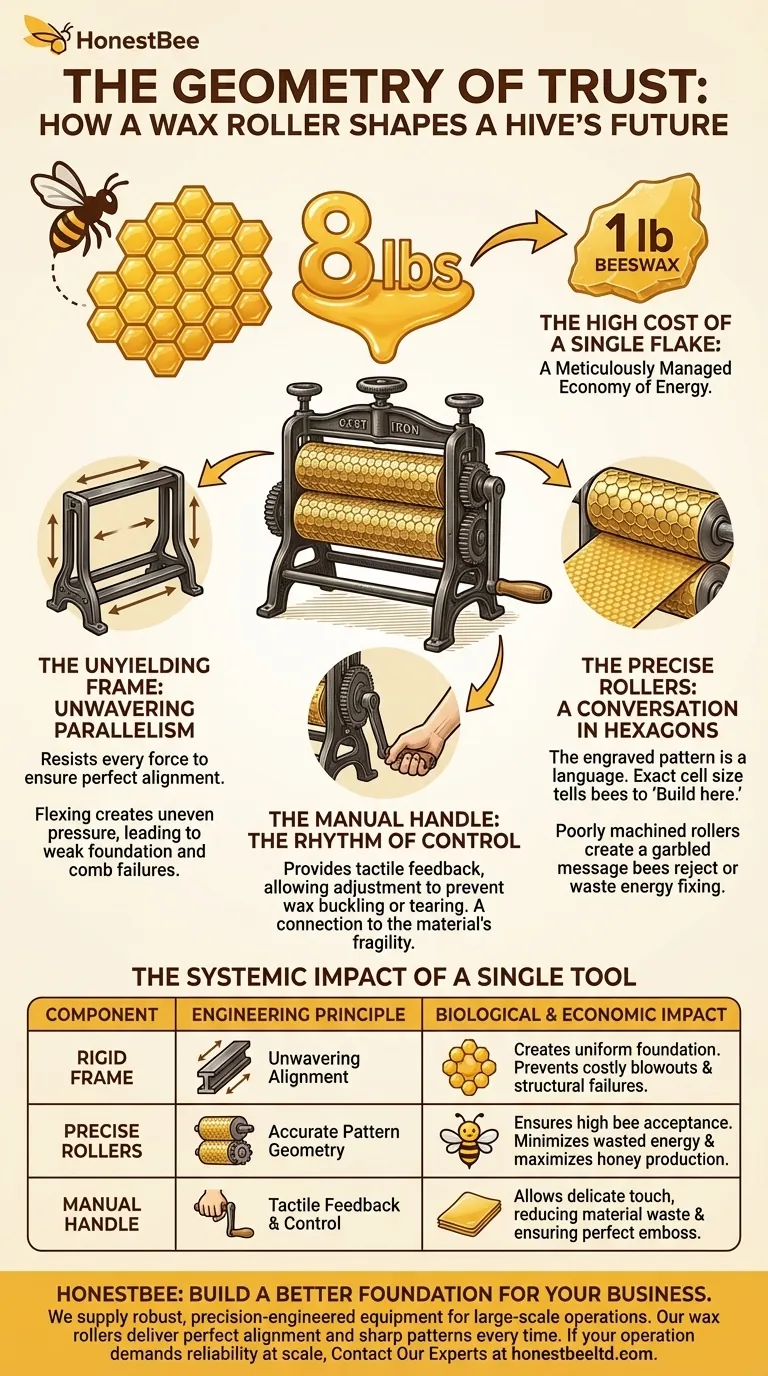
The Frame: An Unyielding Commitment to Parallelism
The most underappreciated component is the frame, often made of heavy-duty cast iron. Its only job is to do nothing—to resist every force, torque, and vibration with absolute rigidity.
Why? Because its function is to hold the two rollers in a state of perfect, unwavering parallelism.
If the frame flexes even a fraction of a millimeter, the pressure across the wax sheet becomes uneven. One side is embossed deeply, creating a dangerously thin and weak foundation. The other is barely marked, leaving a vague suggestion that the bees may ignore. This single, tiny mechanical failure creates a structural flaw that cascades through the entire comb, leading to blowouts during honey extraction and wasted effort by the colony.
The frame isn't just holding metal; it's holding a standard of quality.
The Rollers: A Conversation in Hexagons
The heart of the machine is the pair of engraved rollers. They are the point of contact, the medium through which we communicate our intentions to the hive.
The hexagonal pattern engraved on their surface is a language. It’s a blueprint that tells the bees, "Build here. The geometry is correct. The foundation is sound."
This is where precision engineering becomes non-negotiable. The cell size must be exact. The engraved walls must be sharp and clean. A poorly machined roller creates a garbled message—a misshapen or poorly defined pattern. Bees, being the master engineers they are, will either reject this sloppy blueprint outright, tear it down, or waste energy re-working it to their own exacting standards. They trust precision and reject ambiguity.
The Handle: The Rhythm of Human Control
In an age of automation, the manual hand crank feels anachronistic. Yet, it serves a critical purpose: feedback.
As you turn the handle, you feel the resistance of the wax sheet being pulled through. You can adjust your speed to ensure it feeds smoothly, preventing the buckling or tearing that a purely mechanical process might cause.
This manual control creates a connection to the material. It's a rhythm, a delicate process that acknowledges the fragility of the wax. For a small-scale apiary, this provides an unparalleled level of control. For commercial operations, it highlights the need for equipment so well-engineered that this manual touch is replicated with flawless consistency.
The Systemic Impact of a Single Tool
A wax roller is not an isolated piece of equipment. It is the starting point of a system. Its quality directly influences hive productivity, structural integrity, and the colony's energy budget.
| Component | Engineering Principle | Biological & Economic Impact |
|---|---|---|
| Rigid Frame | Unwavering Alignment | Creates strong, uniform comb foundation. Prevents costly blowouts and structural failures in the hive. |
| Precise Rollers | Accurate Pattern Geometry | Ensures high bee acceptance. Minimizes wasted bee energy and maximizes honey production. |
| Manual Handle | Tactile Feedback & Control | Allows for a delicate touch, reducing material waste and ensuring a perfect emboss on every sheet. |
For commercial apiaries and equipment distributors, where efficiency is measured across hundreds or thousands of hives, the reliability of this foundational tool is paramount. Every sheet of foundation must be a perfect invitation for the bees to build. There is no room for error. This is where professional-grade equipment, built for consistency and durability, becomes the bedrock of a successful operation.
At HONESTBEE, we specialize in supplying the robust, precision-engineered beekeeping equipment that large-scale operations depend on. Our wax rollers are designed to deliver that perfect, unwavering alignment and sharp, bee-accepted hexagonal pattern, every single time. Build a better foundation for your business with tools you can trust.
If your operation demands reliability at scale, Contact Our Experts
Visual Guide
Related Products
- Economy Manual Beeswax Embossing Mill Wax Foundation Machine Roller
- Electric Beeswax Foundation Machine With Operating Tray and Wax Foundation Roller
- Manual Beeswax Flat Sheet Machine for Beeswax Processing
- Electric Flatting and Embossing Machine with Tray for Beekeeping
- Professional Honey Uncapping Roller for Efficient Harvesting
Related Articles
- Are You Choosing the Right Beeswax Embossing Tool? Avoid Common Pitfalls in Foundation Production
- Beyond the Embosser: The Systems Thinking Behind Perfect Beeswax Foundation
- Engineering Symbiosis: The Unseen Role of the Beeswax Embossing Machine
- How to Craft Durable Wax Foundations Using Manual Rollers: A Beekeeper's Guide
- How Beeswax Foundation Machines Transform Beekeeping Efficiency