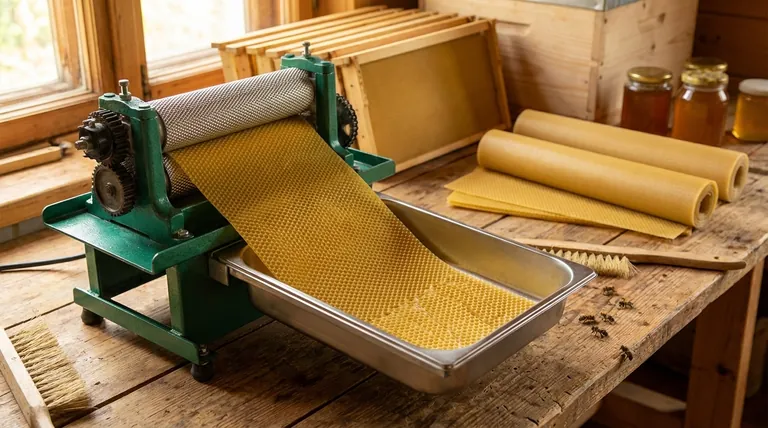
The Tremendous Cost of Creation
A honeybee colony is a relentless engine of production. But its most expensive fuel is not nectar or pollen; it is the energy required to create.
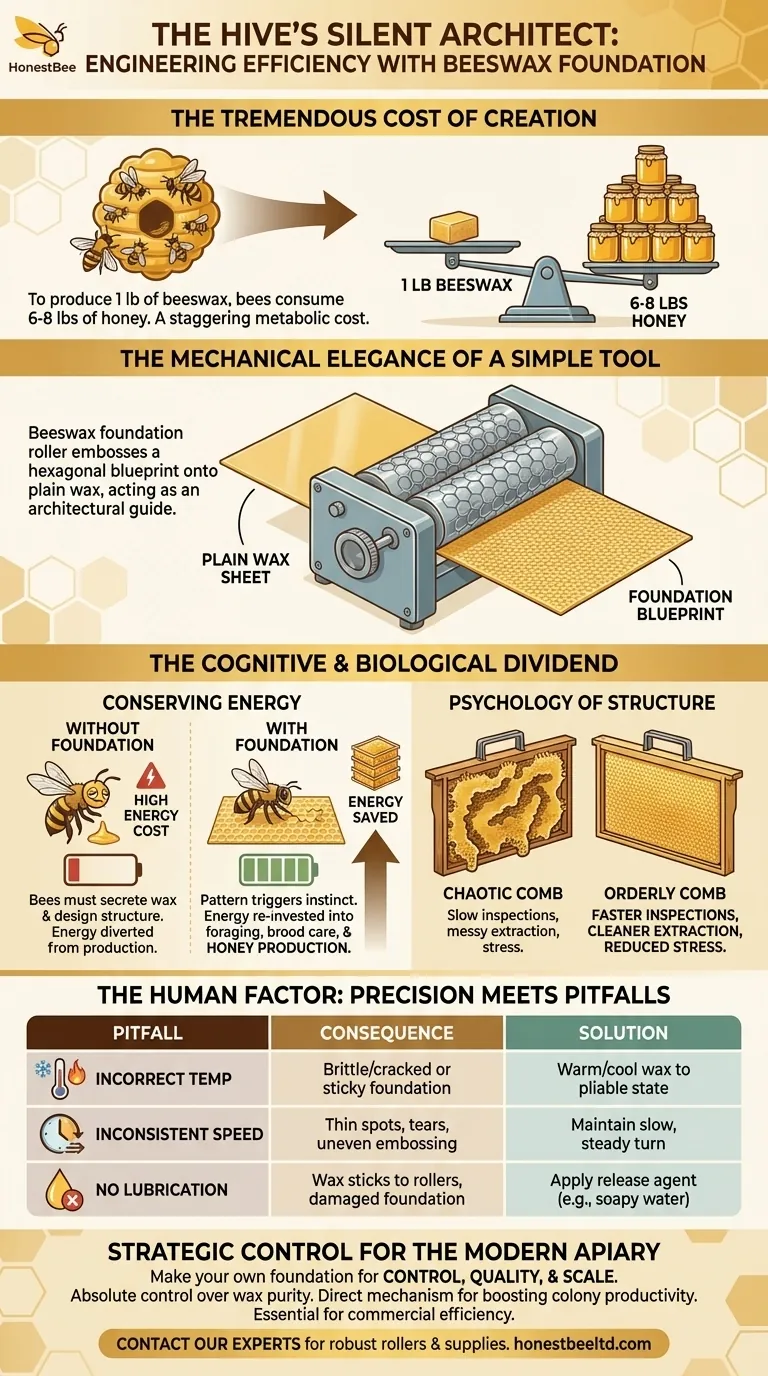
To produce a single pound of beeswax, bees must consume six to eight pounds of honey. This wax is the architectural material for their entire world—the nursery for their young and the pantry for their food. It is a staggering metabolic cost.
Managing a commercial apiary means managing this energy budget. The central question is not just how to help bees make more honey, but how to help them spend less energy doing everything else.
The Mechanical Elegance of a Simple Tool
The solution is a beautiful piece of simple engineering: the beeswax foundation roller. It’s not a complex machine, but its impact on a hive's economy is profound.
A Pact Between Pressure and Pattern
At its core, a wax roller consists of two meticulously engraved rollers. Their surfaces carry the negative imprint of a perfect honeycomb cell base.
A beekeeper feeds a smooth, plain sheet of beeswax between them. With the turn of a crank, the rollers exert precise pressure, embossing the hexagonal blueprint onto the wax. The process is manual, deliberate, and transformative.
From Blank Slate to Blueprint
The machine doesn't just pattern the wax. It converts a blank slate into an architectural guide. This foundation sheet becomes a clear instruction set for the colony, a universally understood language that tells them: "Build here. Build like this."
The Cognitive and Biological Dividend
Providing this blueprint fundamentally changes the hive's workflow by offloading an immense biological burden.
Conserving the Most Precious Resource: Energy
The embossed pattern acts as a powerful trigger for the bees' comb-building instinct. They immediately begin drawing out the cell walls, skipping the two most energy-intensive steps: secreting the wax and figuring out the initial structure from scratch.
This saved energy is directly re-invested into more productive activities—foraging, brood care, and, most critically, honey production. The hive becomes dramatically more efficient.
The Psychology of Structure
A proper foundation also brings order. Bees build straight, consistent combs within the frames. This uniformity is not just aesthetically pleasing; it is operationally critical.
It makes hive inspections faster and less disruptive. It makes honey extraction cleaner and more manageable. By imposing a simple geometric order, we reduce stress on the colony and complexity for the beekeeper.
The Human Factor: Where Precision Meets Pitfalls
While the wax roller is a simple tool, its effectiveness depends on the operator's attention to detail. The process is a dialogue between the beekeeper and the medium.
- The Temperament of Wax: The beeswax sheet must be at the correct temperature. Too cold, and it cracks under pressure. Too warm, and it sticks to the rollers, blurring the fine details of the pattern.
- The Rhythm of the Roll: A slow, steady, and consistent speed is essential. Rushing the process can create thin spots or tears, compromising the foundation's structural integrity.
- The Necessity of Release: A release agent, often as simple as soapy water, prevents the wax from adhering to the metal rollers. Forgetting this step can ruin the sheet and halt the entire workflow.
| Pitfall | Consequence | Solution |
|---|---|---|
| Incorrect Temperature | Brittle, cracked, or sticky foundation | Warm or cool wax sheets to a pliable state |
| Inconsistent Speed | Thin spots, tears, uneven embossing | Maintain a slow, steady turn of the crank |
| No Lubrication | Wax sticking to rollers, damaged foundation | Apply a suitable release agent to the rollers |
Strategic Control for the Modern Apiary
For a commercial beekeeper, making your own foundation is a strategic decision about control, quality, and scale.
It grants you absolute control over the purity of the wax in your hives, eliminating the risk of contaminants from outside sources. More importantly, it provides a direct mechanism for boosting the productivity of every single colony.
For commercial apiaries and distributors, where efficiency and reliability are paramount, this level of control isn't a luxury—it's essential. Sourcing durable, high-performance equipment is the first step toward building a more productive operation. HONESTBEE provides robust wax rollers and beekeeping supplies engineered to meet the demands of wholesale and commercial-scale apiaries.
Understanding the interplay between a simple machine and complex biology is key to unlocking an apiary's full potential. To equip your operation with the tools built for this purpose, Contact Our Experts.
Visual Guide
Related Products
- Economy Manual Beeswax Embossing Mill Wax Foundation Machine Roller
- Electric Beeswax Foundation Machine With Operating Tray and Wax Foundation Roller
- Manual Beeswax Flat Sheet Machine for Beeswax Processing
- Electric Flatting and Embossing Machine with Tray for Beekeeping
- Professional Honey Uncapping Roller for Efficient Harvesting
Related Articles
- Are You Choosing the Right Beeswax Embossing Tool? Avoid Common Pitfalls in Foundation Production
- Beyond the Embosser: The Systems Thinking Behind Perfect Beeswax Foundation
- Engineering Symbiosis: The Unseen Role of the Beeswax Embossing Machine
- How to Craft Durable Wax Foundations Using Manual Rollers: A Beekeeper's Guide
- How Beeswax Foundation Machines Transform Beekeeping Efficiency