The High-Stakes Gateway
To an outsider, the entrance of a beehive is just a slot. A simple opening.
To the honeybee colony, it is the single most critical piece of infrastructure they possess. It is the port, the fortress gate, and the climate control interface all in one. It is a place of constant negotiation between the fragile, meticulously ordered world inside and the chaotic, often hostile world outside.
The psychology of the colony is one of perpetual risk management. Every decision, from foraging patterns to brood rearing, is a calculated trade-off. Nowhere is this tension more visible than at the hive entrance.
The Physics of Survival: Engineering Airflow
A honeybee colony operates within brutally tight thermal tolerances. The brood nest must be kept at a stable 95°F (35°C), regardless of whether it's a scorching summer afternoon or a freezing winter night. The entrance is their primary engineering tool to achieve this.
The Summer Challenge: Preventing a Meltdown
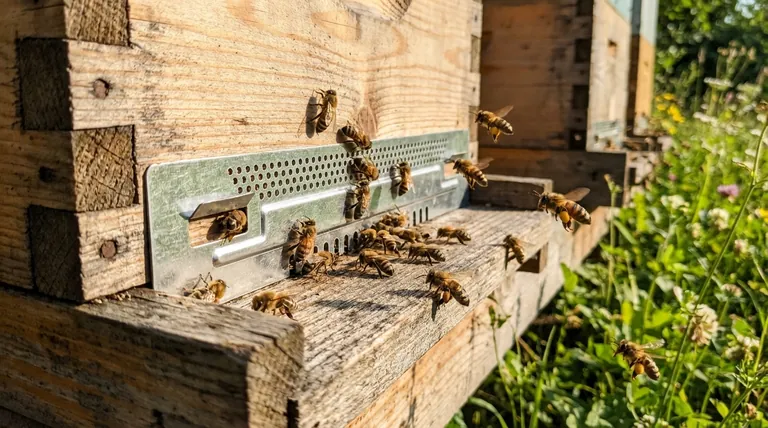
On a hot day, the hive entrance becomes a ventilation port. You will see lines of bees facing inward, fanning their wings in perfect synchrony. They are not just cooling themselves; they are executing a complex airflow protocol.
This coordinated effort creates a current, pulling hot, humid air out of the hive and drawing cooler, fresher air in. It is a living air-conditioning system, preventing the delicate wax combs from melting and protecting the developing brood from overheating. An entrance that is too small creates a bottleneck, turning the hive into an oven.
The Winter Siege: Conserving Every Degree
In winter, the challenge flips. The colony forms a tight cluster, shivering to generate warmth. Now, the entrance is a liability—a breach in the fortress wall that leaks precious heat.
A smaller entrance reduces this thermal loss, minimizing the energy the colony must expend to survive. It also prevents moist air from becoming trapped, where it could condense and drip fatally cold water onto the cluster. The size of the entrance becomes a life-or-death calculation.
The Fortress Airlock: Defending the Economy
The hive is a bank vault filled with liquid gold. Every neighbor—from robber bees from other colonies to opportunistic wasps—wants to get in. The entrance is the only door to guard.
The Gatekeepers: Identity and Access Control
Guard bees are the sentinels. They stand at the entrance, inspecting every bee that tries to enter. They are checking for a very specific thing: the correct scent, the unique pheromonal signature of their colony.
This is a biological password system. Friendlies are granted access. Intruders, robbers, or pests are met with immediate, decisive force.
The Geometry of Defense
The defensive success of the guards is a simple function of geometry. A large, wide-open entrance is like defending a city with a massive, unguarded breach in its walls. It's an open invitation to invaders, overwhelming the colony's ability to patrol its perimeter.
A smaller, defensible entrance focuses the guards' efforts. It forces any would-be attacker into a narrow choke-point, making it far easier to repel them. For a young, small, or struggling colony, this strategic reduction in surface area is not a sign of weakness, but a sign of intelligent, conservative strategy.
The Supply Chain Bottleneck
During a strong nectar flow, the hive entrance transforms again. It becomes the logistics hub of a massive resource-gathering operation. Thousands of foragers are returning every hour, laden with nectar and pollen.
An entrance that is too small during this period creates a traffic jam. Foragers circle, waiting to land and offload their cargo to receiver bees inside. Every second wasted in this queue is a second not spent collecting more resources. Efficiency plummets, and the potential honey harvest is capped not by the foragers' efforts, but by a simple infrastructure bottleneck.
The Beekeeper's Dilemma: A Calculated Trade-Off
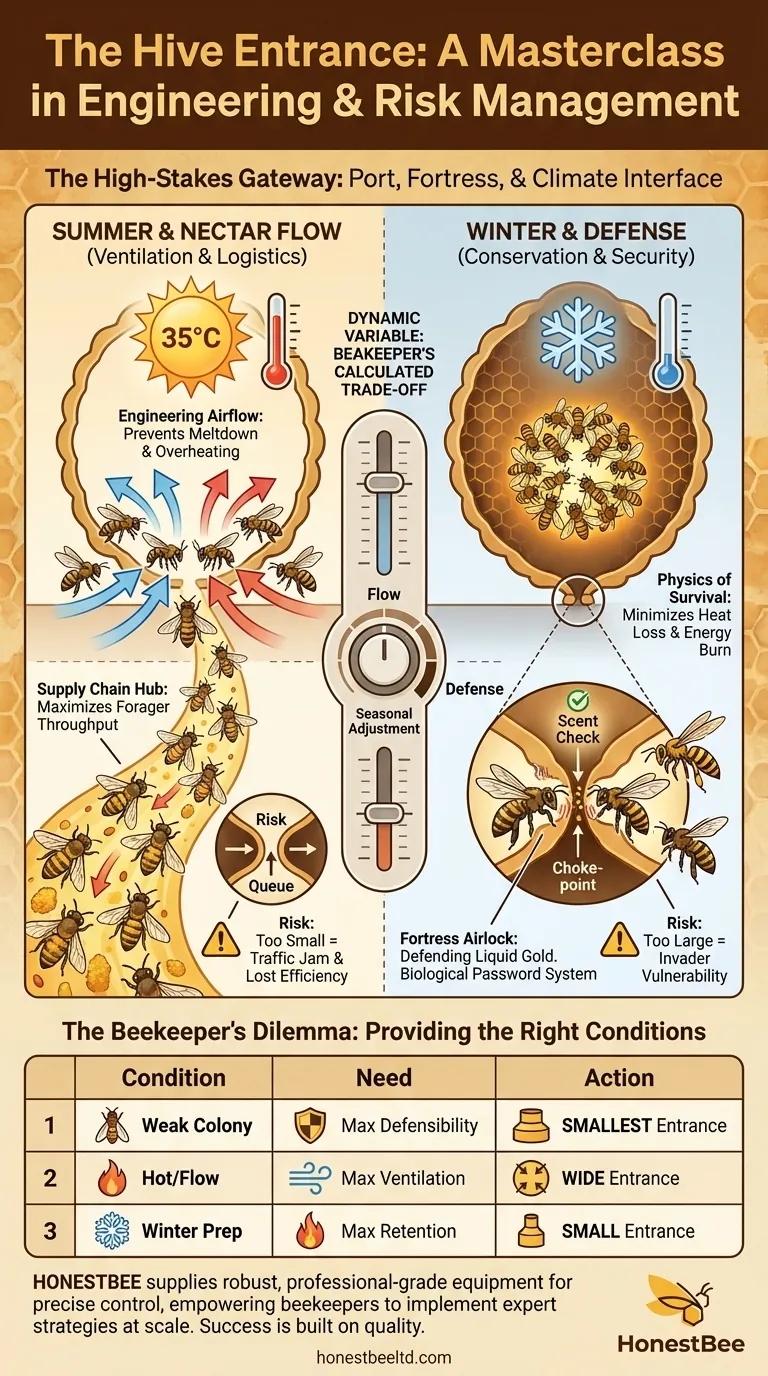
The optimal entrance size is never static. It is a dynamic variable that must be adjusted based on the season, the colony's population, and the environmental pressures. The beekeeper's job is not to dictate, but to assist the colony's own risk management strategy.
This is the art and science of beekeeping: understanding the deep needs of the colony and providing the right conditions for it to solve its own problems.
| Condition | Colony's Need | Beekeeper's Action |
|---|---|---|
| New or Weak Colony | Maximum Defensibility | Use a reducer to create the smallest entrance. |
| Hot Summer & Strong Nectar Flow | Maximum Ventilation & Throughput | Open the entrance fully to prevent bottlenecks. |
| Preparing for Winter | Maximum Heat Retention | Reduce entrance to a small opening to block cold. |
Mastering these adjustments requires not just knowledge, but reliable, professional-grade equipment that allows for precise control. Commercial apiaries and large-scale operations cannot afford the variability and failure points of substandard hardware. The entrance reducer, the hive body, the very foundation of the apiary must be built for durability and performance.
At HONESTBEE, we supply the robust beekeeping equipment that empowers serious beekeepers to implement these expert strategies at scale. We understand that success is built on a foundation of quality. Contact Our Experts
Visual Guide
Related Products
- Multi-Functional Sliding Hive Entrance for Beekeeping
- Multi-Functional Rotary Hive Entrance Disc for Beekeeping
- Professional Reversible Beehive Hive Entrance
- Beehive Entrance Reducer Guardian Metal Hive Entrance for Bees
- Steel Round Disc Entrance Reducer for Flexzion Bee Hive Nuc Box Gate
Related Articles
- How Hive Entrance Size Shapes Bee Health: Balancing Ventilation and Security
- The Choke Point and the Superhighway: A Systems Approach to Hive Entrance Management
- The Unseen Flaw in Your Apiary: Why Hive Entrance Placement Dictates Your Profit
- Calibrating the Gateway: The Critical Engineering of the Hive Entrance
- A Single Point of Failure: The Critical Importance of a Clear Hive Entrance in Winter