Across your apiary, some colonies are thriving. They are packed with brood, bursting with bees, and producing honey exactly as you'd expect. But right next to them, other hives with queens from the same stock and access to the same forage are struggling. Their growth is sluggish, inspections are frustrating, and honey production is disappointing. You've checked for mites, swapped queens, and ensured they have adequate food, yet the performance gap remains a costly mystery. Does this sound familiar?
You are not alone in this struggle. For many commercial beekeepers, this inconsistency is one of the most challenging aspects of scaling their operations.
The High Cost of Chasing Symptoms
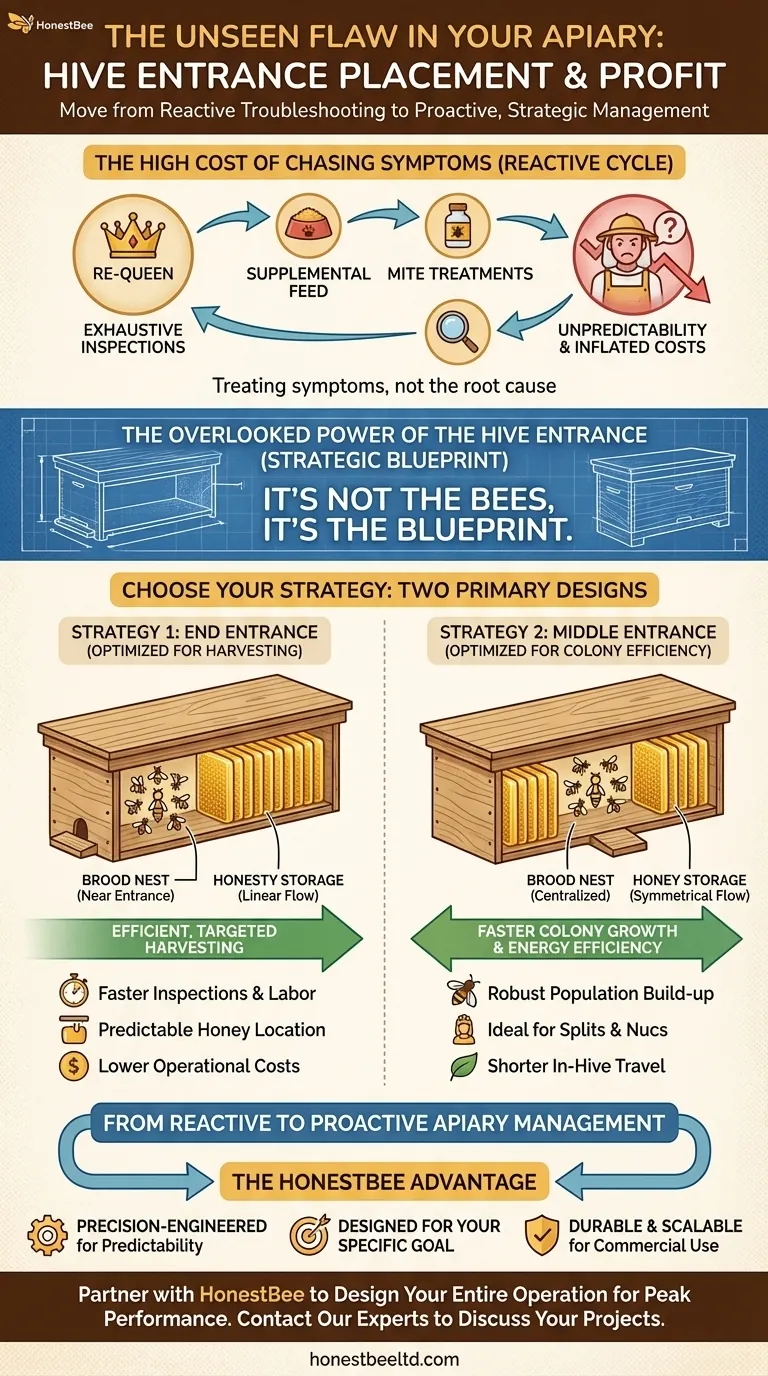
When a hive underperforms, the standard playbook kicks in. We might:
- Re-queen the colony, hoping for better genetics.
- Provide supplemental feeding to boost the population.
- Apply different mite treatments, suspecting a hidden pest problem.
- Spend hours on exhaustive inspections, searching for a sign of disease that isn't there.
Each of these actions costs time and money. But more importantly, they often fail to fix the underlying issue. The true cost isn't just the price of a new queen or a bag of sugar; it's the unpredictability that cripples your business. Inconsistent yields make it impossible to accurately forecast production for your distributors and customers. Wasted labor on problem hives inflates your operational costs, eating directly into your margins. You're stuck in a reactive cycle, constantly troubleshooting instead of strategically growing.
But what if the root of the problem isn't biological, but architectural? What if the issue lies not with the bees, but with the box we put them in?
It's Not the Bees, It's the Blueprint: The Overlooked Power of the Hive Entrance
The most critical—and most frequently overlooked—design decision in a top-bar hive is not the size of the entrance, but its placement. The location of the entrance acts as the colony's "front door" and dictates the entire internal logistics of the hive. It forces the bees into a specific, predictable pattern of organization.
There are two primary schools of thought, each creating a completely different internal environment.
Strategy 1: The End Entrance (Optimized for Harvesting)
When the entrance is placed at one of the narrow ends of the hive, the colony's layout becomes highly linear.
- Organization: The queen establishes the brood nest right near the entrance. As the colony gathers nectar, they store honey in a consolidated block, building combs progressively further and further away, toward the back of the hive.
- Business Impact: This design makes honey harvesting incredibly straightforward and efficient. You know exactly where to go to find honey-filled combs, minimizing inspection time and disruption to the brood nest. Your labor is faster and more targeted.
Strategy 2: The Middle Entrance (Optimized for Colony Efficiency)
When the entrance is placed in the center of one of the long sides, the hive develops a symmetrical structure.
- Organization: The brood nest is established in the center, directly behind the entrance. Honey is then stored on both sides of the brood, expanding outwards towards each end of the hive.
- Business Impact: This layout is arguably more efficient for the bees. The average travel distance from the entrance to any given comb is shorter, potentially reducing the energy bees expend on in-hive travel. This can lead to a more robust and rapidly growing colony. The trade-off is that your honey stores are split, which can make harvesting slightly more complex.
The "failed solutions" from before—like re-queening a sluggish hive—now make sense. You were trying to solve a logistical problem (inefficient hive layout) with a personnel change (a new queen). You were treating a symptom, not the cause. The cause is a fundamental mismatch between the hive's design and your operational goals.
The Right Tool for a Strategic Apiary
To escape the cycle of troubleshooting, you don't need a "better" bee; you need a smarter hive—one that is intentionally designed to achieve a specific business outcome. A hive is not just a box; it is a tool for managing colony behavior and maximizing your return on investment.
This is where the quality of your equipment becomes paramount. Choosing between an end or middle entrance isn't a decision to be made with a power drill on a generic box. It requires equipment built with precision and strategic intent.
At HONESTBEE, we understand that commercial success is built on control and predictability. Our top-bar hives and wholesale equipment are engineered to serve as the foundation of your strategy.
- Precision-Engineered for Predictability: Our hives feature precisely located and cleanly drilled entrances, ensuring the colony organizes itself exactly as planned, year after year.
- Designed for Your Goal: Whether your priority is maximizing honey yield with an end-entrance design or fostering rapid colony growth with a middle-entrance model, we provide the equipment that turns your strategy into a reality.
- Durable and Scalable: Built for the demands of commercial use, our supplies ensure that the strategic choices you make today will deliver consistent results for seasons to come.
By choosing equipment designed with the problem in mind, you are no longer at the mercy of hive-to-hive variability. You are taking control.
From Reactive Beekeeping to Proactive Apiary Management
Once you recognize the power of entrance placement, a new world of strategic management opens up. The "unpredictable" nature of your apiary disappears, replaced by a system you can direct with purpose.
Imagine designating rows of hives with end entrances specifically for high-yield, low-labor honey production to fulfill your largest contracts. At the same time, you can use middle-entrance hives to serve as efficient "nursery colonies" for raising nucleus colonies and queens for expansion or sale.
You shift from being a reactive problem-solver to a proactive portfolio manager. Your apiary becomes a collection of assets, each optimized for a specific role, all working together to build a more profitable and scalable business. This level of control allows you to forecast with confidence, allocate labor effectively, and finally break free from the costly cycle of chasing symptoms.
Your success as a commercial beekeeper depends on having the right strategy and the right tools to execute it. If you're ready to move beyond treating individual problems and start designing your entire operation for peak performance, our team is here to help. We can help you select the equipment that aligns perfectly with your business goals, from honey production to colony expansion. To discuss your unique projects and discover how our wholesale operations can be the bedrock of your success, Contact Our Experts.
Visual Guide
Related Products
- Multi-Functional Sliding Hive Entrance for Beekeeping
- Multi-Functional Rotary Hive Entrance Disc for Beekeeping
- Professional Reversible Beehive Hive Entrance
- Beehive Entrance Reducer Guardian Metal Hive Entrance for Bees
- Steel Round Disc Entrance Reducer for Flexzion Bee Hive Nuc Box Gate
Related Articles
- How Hive Entrance Size Shapes Bee Health: Balancing Ventilation and Security
- The Choke Point and the Superhighway: A Systems Approach to Hive Entrance Management
- Calibrating the Gateway: The Critical Engineering of the Hive Entrance
- The Hive Entrance: A Masterclass in Engineering and Risk Management
- A Single Point of Failure: The Critical Importance of a Clear Hive Entrance in Winter