The All-in-One Fallacy
An apiary business is thriving. Honey sales are strong. The next logical step is to expand the product line—perhaps a thick, artisanal apple butter or a signature mustard sauce using the house honey.
The question that inevitably follows is a practical one: "Can my honey filling machine handle this new product?"
This question reveals a common psychological trap in business operations: the desire for a single, universal solution. We instinctively seek a tool that can do everything. But in the world of precision engineering, versatility often comes at the cost of performance. The truth is, your honey filler is incredibly versatile, but only if you understand the single physical principle that governs its design.
The Unseen Force: Viscosity
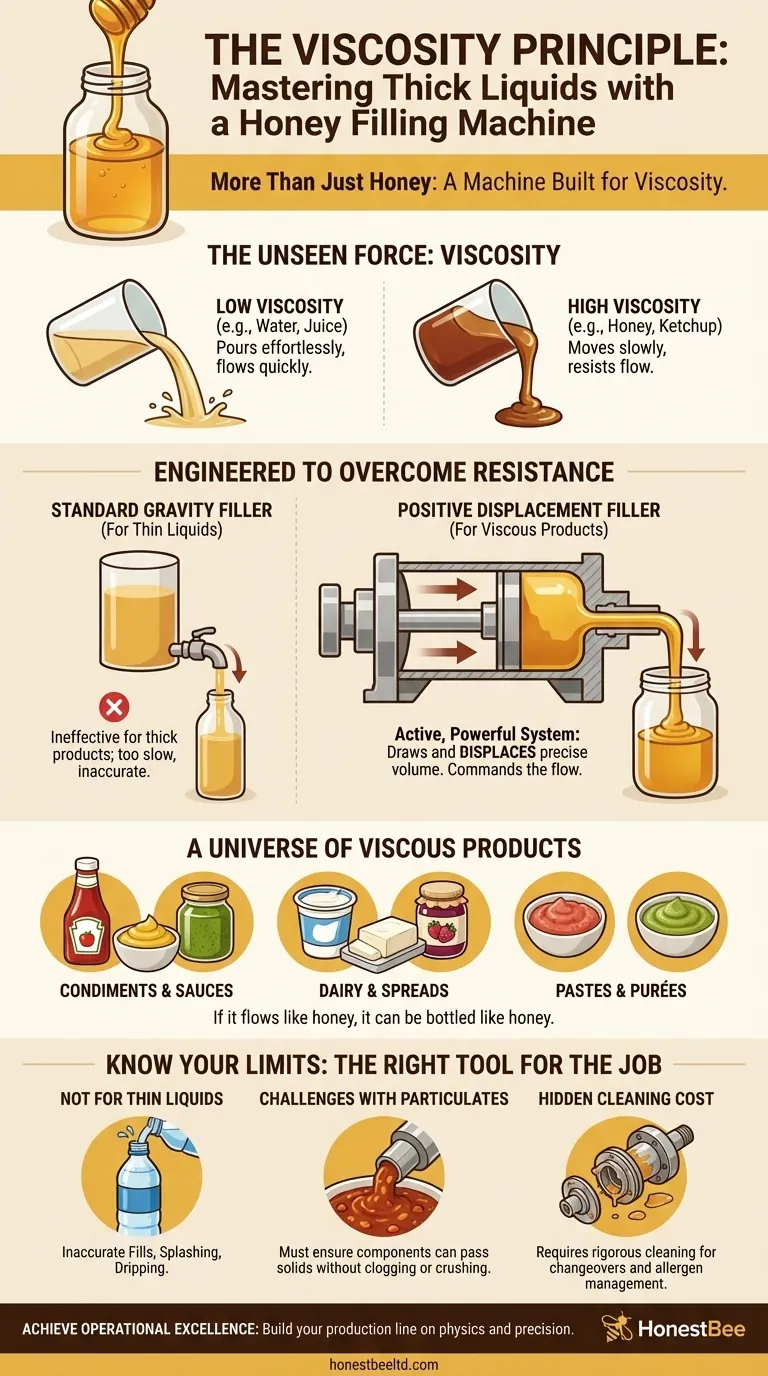
The defining characteristic of a honey filling machine is not that it's made for honey. It's that it's made to overcome viscosity.
Viscosity is simply a fluid's resistance to flow. Water, with its low viscosity, pours effortlessly. Honey, with its high viscosity, moves slowly, clinging to surfaces. This difference is everything.
Why Gravity Isn't Enough
Most standard liquid fillers rely on gravity. They open a valve and let the low-viscosity product flow into the bottle. This method is simple, fast, and efficient—for things that flow easily.
But for honey, gravity is useless. It would take ages to fill a single jar, and achieving a precise volume would be nearly impossible. A honey filler can't be passive; it must be an active, powerful system.
The Engineer's Solution: Positive Displacement
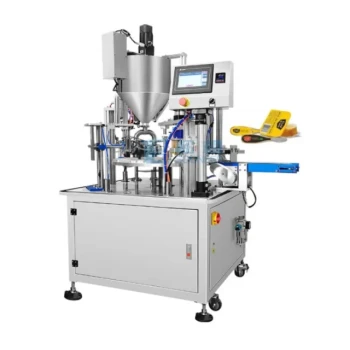
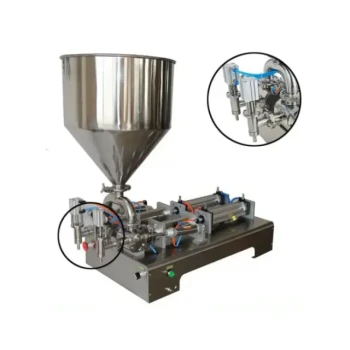
To master viscosity, engineers use powerful mechanisms like piston fillers or positive displacement pumps.
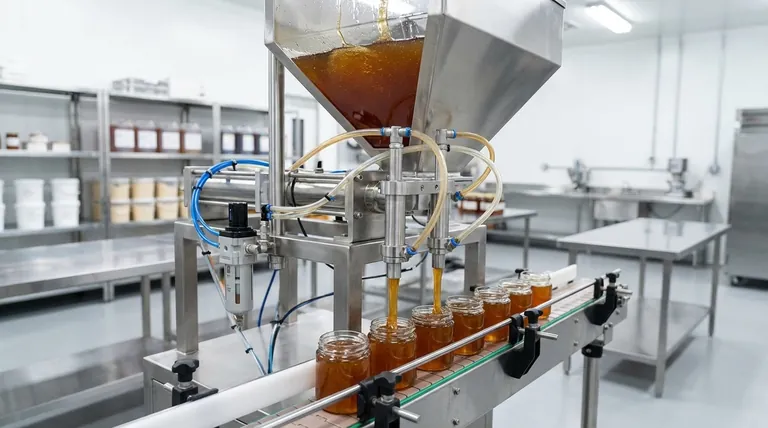
Instead of waiting for the product to flow, these systems draw a precise volume of thick liquid into a cylinder or chamber and then forcefully displace it into the container. It's a brute-force solution of beautiful simplicity. The machine doesn't ask the liquid to move; it commands it.
This elegant solution to a specific physics problem is what gives the machine its hidden power.
A Universe of Viscous Products
A machine built to command the flow of thick honey is, by its very nature, capable of commanding the flow of other thick substances. The pump doesn't know the difference between honey and ketchup; it only understands resistance to flow.
This opens up a world of possibilities for products that share honey's physical properties:
- Condiments & Sauces: Ketchup, mustard, pesto, and thick dressings are perfect candidates. Their high viscosity is easily managed by the powerful pump.
- Dairy & Spreads: Products like yogurt, cream cheese, and fruit preserves have similar handling requirements.
- Pastes & Purées: Thick fruit mush, vegetable purées, and other paste-like substances are handled with the same precision as honey.
The common thread is not flavor or category, but physics. If it flows like honey, it can be bottled like honey.
Know Your Machine's Limits
Respecting a tool means understanding not just what it can do, but what it shouldn't do. The specialization that makes a honey filler powerful also creates its limitations.
The Problem with Low-Viscosity Liquids
Attempting to bottle water, juice, or light syrups with a honey filler is like using a sledgehammer to tap in a nail. The powerful pump, designed to overcome resistance, lacks finesse when there is none.
This mismatch leads to predictable problems:
- Inaccurate Fills: The system overshoots the target volume.
- Splashing: The product is forced out too aggressively.
- Dripping: Thin liquids leak past seals designed to hold back a thick substance.
The Challenge of Particulates
The machine is engineered for a homogenous, viscous fluid. If your product contains solids—like a chunky pasta sauce or fruit preserves—you introduce a new variable. The pump mechanism and nozzle opening must be large enough to pass the particulates without clogging the system or, worse, crushing your premium ingredients.
The Hidden Cost of Changeover
Switching from honey to pesto isn't just a matter of flushing the lines. The same components that provide power also create more surface area where thick products can stick. Rigorous cleaning is essential to prevent flavor contamination and manage potential allergens. This operational downtime is a real, and often underestimated, cost.
The Right Tool for the Right Job
The most efficient production line isn't built on all-in-one machines, but on the intelligent application of specialized tools. The key is to match the equipment's core competency to the product's physical properties.
- If your business focuses on high-viscosity products, a robust filler designed for honey is a powerful, versatile asset. HONESTBEE supplies wholesale equipment, including piston and positive displacement fillers, engineered for the reliability and precision that commercial operations demand.
- If you bottle both thick and thin liquids, you will achieve far better results with two specialized machines than with one compromised system.
- If your products contain large solids, you must confirm that the filler's specifications are explicitly designed to handle them.
True operational excellence comes from understanding the physics behind your process. Whether you are bottling honey, sauces, or creams, precision starts with the right equipment. To ensure your production line is built on a foundation of reliability and accuracy, Contact Our Experts.
Visual Guide
Related Products
- Precision Durable Efficient HONESTBEE Rotary Honey Filling Machine
- Semi Automatic Small Honey Bottle Filling Machine Honey Filler
- Economy Small Honey Filling Machine Honey Bottle Filler Packaging Machine
- Commercial Rotary Honey Filling Machine for Production
- Fully Automatic Honey Filling Packaging Machine for Processing Line
Related Articles
- How to Choose Between Semi-Automatic and Fully Automatic Honey Filling Machines
- The Bottleneck in a Bottle: Why Manual Honey Filling Limits Your Apiary's Growth
- The Sticky Truth: Why Your Honey Filling Fails and How to Fix It for Good
- The Mechanics of Trust: Why Your Honey Filling Process is Your Brand's First Handshake
- The Flow, The Fill, and The Future: A Honey Bottler's Guide to Scale