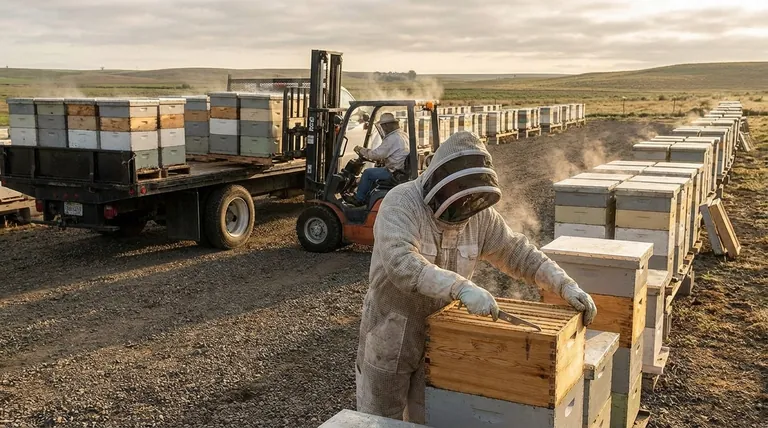
The Silent Moment Before the Move
Picture an apiary at dawn. Rows of hives sit silent, but inside, tens of thousands of lives are humming. For the beekeeper, this is a moment of calm before a storm of logistics. Today, these hives must move.
This task—transporting a living superorganism—is one of the most physically demanding and biologically sensitive challenges in beekeeping. It’s not about moving boxes; it’s about managing immense weight, mitigating colony stress, and trusting your equipment with the health of your entire operation.
A Deceptively Simple Box
At first glance, a beehive is just a stack of wooden boxes. But this simplicity hides a complex set of engineering and biological challenges that standard moving tools are utterly unprepared to handle.
The Gravity of the Situation
A single deep hive box, brimming with honey, brood, and bees, can easily top 90 pounds (40 kg). A full production hive can weigh several hundred. This isn't just heavy; it's a dense, awkward, and unstable load.
The human body is not designed for this. Every manual lift is a gamble with spinal health. The core problem isn't just strength, but the physics of leverage and stability. This is where the risk of injury quietly compounds with every hive you manage.
A Colony Under Duress
For the bees, a move is a seismic event. The vibration, the tilting, the sudden acceleration—it's a traumatic disruption. Without proper support and ventilation, two critical failures can occur:
- Structural Collapse: Frames can shift, crushing bees and destroying delicate brood comb. The modular boxes themselves can slide apart, breaking the integrity of the colony's home.
- Overheating: An agitated, confined colony generates an enormous amount of heat. Without adequate airflow, a hive can perish in a remarkably short time, essentially cooking itself from the inside out.
Effective transport equipment is designed to solve for these two points of failure. It’s a life support system, not just a dolly.
The Escalation of Scale
The right solution is dictated entirely by the scale of your ambition. The tools that work for two hives in a backyard become a liability for twenty, and an impossibility for two hundred.
The Hobbyist’s Dilemma: Muscle vs. Care
For the small-scale beekeeper, moving a hive is an infrequent event. Manual tools like two-person hive carriers or heavy-duty hand trucks suffice. The primary investment here is caution and physical effort. The risk is personal and acute.
The Sideliner's Crossroads: Investing in Longevity
As an operation grows to encompass several apiaries, the math changes. Moving dozens of hives manually is no longer a task; it's a grueling, repetitive strain. This is the inflection point where mechanization becomes a strategic investment.
Vehicle-mounted loaders or small boom cranes aren't luxuries; they are investments in personal longevity and operational efficiency. The psychological shift is from "I can lift this" to "I need a system to protect my body and my business."
The Commercial Imperative: From Labor to Logistics
For commercial pollinators, moving hives is the business. When you measure hives by the truckload, the problem transforms from manual labor into a high-stakes logistical operation. Speed, safety, and throughput are paramount.
This is the realm of specialized flatbed trucks, integrated hydraulic loaders, and palletized systems. Here, the equipment isn't just an aid; it is the core infrastructure that makes the business model possible. Every component must be engineered for reliability because a single point of failure can jeopardize thousands of dollars in assets and pollination contracts.
The Operator's Calculus: Speed, Safety, and Sanity
Choosing your transport system is a balancing act. It's a pragmatic calculation of cost, but it's also a psychological one about risk tolerance and peace of mind. You aren't just buying steel; you're buying confidence.
| Operational Scale | Primary Toolset | Core Consideration |
|---|---|---|
| Hobbyist (1-10 Hives) | Two-person carriers, hand trucks | Personal safety and careful planning |
| Sideliner (10-100 Hives) | Vehicle-mounted loaders, small forklifts | Preventing injury, creating efficiency |
| Commercial (100+ Hives) | Integrated loaders, specialized trucks, pallet systems | System reliability, speed, and asset protection |
Engineering for a Living System
Ultimately, hive transport equipment is the physical interface between a beekeeper’s intention and a colony's well-being. Good equipment respects both the physics of the load and the biology of the bees.
For commercial apiaries and distributors, where this calculation is made at an industrial scale, the equipment ceases to be a tool and becomes foundational infrastructure. Reliability isn't a feature; it's the entire point. At HONESTBEE, we supply the wholesale, commercial-grade equipment built for the demands of large-scale operations, ensuring your logistics are as robust as your colonies are healthy.
If you're ready to build a transport system that protects your bees, your people, and your bottom line, we can help you engineer the right solution. Contact Our Experts
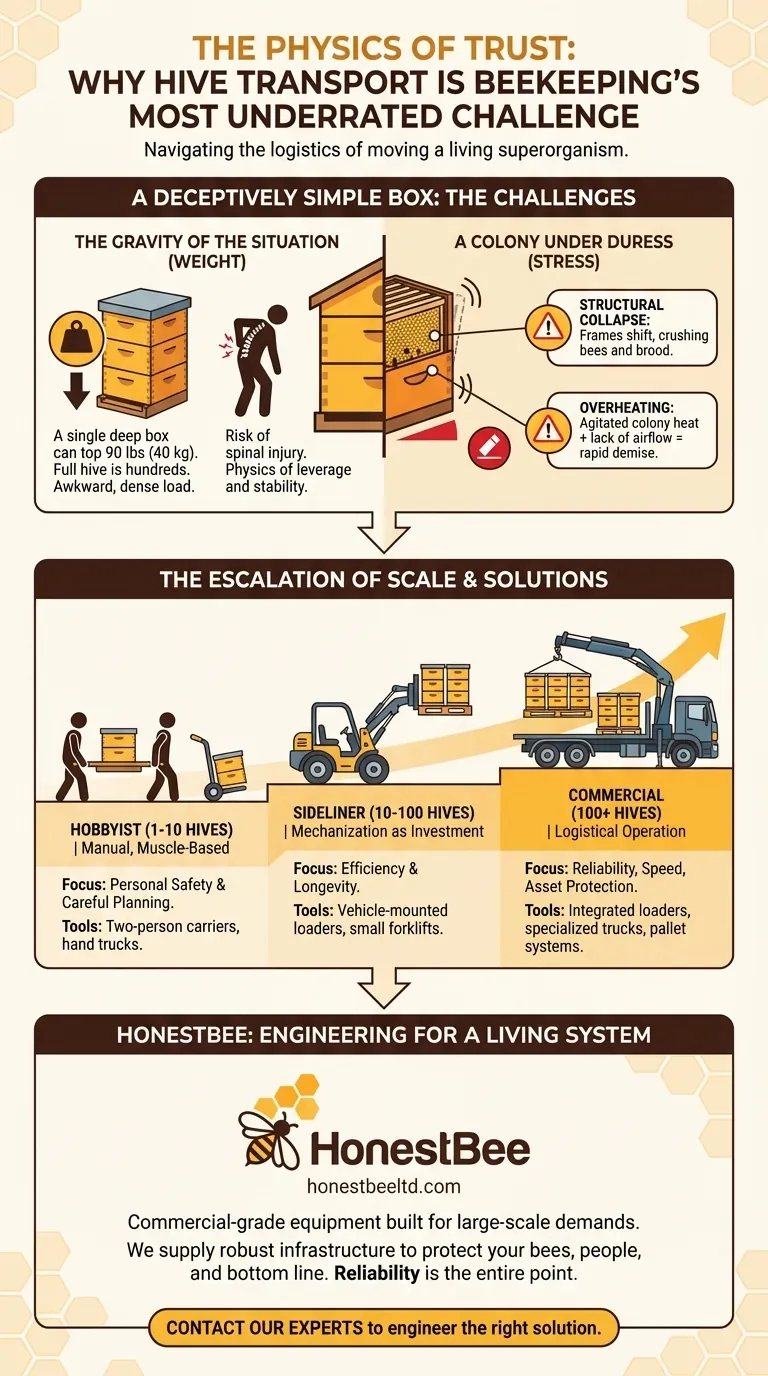
Visual Guide
Related Products
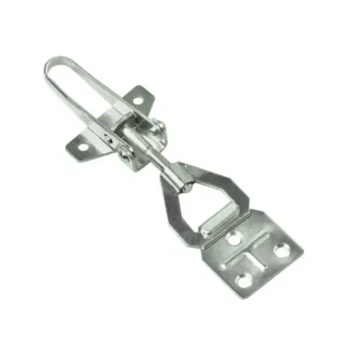
- Heavy Duty Adjustable Hive Connector
- Durable Plastic Interlocking Hive Connector for Beekeeping
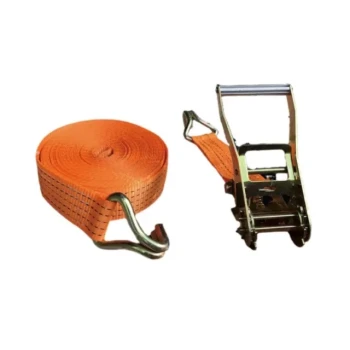
- Heavy Duty Ratchet Hive Strap
- Plastic Transporting Bee Packages and Nuc Boxes for Beekeeping
- Ergonomic Two Person Foldable Hive Lifter
Related Articles
- Gravity is Not Your Friend: The Simple Physics of Safe Beehive Transport
- The Physics of a Stacked Beehive: Why a Simple Connector is a Non-Negotiable Tool
- Stop Losing Bees in Transit: The Real Reason Your Hive Transport is Chaotic and How to Fix It for Good
- The Aerodynamics of Survival: Why Hive Transportation Is a Race Against Heat
- Beyond the Lift: Why Your Hive Transport Strategy is Limiting Your Apiary's Growth