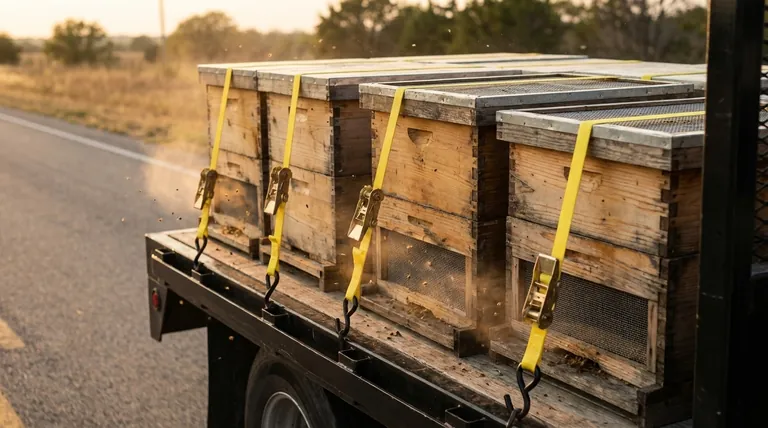
The Invisible Threat on the Road
Imagine a beekeeper preparing for a move. The hives are stacked, the straps are tight, and the truck is ready. Every visible risk has been managed. Yet, the greatest danger is one you cannot see, hear, or feel until it's too late: heat.
A sealed beehive on a moving truck is not a dormant box. It’s a pressure cooker of biological activity. The stress of confinement and vibration sends a colony’s metabolism into overdrive, generating a lethal amount of internal heat.
The common-sense solution seems to be to point the hive entrance forward, letting air rush in. This is one of the most dangerous and widespread misconceptions in beekeeping. The solution lies not in brute force, but in a simple, elegant principle of physics.
The Psychology of a Fatal Mistake
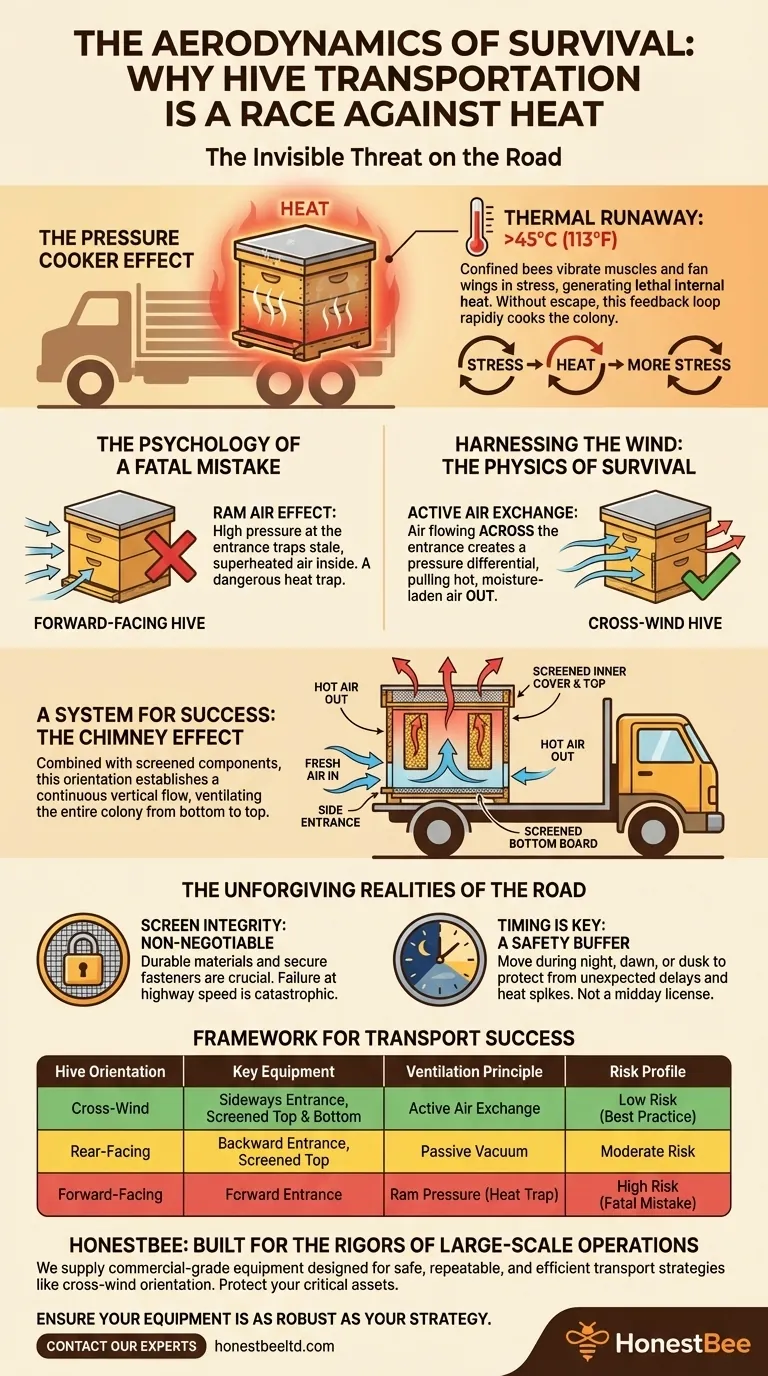
Our intuition often fails us when dealing with complex systems. We see an opening and think pushing air into it is the best way to ventilate. In the case of a beehive, this creates a high-pressure zone at the entrance.
This "ram air" effect can be too forceful for bees near the opening and, more critically, it can prevent hot, humid air from escaping elsewhere. The hive becomes a trap, with fresh air fighting to get in while stale, superheated air has nowhere to go. This is how a well-intentioned decision leads to disaster.
Inside the Thermal Runaway
To appreciate the solution, we must first respect the problem. The danger is a disastrous feedback loop rooted in bee biology.
- Stress Triggers Heat: Confined and jostled, bees become agitated. They vibrate their flight muscles and fan their wings, a collective survival response that rapidly generates heat.
- Heat Triggers More Stress: Without an escape, this heat builds. As the internal temperature climbs, the bees become more stressed, which in turn causes them to generate even more heat.
- The Point of No Return: This cycle, known as thermal runaway, can raise the hive's internal temperature above 45°C (113°F) with alarming speed. The colony literally cooks itself to death, a catastrophic loss caused by its own biology working against it in an artificial environment.
Harnessing the Wind: The Physics of Survival
The most effective solutions are often the simplest. Cross-wind transportation is the practice of orienting the hive entrance sideways, perpendicular to the direction of travel.
This alignment leverages a basic aerodynamic principle. As air flows swiftly across the entrance, it creates a pressure differential that actively pulls stale, hot, and moisture-laden air out of the hive. It creates a gentle, consistent, life-saving vacuum.
It's not a fan; it's a sophisticated ventilation system powered by the motion of the truck itself.
A System, Not a Single Action
Cross-wind orientation works best when it's part of a system. When combined with a screened bottom board and a screened inner cover, it establishes a clear "chimney effect."
Cooler, fresh air is drawn in through the side entrance, flows up through the colony, and the hot, exhausted air exits through the top screen. This ensures the entire hive, from the bottom box to the top, benefits from a continuous exchange of air.
The Unforgiving Realities of the Road
While elegant, this technique requires professional execution. The road is an unforgiving environment, and the weak points in any system are quickly exposed.
The Non-Negotiable: Screen Integrity
The entire system depends on the reliability of your screens. An entrance screen or top cover that fails at highway speeds is a public safety disaster and a total loss for the colony. The materials must be durable, and the fasteners must be secure. This is not the place for makeshift solutions.
A Buffer, Not a Blank Check
Cross-wind ventilation is a critical safety buffer, not a license to move bees in the midday sun. The best practice remains moving at night or during the cool hours of dawn and dusk. This technique protects your colonies from the unexpected—a traffic jam, a breakdown, or a sudden rise in humidity—that can turn a routine move deadly.
A Framework for Transport Success
Your transportation strategy should be a conscious choice based on risk management.
| Hive Orientation | Key Equipment | Ventilation Principle | Risk Profile |
|---|---|---|---|
| Cross-Wind | Sideways Entrance | Screened Top & Bottom | Active Air Exchange |
| Rear-Facing | Backward Entrance | Screened Top | Passive Vacuum |
| Forward-Facing | Forward Entrance | N/A | Ram Pressure (Heat Trap) |
Understanding the physics of hive ventilation is the first step. Executing it reliably, trip after trip, requires equipment designed for the task. As a commercial apiary or distributor, every colony is a critical asset. Protecting them in transit is not an expense; it is an investment.
At HONESTBEE, we supply commercial-grade beekeeping equipment built for the rigors of large-scale operations. Our screened bottom boards, secure travel screens, and durable hive components are designed to make best practices like cross-wind transportation safe, repeatable, and efficient.
Don't let a preventable problem compromise your bottom line. To ensure your equipment is as robust as your strategy, Contact Our Experts
Visual Guide
Related Products
- Plastic Transporting Bee Packages and Nuc Boxes for Beekeeping
- Heavy Duty Adjustable Hive Connector
- Durable Plastic Interlocking Hive Connector for Beekeeping
- Professional Grade Foldable Beehive Handles
- JZBZ Style Professional Battery Box with 20 Shipping Cages
Related Articles
- Why Your Bee Boxes Don't Match: The Secret to Flawless Apiary Scaling
- The 90-Pound Mistake: Why Your Heaviest Bee Boxes Are Costing Your Business More Than Just Back Pain
- The Architect's Dilemma: How a Nuc Box Solves a Honeybee Swarm's Housing Crisis
- The Nuc Box Is Not a Home, It's a Tool: A Strategic Guide to Apiary Fleet Management
- Designing for Instinct: Why the Nuc Box is the Perfect Swarm Trap