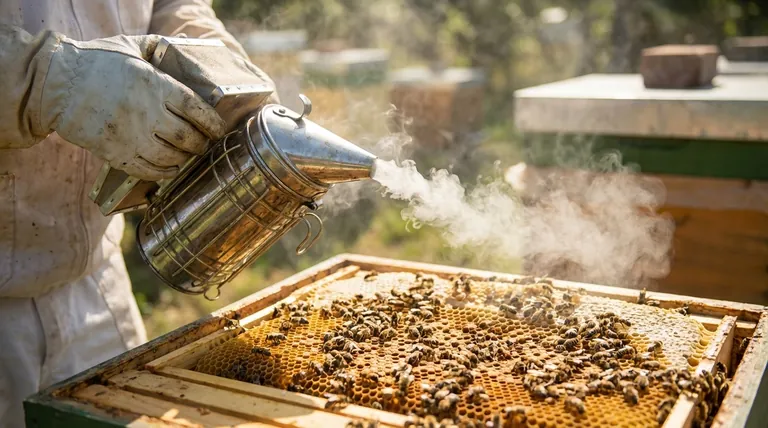
It’s an intuitive idea. You have an unwanted pest, you introduce something unpleasant like smoke, and the pest leaves. We see this logic applied everywhere.
But a honey bee colony is not a simple pest. It's a complex, deeply integrated superorganism.
Applying simple logic to a complex system often leads to failure. Attempting to "smoke bees out" of a hive or a wall is a perfect example of this flawed intuition. A bee smoker is an essential tool, but it is a tool of influence, not of force.
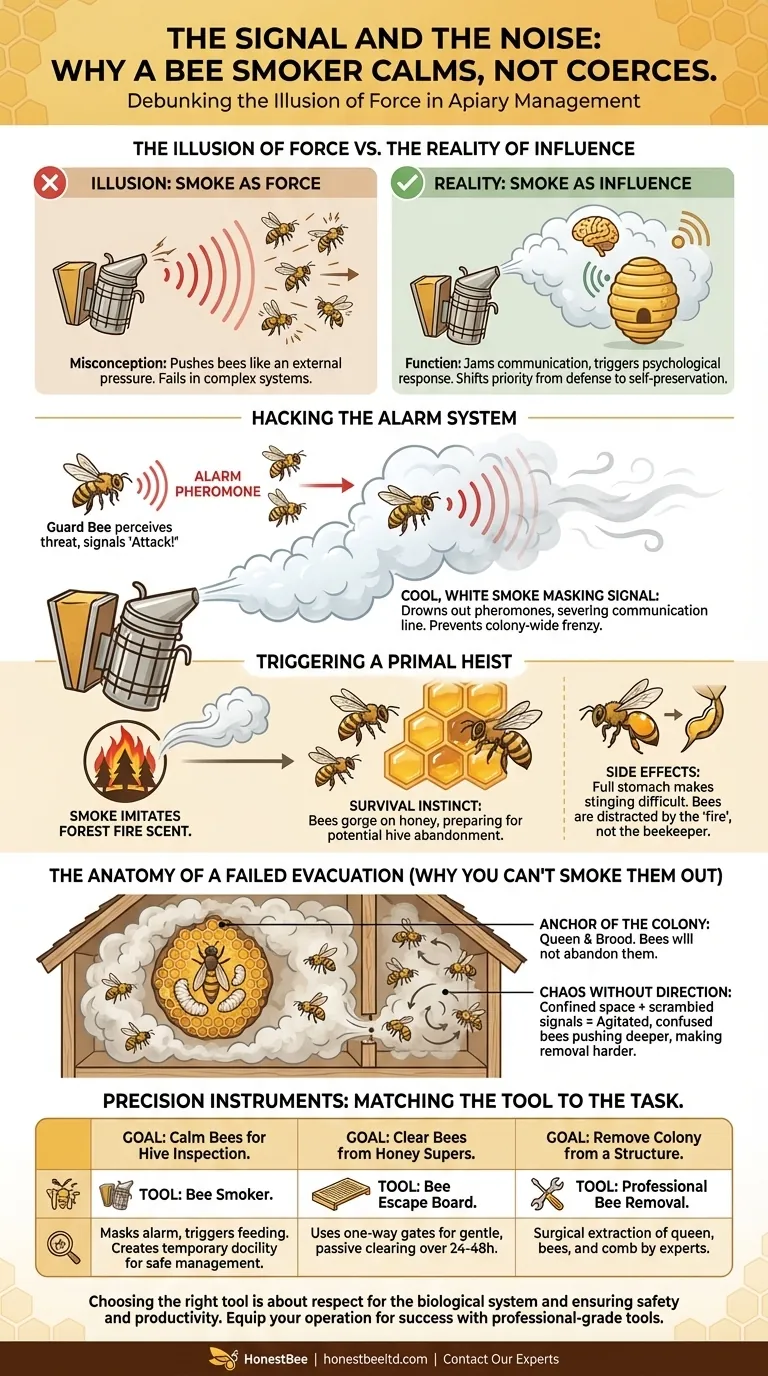
The Illusion of Force
The common misconception is that a smoker works like a cattle prod—an external pressure that pushes the animals in a desired direction. This is fundamentally wrong.
The smoker’s true function is far more elegant. It doesn’t interact with the bees physically; it interacts with their perception of reality. It’s a communication jammer and a psychological trigger, designed to shift the colony's collective priority from defense to self-preservation.
Hacking the Alarm System
To understand how the smoker works, you have to understand how a colony defends itself. It’s not chaos; it’s a coordinated response based on chemical signals.
Silencing the Sentinels
When a guard bee perceives a threat, it releases an alarm pheromone—a chemical signal that effectively screams "Attack!" to its sisters. This signal rapidly puts the entire colony on high alert.
Cool, white smoke from a smoker acts as noise that drowns out this signal. It masks the pheromones, severing the communication line. A localized disturbance can no longer escalate into a colony-wide defensive frenzy. The alarm has been muted.
Triggering a Primal Heist
The smoke also introduces a second, more powerful signal: the smell of a forest fire. This triggers a deeply ingrained survival instinct.
To a bee, a fire means their home might be destroyed and they may have to abandon it. Their immediate response is to prepare for this possibility. They fly to their honey stores and begin gorging themselves, loading up on fuel for the potential journey to build a new home.
This act of feeding has a wonderful side effect for the beekeeper. A bee with a full stomach of honey is physically less able to curl its abdomen to sting. It’s also distracted. The beekeeper is no longer the primary threat; the imaginary fire is.
The Anatomy of a Failed Evacuation
So why can’t this powerful tool force bees out of a structure? Because its effects are internal, not directional.
The Anchor of the Colony
A colony’s central purpose is the protection of its queen and its brood (the developing bees) . They will not abandon their young or their leader at the mere suggestion of danger. They are anchored by millions of years of evolutionary programming. The smoke makes them docile inside the hive, not willing to flee it.
Chaos Without Direction
In a confined space like the wall of a house, excessive smoke can backfire spectacularly. With no clear exit path and their communication systems scrambled, the bees become agitated and confused.
Instead of leaving, they are more likely to push deeper into the structure, making a future removal exponentially more difficult and dangerous.
Precision Instruments: Matching the Tool to the Task
Effective beekeeping, especially at a commercial scale, is about precision. It’s about understanding the system and applying the correct tool to achieve a specific outcome without fighting against the bees' nature.
-
For Calm Inspections: The Bee Smoker is the correct instrument. Its purpose is to create a temporary window of docility, allowing for safe management and inspection.
-
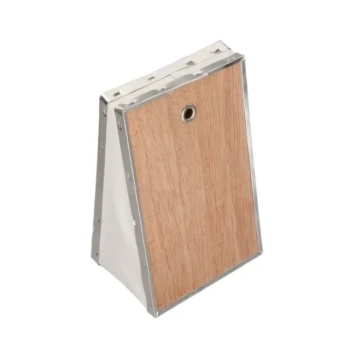
For Clean Honey Harvests: The Bee Escape Board is the tool of choice. This clever device uses one-way gates placed between the honey supers and the brood chamber. It gently clears bees from the honey boxes over 24-48 hours by leveraging their natural movement, causing zero stress.
-
For Structural Removals: This requires a Professional Removal Service. It’s a surgical operation to remove the queen, bees, and all honeycomb, ensuring the colony can be relocated safely and preventing future infestations.
| Goal | Correct Tool/Method | Rationale |
|---|---|---|
| Calm Bees for Hive Inspection | Bee Smoker | Masks alarm signals and triggers feeding, making bees docile and manageable. |
| Clear Bees from Honey Supers | Bee Escape Board | Uses one-way gates to passively and gently guide bees out of honey boxes. |
| Remove Colony from a Structure | Professional Bee Removal | A complex task requiring experts to physically extract the entire colony and comb. |
Choosing the right tool isn't just about efficiency; it's about a fundamental respect for the biological system you're working with. For commercial apiaries, where safety and productivity are paramount, using professional-grade equipment designed for the specific task at hand is non-negotiable. At HONESTBEE, we supply the high-quality, reliable tools that successful beekeeping operations are built on.
Don't let a simple misunderstanding compromise your work. Equip your operation for success. Contact Our Experts
Visual Guide
Related Products
- Stainless Steel Honey Bee Smoker Hive and Honeycomb Smoker for Beekeeping
- Professional Bee Smoker with Elongated Spout and Durable Bellows for Beekeeping
- Premium Traditional Copper Bee Smoker with Bellows
- Heavy Duty Manual Bee Smoker Blower for Beekeeping
- European Stainless Steel Bee Smoker for Honey Bee Hive
Related Articles
- The End of 'Hot Hives': Why Your Bee Smoker Is More Important Than Your Suit
- Why Your Bee Smoker Might Be Making Your Hives More Aggressive—And How to Fix It
- Why Your Bee Smoker Keeps Going Out—And the 3-Layer Fix
- How to Operate a Bee Smoker Safely: Expert Techniques for Calmer Hives
- How to Choose the Right Bee Smoker Size for Your Beekeeping Operation