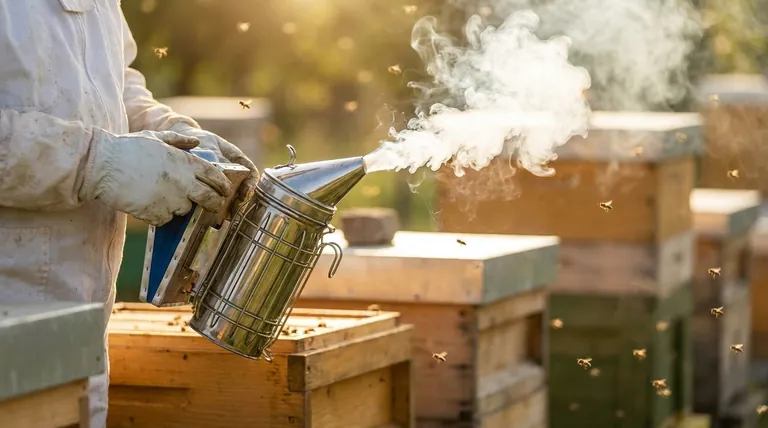
You’re halfway through a hive inspection on a hot afternoon. The colony is getting agitated, the buzzing rising in pitch. You reach for your smoker to calm them down, give the bellows a confident squeeze, and… nothing. Just a pathetic, wispy puff of gray smoke before it dies completely.
Suddenly, a calm inspection has become a race against the clock. You either have to rush your work—and risk missing a critical sign of disease—or retreat and spend another ten minutes trying to relight the stubborn smoker.
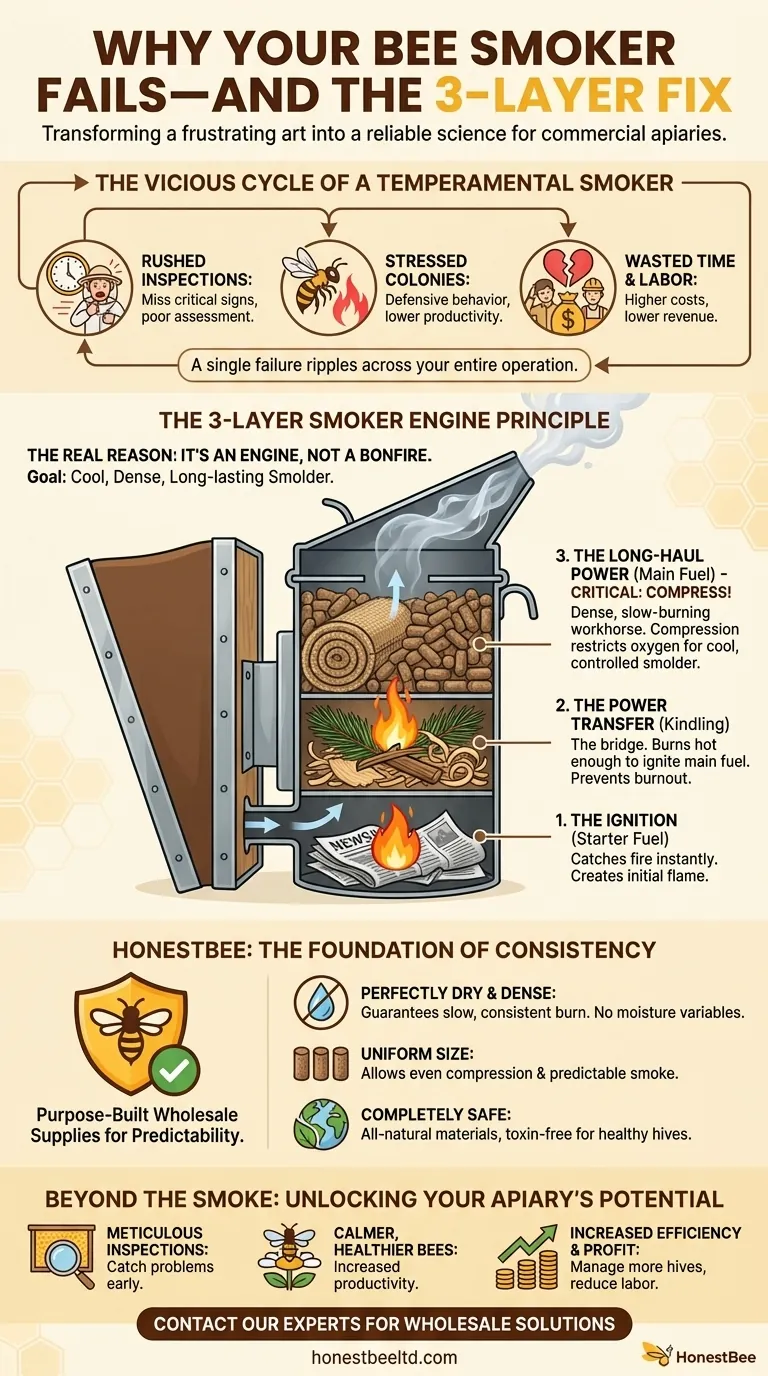
The Vicious Cycle of a Temperamental Smoker
If this scenario feels familiar, you are not alone. For commercial beekeepers, an unreliable smoker isn't just an annoyance; it's a direct threat to efficiency and safety. This single point of failure ripples across your entire operation:
- Rushed Inspections: You can't properly assess colony health, check for Varroa mites, or confirm the queen is laying if you're constantly fighting your equipment and agitated bees.
- Stressed Colonies: Bees subjected to hot, flaming smoke or inconsistent puffs become more defensive and less productive. A stressed hive is a less profitable hive.
- Wasted Time and Labor: Every minute spent relighting a smoker is a minute you're not managing your apiary. Across dozens or hundreds of hives, this lost time translates directly into higher labor costs and lower revenue.
Many beekeepers find themselves trapped in a loop of failed fixes: frantically pumping the bellows (which often creates a hot flame that angers the bees), stuffing more fuel in (which smothers the fire), or constantly relighting, hoping for a different outcome. But these are just symptoms. The real problem lies deeper.
The Real Reason Your Smoker Fails: It’s Not a Fire, It’s an Engine
The core misunderstanding is this: The goal of a smoker is not to create a fire; it is to engineer a specific type of combustion. You don't want a hot, roaring flame. You want a cool, dense, long-lasting smolder.
Think of it like building a small engine that runs for hours, not a bonfire that burns out in minutes. This engine requires a precise, three-part structure to function correctly.
1. The Ignition (Starter Fuel)
You need something that catches fire instantly, like crumpled newspaper. Its only job is to create a small, hot flame to get the process started.
2. The Power Transfer (Kindling)
Next, you need a "bridge" fuel, like pine needles or wood shavings. This layer catches fire from the starter and burns hot enough to ignite the main, slow-burning fuel. Without this crucial bridge, the initial flame dies before it can transfer its energy. This is why smokers often go out after a few minutes.
3. The Long-Haul Power (Main Fuel)
Finally, you add the dense, slow-burning fuel like smoker pellets or untreated burlap. This is the workhorse. Critically, you must compress this layer. Compression restricts oxygen, preventing it from bursting into flames and forcing it into the cool, controlled smolder you need. This is why smokers often shoot hot flames—too much oxygen is reaching the main fuel.
The "common fixes" fail because they disrupt this engine. Frantically pumping the bellows provides too much oxygen, turning your smolder into a blowtorch. Stuffing more fuel on a weak fire smothers the initial ignition before it can transfer power.
From Frustration to Control: The Right Fuel, The Right Tool
Understanding this three-layer principle is the key to mastering your smoker. And executing it consistently, hive after hive, day after day, depends on having professional-grade tools and materials.
This is where the right equipment transforms a frustrating art into a reliable science. A professional-grade smoker isn't just a can with a spout; it's designed with bellows that provide consistent, controllable airflow. More importantly, using high-quality, purpose-made fuel is a non-negotiable for commercial operations.
This is why HONESTBEE focuses on providing wholesale supplies that ensure predictability. Our smoker fuel pellets are specifically engineered to be the ideal "main fuel." They are:
- Perfectly Dry and Dense: Guaranteeing a slow, consistent burn without the moisture variable that causes so many smokers to fail.
- Uniform in Size: Allowing for even compression and predictable, cool smoke production every single time.
- Completely Safe: Made from all-natural materials, ensuring you never introduce harmful toxins to your hives.
By pairing a reliable smoker with purpose-built fuel, you eliminate the guesswork. You are no longer just lighting a fire; you are assembling a high-performance smoldering engine that you can count on for hours.
Beyond the Smoke: What a Reliable Apiary Unlocks
When your smoker works perfectly every time, something fundamental shifts. You move from fighting your tools to focusing entirely on your bees.
This reliability unlocks a new level of professional management. You can perform longer, more meticulous inspections, catching problems early before they devastate a colony. You can manage more hives per day, increasing the efficiency of your operation. Your bees are calmer, healthier, and ultimately, more productive. Training new staff becomes simpler and safer when their equipment is dependable.
In short, a predictable smoker is the foundation for a more predictable—and more profitable—beekeeping business.
Mastering your smoker is a critical first step. At HONESTBEE, we partner with commercial apiaries and equipment distributors to build more efficient, productive, and profitable operations from the ground up. If you're ready to move past equipment frustrations and focus on scaling your business, we're here to help. Contact Our Experts to discuss how our wholesale supplies can bring new levels of consistency and success to your apiary.
Visual Guide
Related Products
- Professional Bee Smoker with Elongated Spout and Durable Bellows for Beekeeping
- Stainless Steel Honey Bee Smoker Hive and Honeycomb Smoker for Beekeeping
- European Stainless Steel Bee Smoker for Honey Bee Hive
- Premium Traditional Copper Bee Smoker with Bellows
- Heavy-Duty Bee Smoker with Durable Plastic Bellows for Beekeeping
Related Articles
- The End of 'Hot Hives': Why Your Bee Smoker Is More Important Than Your Suit
- Why Your Bee Smoker Might Be Making Your Hives More Aggressive—And How to Fix It
- How to Operate a Bee Smoker Safely: Expert Techniques for Calmer Hives
- How to Choose the Right Bee Smoker Size for Your Beekeeping Operation
- How to Choose the Right Beekeeping Smoker for Optimal Performance