The Control System You're Overlooking
In complex systems, we often fixate on the most dramatic variables—queen health, mite counts, nectar flows. It’s a natural human bias to look for complex solutions to complex problems.
Yet, often the most powerful point of leverage is the simplest. For a beehive, this is the entrance.
We tend to see it as a mere door. This is a mistake. The hive entrance is a dynamic control system: a fortress gate, a climate thermostat, and a traffic interchange all in one. Treating it as a static feature is one of the most common and costly errors in beekeeping.
The Psychology of Defense: The Robbing Cascade
Imagine a calm, late-summer afternoon. The goldenrod has faded, and the air is still. For a strong, foraging colony, this quiet is a signal. Nectar is scarce. Their focus shifts from gathering to scouting for any available resource.
This is the moment a weak or poorly managed hive becomes a target. An overly large entrance, left over from the summer nectar flow, is an open invitation. It broadcasts vulnerability.
A few scout bees investigate. They slip past the overwhelmed guards, find the honey stores, and return to their hive with the news. What follows is not a polite visit; it is a violent, cascading frenzy. The robbing bees pour into the weak hive, killing the queen, tearing apart comb, and stealing every last drop of honey. The target colony is destroyed in hours.
This entire behavioral cascade pivots on a single, physical vulnerability: an entrance too large for the colony's population to defend. Reducing it creates a defensible chokepoint, a place where a few determined guards can hold the line. It's a simple adjustment that changes the entire psychological and physical dynamic of the apiary during a dearth.
The Physics of Climate: Managing Invisible Forces
A colony of bees is a master of thermodynamics. The brood nest must be kept at a stable 95°F (35°C), regardless of the weather outside. This requires an immense amount of energy.
The entrance is the primary tool for this climate control.
-
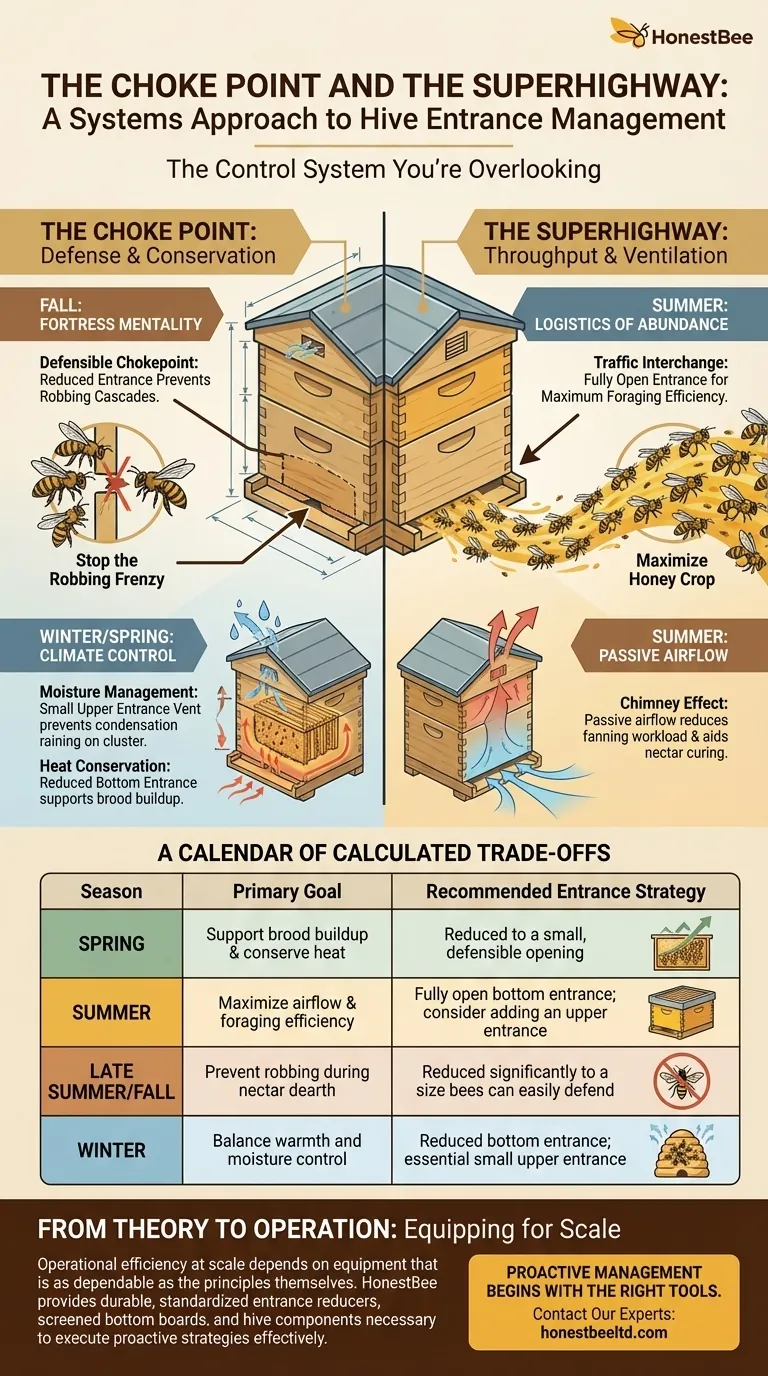
In summer, a wide-open bottom entrance is an air intake. Many beekeepers add a small upper entrance, which acts as an exhaust vent. This creates a "chimney effect," passively pulling hot, humid air out of the hive, reducing the bees' fanning workload and helping them efficiently cure nectar into honey.
-
In winter, the enemy is not just cold, but moisture. A cluster of bees generates significant water vapor through respiration. In a sealed hive, this warm, moist air rises, hits the cold inner cover, and condenses—raining cold water back down on the bees. This is often lethal. A small upper entrance provides a critical escape route for this moisture, a simple failsafe against an invisible threat.
Thinking of entrances in terms of airflow and thermodynamics allows a beekeeper to act as a proactive systems engineer for the colony's environment.
A Calendar of Calculated Trade-offs
There is no single "correct" entrance size. The optimal configuration is a constant negotiation between competing needs. Your strategy must adapt.
Spring: The Economics of Scarcity
A young colony is focused entirely on growth. Every calorie is precious. A small, reduced entrance helps them conserve heat, dedicating more energy to raising brood and less to simply staying warm.
Summer: The Logistics of Abundance
During a heavy nectar flow, the problem shifts from conservation to throughput. Thousands of foragers create a traffic jam at a small opening. A fully open entrance becomes a superhighway, maximizing foraging efficiency and, ultimately, the honey crop.
Fall: A Return to Fortress Mentality
As nectar sources dry up, the environment becomes hostile. Robbing pressure from other bees and wasps skyrockets. The strategy must revert to defense. The entrance is reduced to a size the colony can easily guard.
Winter: The Delicate Balance of Survival
The goal is stasis and moisture management. A reduced bottom entrance allows for cleansing flights on warm days, while a small upper entrance provides the essential ventilation to prevent condensation.
| Season | Primary Goal | Recommended Entrance Strategy |
|---|---|---|
| Spring | Support brood buildup & conserve heat | Reduced to a small, defensible opening |
| Summer | Maximize airflow & foraging efficiency | Fully open bottom entrance; consider adding an upper entrance |
| Late Summer/Fall | Prevent robbing during nectar dearth | Reduced significantly to a size bees can easily defend |
| Winter | Balance warmth and moisture control | Reduced bottom entrance; essential small upper entrance |
From Theory to Operation: Equipping for Scale
For a hobbyist, managing a few hives this way is straightforward. For commercial apiaries and equipment distributors, implementing these strategies across hundreds or thousands of colonies requires absolute consistency and reliability.
You cannot afford to have entrance reducers that warp, crack, or fit improperly. You need hive components that create a predictable, manageable system, year after year. Operational efficiency at scale depends on equipment that is as dependable as the principles themselves.
HONESTBEE is a wholesale supplier dedicated to this principle. We provide commercial apiaries and distributors with the durable, standardized entrance reducers, screened bottom boards, and hive components necessary to execute these proactive management strategies effectively. Our focus is on providing the robust infrastructure that allows you to manage your colonies as the complex, dynamic systems they are.
Proactive management begins with understanding the system and using the right tools. To ensure your operation is equipped for success in every season, Contact Our Experts.
Visual Guide
Related Products
- Multi-Functional Sliding Hive Entrance for Beekeeping
- Multi-Functional Rotary Hive Entrance Disc for Beekeeping
- Professional Reversible Beehive Hive Entrance
- Beehive Entrance Reducer Guardian Metal Hive Entrance for Bees
- Steel Round Disc Entrance Reducer for Flexzion Bee Hive Nuc Box Gate
Related Articles
- How Hive Entrance Size Shapes Bee Health: Balancing Ventilation and Security
- The Unseen Flaw in Your Apiary: Why Hive Entrance Placement Dictates Your Profit
- Calibrating the Gateway: The Critical Engineering of the Hive Entrance
- The Hive Entrance: A Masterclass in Engineering and Risk Management
- A Single Point of Failure: The Critical Importance of a Clear Hive Entrance in Winter