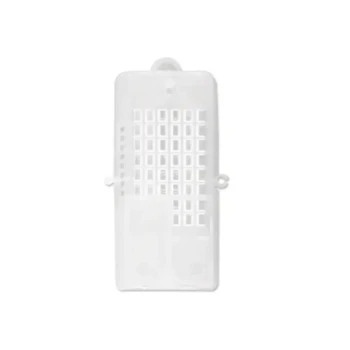
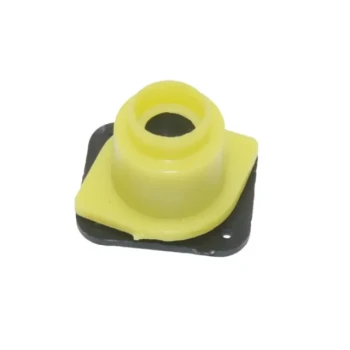
Queen cups start the rearing process, emergence vials control the final transition, and queen candy supports the newly emerged queen. In a standard artificial queen-rearing protocol, larvae younger than approximately 36 hours are grafted into queen cups and placed in a queenless starter or cell-builder colony. About 48 hours before emergence, capped queen cells are moved into individual sterile emergence vials provisioned with queen candy, after which the queens can be introduced to mating nuclei or colonies.
The three products serve different, sequential roles: queen cups support larval grafting and development, emergence vials provide individual protection and observation near eclosion, and queen candy supplies immediate nutrition after emergence.
How the Three Components Fit Together
Queen cups provide the grafting foundation
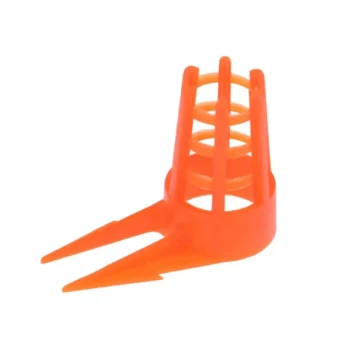
Artificial queen cups are the physical carriers for grafted larvae. Their standardized shape and dimensions imitate the larger, downward-facing geometry of natural queen cells while allowing many cells to be mounted on a grafting bar or rearing frame.
The beekeeper transfers a worker larva under approximately 36 hours old into each cup. The cups are then placed in a starter or cell-builder colony, typically one that has been queenless for about 24 hours.
Nurse bees convert the graft into a queen cell
Once installed in the queenless colony, nurse bees recognize the cups as sites for queen rearing. They extend the cells with wax and feed the larvae substantial quantities of royal jelly, supporting the larva’s development as a queen rather than a worker.
Because the cups are uniform and detachable, the beekeeper can manage grafted batches consistently. Mature cells can later be moved without handling the developing queen directly.
Emergence vials individualize the final stage
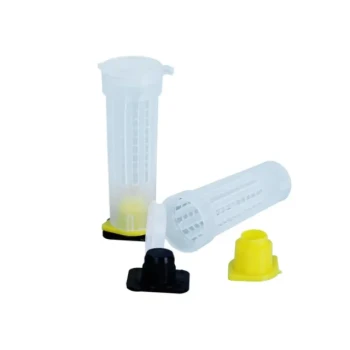
Approximately 48 hours before expected emergence, capped queen cells are transferred from the hive into individual sterile emergence vials. The vial isolates each developing queen and provides a controlled environment for observation, handling, and release.
This step also reduces the risk that an emerged queen will encounter another queen or be harmed by workers during handling. The exact transfer point must be coordinated with the expected emergence time, because timing varies with colony conditions and development.
Queen candy supports the newly emerged queen
Each emergence vial is provisioned with queen candy, a paste synthesized from powdered sugar, honey, and water according to the referenced protocol. The candy provides immediate nutrition after the queen emerges and remains available before she is introduced to a mating nucleus or colony.
Candy is therefore not a larval-rearing feed. During the earlier developmental stage, the larva depends on nurse bees and royal jelly; candy becomes relevant at the controlled emergence and shipping or introduction stage.
Why This Workflow Is Standardized
It separates biological development from operational handling
The colony provides the biological environment for queen development, including temperature regulation, nurse-bee care, wax construction, and royal jelly feeding. The emergence vial then provides the operational environment needed for individual management.
This separation makes it easier to inspect, count, label, transport, and introduce queens without repeatedly disturbing the rearing colony.
It supports batch production
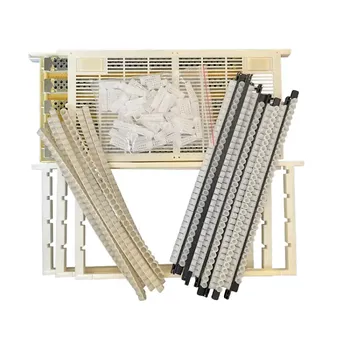
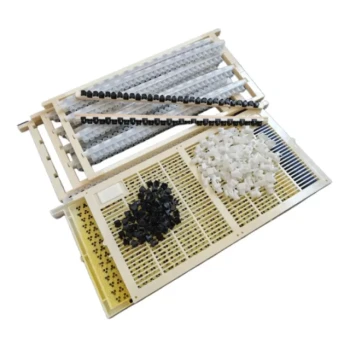
Queen cups mounted on wood bars allow multiple larvae to be grafted and reared simultaneously. Individual mature cells can then be detached and transferred into separate vials as a batch reaches the appropriate stage.
For distributors and commercial beekeepers, this modularity is important because cups, vials, and candy can be standardized as a coordinated product set rather than sourced as unrelated consumables.
It improves repeatability
Uniform cups reduce variation in the physical space available to each grafted larva. This helps operators control the process around measurable factors such as larval age, colony condition, cell position, and transfer timing.
The equipment does not eliminate biological variation, but it makes the workflow more consistent and easier to evaluate across colonies and production cycles.
Operational Sequence From Graft to Introduction
Step 1: Select appropriately aged larvae
Larvae under approximately 36 hours old are selected from worker cells. Age is critical because the developmental pathway is influenced by how early the larva receives intensive royal-jelly feeding.
Step 2: Graft larvae into queen cups
Each selected larva is moved into an artificial queen cup. The cups are fixed to grafting bars or a rearing frame so they can be inserted into the starter or cell-builder colony as a managed batch.
Step 3: Place the cups in a queenless colony
The grafted cups are placed into a colony that has been queenless for approximately 24 hours. This condition encourages nurse bees to accept the grafts and begin queen-rearing behavior.
Step 4: Allow capped-cell development
The colony provides feeding, temperature control, wax extension, and protection while the larvae develop into capped queen cells. The cups remain the underlying carriers during this phase.
Step 5: Transfer cells to emergence vials
About 48 hours before expected emergence, individual capped cells are moved into sterile emergence vials. Each vial should be matched to the correct queen cell and clearly managed as an individual unit.
Step 6: Add queen candy
A suitable portion of queen candy is placed in each vial. The candy is intended to be immediately available to the newly emerged queen, not to replace the colony-based feeding that occurred during larval development.
Step 7: Introduce the queen
After emergence and appropriate inspection, the queen is introduced to a mating nucleus or colony. The vial provides a controlled transition point between emergence and introduction.
Understanding the Trade-offs
Standardization improves control but does not guarantee acceptance
Uniform cups and vials make the workflow repeatable, but nurse-bee acceptance still depends on colony condition, queenlessness, population strength, temperature, and handling quality.
Artificial equipment supports the biology; it cannot compensate for a weak or poorly prepared cell-builder colony.
Earlier transfer improves individual control but increases handling demands
Moving cells into vials before emergence allows individual protection and easier scheduling. However, transferring capped cells introduces additional handling, and incorrect timing or rough treatment can damage developing queens.
Operators should therefore maintain accurate grafting records and calculate expected emergence dates rather than relying only on visual estimates.
Sterile vials support hygiene but require disciplined preparation
Individual vials help isolate queens and simplify observation, but contamination can undermine the benefit. Vials, tools, and work surfaces must be prepared consistently, and candy should be handled hygienically.
Sterility is a process requirement, not merely a specification printed on the packaging.
Candy provides nutrition but is not a substitute for a colony
Queen candy helps sustain the newly emerged queen during the short period before introduction or shipment. It does not provide the full environmental, social, and nutritional functions of a mating nucleus or established colony.
The introduction plan must therefore be synchronized with emergence and handling schedules.
Broad product portfolios can create compatibility issues
Cups, mounting bars, frames, vials, and candy may be sourced from different suppliers. Differences in dimensions, attachment methods, vial capacity, or candy consistency can create avoidable workflow problems.
For commercial users, a coordinated supply program with clear specifications and rapid replenishment can be more valuable than selecting each item solely on unit price.
How to Apply This to Your Project
The most reliable purchasing approach is to treat these products as a connected workflow rather than as isolated items.
- If your primary focus is larval grafting and colony-scale production: Prioritize uniform queen cups, compatible grafting bars, and rearing frames that support repeatable batch handling.
- If your primary focus is queen emergence and protection: Select individual emergence vials that support hygienic handling, clear identification, observation, and controlled queen release.
- If your primary focus is shipping or short-term holding: Pair emergence vials with appropriately prepared queen candy and coordinate packaging with the expected emergence schedule.
- If your primary focus is commercial fulfillment: Source cups, vials, and candy through a supplier capable of maintaining consistent specifications, responsive service, and fast, coordinated replenishment.
- If your primary focus is experimental repeatability: Standardize cup dimensions, graft age, cell-builder preparation, transfer timing, vial conditions, and candy formulation across every production batch.
When each component is used at the correct stage, queen cups, emergence vials, and queen candy form a practical chain from grafting to safe queen introduction.
Summary Table:
| Component | Role | Timing |
|---|---|---|
| Queen cups | Initial graft carrier; foundation for cell building | At grafting (larva <36h old) |
| Emergence vials | Individual protection and observation near eclosion | 48h before emergence |
| Queen candy | Immediate nutrition for newly emerged queen | After emergence, until introduction |
For commercial apiaries and distributors needing reliable queen-rearing supplies, HONESTBEE offers a full spectrum of beekeeping equipment and consumables, including queen cups, emergence vials, and queen candy. Our one-stop sourcing, rapid response, and dedicated service ensure your protocols run smoothly. Contact us today to discuss your bulk requirements and experience the HONESTBEE advantage. Get in touch
Related Products
- Premium Nicot Style Queen Rearing Kit with Hair Roller Bee Cages
- Nicot Queen Rearing Kit for Beekeeping and Grafting in Nicot System
- Jenter Queen Rearing Kit Complete Set for Bee Breeding
- HONESTBEE Improved No Grafting Queen Rearing Kit For Queen Rearing and Royal Jelly Production
- No Grafting Queen Rearing Kit: System for Royal Jelly Production and Queen Rearing
People Also Ask
- What is the primary function of a queen rearing kit? Eliminate Manual Grafting for Superior Bee Breeding
- What are some alternative methods to grafting for queen cell production? Discover Graft-Free Queen Rearing Systems
- How do specialized queen rearing kits and queen management tools improve the success rate of bee colony expansion?
- How do modern queen bee rearing and breeding kits improve apiary management? Transition to Proactive Precision Breeding
- How is 'active' queen rearing defined in beekeeping? Master Intentional Colony Management & Genetic Control