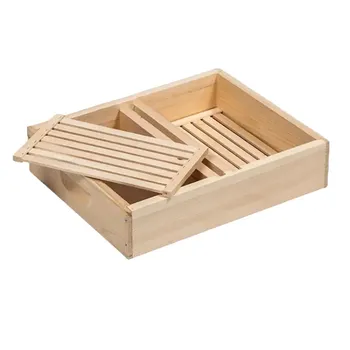
Transitioning to improved beehives and specialized feeding equipment can raise honey yield by making colony management more precise, timely, and scalable. Standardized hives simplify inspections, pest control, feeding, and harvesting, while feeders and water-management equipment help maintain colony strength during nectar shortages. When these systems are combined with reliable extraction and handling tools, beekeepers can reduce losses, improve honey quality, and increase operational productivity.
Improved hives create the management structure; feeding and water equipment support colony strength when natural resources are limited. The greatest gains come from using the full system together—not from purchasing a new hive or feeder in isolation.
Why Improved Beehives Increase Productivity
Better access to the colony
Modern box hives and standardized frames allow beekeepers to inspect brood development, food stores, and colony strength without unnecessary disruption.
More efficient inspections make it easier to identify weak colonies, overcrowding, queen problems, pests, and disease before they reduce production or cause colony loss.
More precise pest and disease control
Improved hive designs provide better access to individual frames and internal hive conditions. This supports timely interventions rather than relying on delayed or improvised treatment.
Professional-grade equipment is particularly valuable for commercial apiaries that need frequent inspections and consistent management procedures across many colonies.
More consistent hive conditions
Precisely manufactured wooden or composite hives maintain standardized dimensions and provide predictable space for bee activity. Consistent construction can also support more stable temperature management when colonies face changing weather conditions.
Standardization reduces variation between hives and makes it easier to apply repeatable management practices across a large apiary.
More efficient harvest management
Modern frames and hive layouts allow honey stores to be monitored and collected with less disruption. This supports non-destructive collection during peak nectar flow and reduces avoidable honey loss.
When standardized hives are paired with professional extractors, the result can be higher-purity honey and stronger quality control, including for unifloral products.
How Specialized Feeding Equipment Supports Strong Colonies
Bridging gaps in nectar availability
Colonies may face periods when nectar or pollen is insufficient because of weather, seasonal gaps, drought, or discontinuous floral sources. Proper feeding equipment allows beekeepers to provide supplemental feed in a controlled and accessible way.
The purpose is not to replace natural forage during a strong nectar flow. It is to help prevent colony weakening when natural food resources temporarily fail.
Supporting colony development
Adequate feed and water management help maintain colony strength, particularly during buildup periods or environmental stress. A stronger colony is better positioned to expand its population and exploit a later nectar flow.
Feeders also make supplementation more systematic than placing improvised containers inside or near the apiary, which can create inconsistent access and unnecessary management problems.
Improving operational consistency
Specialized feeders and water equipment help standardize how resources are delivered across colonies. This is important for distributors and commercial beekeepers managing multiple apiaries, where inconsistent feeding can produce uneven colony development.
A coordinated equipment portfolio—improved hives, feeders, water systems, frames, and inspection tools—reduces dependence on unsuitable substitutes and simplifies procurement.
Avoiding unnecessary colony disturbance
Equipment designed for hive management can allow feeding and monitoring with less disruption to the bees. Reduced disturbance helps beekeepers maintain a predictable inspection and production routine.
The exact benefit depends on correct installation, sanitation, feed type, timing, and local conditions. Feeding equipment is a management aid, not a substitute for adequate forage or sound colony health practices.
The Productivity Gains Come From an Integrated System
Standardized frames improve management
Scientific nest-frame designs create consistent spacing and structure within the hive. This makes inspections, brood assessment, honey-store monitoring, and frame replacement more efficient.
Standardized frames also work more effectively with foundation preparation equipment, including comb foundation casting molds, which support consistent foundation-sheet production.
Mechanical extraction reduces harvest losses
Honey extractors remove honey efficiently while helping preserve comb for reuse. This can shorten harvest cycles and reduce the amount of honey left behind or damaged during manual extraction.
Extractor capacity must match the size of the apiary and the expected harvest window. Delayed extraction during peak season can contribute to deterioration and lower commercial quality.
Queen-rearing tools address colony potential
Grafting needles and precision queen-breeding equipment can support the production and selection of queens with desirable traits, including stress resistance and foraging capability.
These tools are most effective when combined with skilled breeding and colony-management practices. Equipment alone cannot guarantee superior genetics or higher yields.
Mobility extends access to forage
Specialized hive-transfer and logistics equipment allows colonies to be moved according to regional flowering periods. This can be especially valuable in arid areas or regions where nectar sources are separated by geography and season.
By positioning colonies near abundant nectar and pollen, mobile apiary management can reduce interruptions in honey flow and improve total production potential.
What Results Can Be Expected?
Yield improvement depends on management quality
The supplementary reference describes traditional yields of approximately 15–20 kilograms per hive and improved systems reaching roughly 25–30 kilograms per hive under scientific management.
These figures should be treated as indicative rather than guaranteed benchmarks. Actual results depend on bee genetics, forage availability, climate, colony strength, disease control, feeding practices, operator skill, and harvest timing.
Colony survival is part of productivity
Higher honey yield per surviving hive is only one measure of success. Reduced colony losses, more consistent colony growth, and improved ability to recover from environmental stress can have an equally important effect on annual output.
Improved equipment helps create these conditions by making monitoring and intervention more timely and repeatable.
Understanding the Trade-offs
Equipment requires upfront investment
Modern hives, feeders, extractors, foundation tools, and logistics equipment require more initial capital than traditional or improvised systems.
The investment is easier to justify when equipment is selected according to apiary scale, seasonal workload, expected turnover, and the cost of avoidable honey or colony losses.
Standardization requires discipline
Standardized equipment delivers its greatest value when frames, hive bodies, accessories, and handling procedures are compatible. Mixing incompatible dimensions can create gaps, poor fit, difficult inspections, and inefficient workflows.
For commercial buyers, confirming specifications before purchasing is essential. A low unit price is not advantageous if it creates replacement or compatibility problems.
Feeding must be managed carefully
Supplemental feeding is beneficial when colonies lack adequate natural resources, but poorly managed feeding can create hygiene, storage, or colony-management problems. Feeders should be selected for secure placement, practical access, and easy cleaning.
Water provision also matters, particularly in hot or dry conditions. However, feeding and watering should complement—not conceal—problems involving disease, poor forage, weak queens, or unsuitable hive placement.
Harvest capacity can become a bottleneck
Increasing colony productivity without securing enough extraction and processing capacity can create a new operational constraint. Honey may remain in the hive or wait too long for processing during peak harvest periods.
Distributors and resellers should therefore view extractors, foundation equipment, frames, and replacement parts as part of the same supply plan rather than as optional add-ons.
Making the Right Choice for Your Goal
A practical sourcing strategy should align the equipment package with the apiary’s production objective and operating environment.
- If your primary focus is higher honey yield: Combine standardized improved hives with reliable feeding and water-management equipment, strong inspection routines, and sufficient extraction capacity.
- If your primary focus is colony health and survival: Prioritize accessible hive designs, precise monitoring tools, practical feeders, water equipment, and timely pest and disease-management capabilities.
- If your primary focus is commercial scalability: Select compatible, standardized hive components and build a full equipment portfolio that supports inspection, feeding, foundation preparation, transport, and harvest.
- If your primary focus is honey quality: Secure professional extractors and timely processing equipment so honey can be harvested efficiently without avoidable contamination, deterioration, or extraction losses.
- If your primary focus is seasonal or migratory production: Invest in specialized hive-transfer and logistics equipment to place colonies near successive flowering periods and maintain more continuous access to forage.
With the right equipment ecosystem and dependable supply partner, beekeepers can turn hive improvement into measurable gains in colony productivity, harvest efficiency, and honey quality.
Summary Table:
| Strategy | Key Tools | Expected Benefit |
|---|---|---|
| Efficient inspections | Standardized frames & hives | Faster monitoring, early problem detection |
| Pest & disease control | Accessible hive designs | Timely interventions, reduced colony losses |
| Consistent hive conditions | Precision-manufactured hives | Stable environment, predictable management |
| Efficient harvest | Modern frames + extractors | Higher honey purity, less waste |
| Supplemental feeding | Specialized feeders | Maintain colony strength during nectar gaps |
| Water management | Watering equipment | Prevent dehydration, support brood development |
| Queen rearing | Grafting tools | Better genetics, improved foraging |
| Migratory beekeeping | Hive transfer equipment | Access to diverse floral sources |
Elevate your apiary's performance with HONESTBEE's comprehensive range of beehives, feeders, extractors, and management tools. We serve commercial apiaries and distributors with wholesale solutions, offering one-stop sourcing, rapid delivery, and expert support. Maximize your honey yield and colony productivity — contact us today to discuss your needs!
Related Products
- HONESTBEE Professional Hive Top Bee Feeder Feeding Solution
- HONESTBEE Entrance Bee Feeder Professional Hive Nutrition Solution for Beekeeping
- Professional Hive Top Bee Feeder for Beekeeping
- Professional Hive Front Entrance Bee Feeder
- In-Hive Dual Compartment Frame Bee Feeder for Targeted Colony Nutrition
People Also Ask
- How does a bee hive top feeder work? A Guide to Efficient, Protected Feeding
- Do I need an inner cover with a hive top feeder? Optimize Your Hive Setup for Healthy Bees
- What is a hive top feeder? A Guide to Efficient, Low-Stress Beekeeping
- What is a hive top feeder, and how does it work? A Complete Guide to Efficient In-Hive Feeding
- What are the characteristics, advantages, and disadvantages of hive top feeders? Optimize Your High-Volume Feeding