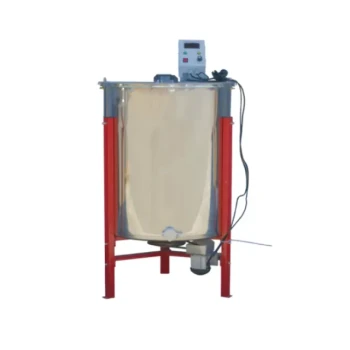
Industrial centrifuges are the technical cornerstone of melissopalynology. They use high-speed centrifugal force to isolate and concentrate pollen grains from the dense honey matrix. By rotating diluted honey samples at specific speeds—typically between 2500 and 3500 rpm—these machines force trace amounts of pollen to form a concentrated sediment or "pellet" at the bottom of the tube. This physical separation is essential for removing interfering sugars and preparing clean samples for microscopic examination.
The industrial centrifuge serves as a critical phase-separation tool that transforms trace, dispersed pollen into a concentrated sediment. For distributors and wholesalers, providing equipment that maintains consistent RPM and supports multiple washing cycles is the key to enabling accurate botanical origin identification for the end user.
The Mechanics of Pollen Enrichment
Leveraging Centrifugal Force and Density
Industrial centrifuges utilize the density difference between microscopic pollen grains and the liquid honey solution. As the centrifuge rotates, the resulting force directs suspended particles toward the bottom of the container.
This process effectively transforms low-concentration samples into high-concentration precipitates. This enrichment is a prerequisite for capturing a sufficient number of grains to satisfy quantitative pollen analysis (APC) standards.
The Role of Multiple Processing Cycles
Separation is rarely a single-step process; it requires multiple washing and processing cycles. By repeatedly centrifuging and replacing the liquid, laboratories can effectively remove the sugar matrix and other interfering substances.
This iterative approach ensures that the final sediment is "clean." A clean sample allows for the recovery of highly concentrated pollen specimens from relatively large liquid volumes.
Commercial Value of High-Precision Centrifugation
Ensuring Purity for Microscopic Examination
The primary goal of using an industrial centrifuge is to prepare a sample suitable for microscopic observation. Without this concentration, trace pollen would be too dispersed within the sugar solution to be accurately counted.
The centrifuge removes fungal spores, honeydew indicators, and sugars that could otherwise obscure the pollen. This results in a dense sediment pellet that is ready for slide preparation.
Determining Botanical and Geographical Origin
For the honey trade, accuracy in identifying botanical and geographical origins is a major value driver. Centrifugation provides the necessary enrichment to identify the specific flowers visited by the bees.
Wholesalers who provide high-speed, stable equipment (maintaining 2500–3000 rpm) empower labs to verify honey authenticity. This verification is vital for maintaining the integrity of the global honey supply chain.
Understanding the Trade-offs
Balancing Speed vs. Sample Integrity
While higher speeds, such as 3500 rpm, can accelerate the sedimentation process, they must be balanced against sample integrity. Excessive force or heat generation during long cycles (e.g., 10 minutes) can potentially damage delicate microscopic structures.
Distributors should guide clients toward units with precise speed control and cooling features. This ensures that the physical properties of the pollen grains remain intact for accurate identification.
Operational Complexity and Maintenance
High-speed industrial centrifuges require regular calibration to ensure the centrifugal force remains stable over hundreds of cycles. Inconsistent speeds can lead to incomplete sedimentation, resulting in "lost" pollen and inaccurate lab reports.
Resellers should emphasize the importance of dedicated customer service and technical support. Providing a reliable maintenance schedule is as important as the initial sale of the hardware.
Strategic Sourcing for Laboratory Efficiency
Optimizing Your Product Portfolio
For B2B buyers, sourcing from a partner with a full-spectrum product portfolio is essential for meeting diverse lab requirements. This includes offering units that handle different tube volumes and provide variable speed settings for specialized honey types.
Our commitment to deep professional industry expertise ensures you receive equipment tailored to the rigorous demands of pollen analysis. We prioritize ultra-fast delivery and efficient order fulfillment to keep your supply chain moving without interruption.
How to Apply This to Your Inventory
- If your primary focus is high-throughput testing labs: Stock high-capacity centrifuges that support rapid-cycle washing and automated speed profiles for efficiency.
- If your primary focus is regulatory and purity compliance: Prioritize units with high-precision digital controls and documented stability at the 2500–3500 rpm range.
- If your primary focus is market versatility: Choose versatile models that accommodate various tube sizes, allowing users to switch between small-batch research and large-scale origin verification.
By providing the right centrifugation technology, you empower your clients to unlock the botanical secrets hidden within every honey sample.
Summary Table:
| Key Feature | Main Benefit | Technical Application |
|---|---|---|
| High-Speed RPM | Rapid Pollen Separation | Stable 2500–3500 rpm for efficient pellet formation |
| Density-Based Force | Concentrated Sediment | Isolates trace pollen grains from the dense honey matrix |
| Multi-Cycle Washing | Superior Sample Purity | Effectively removes interfering sugars and fungal spores |
| Precision Control | Sample Integrity | Prevents damage to delicate microscopic pollen structures |
| Versatile Rotors | Operational Flexibility | Supports various tube volumes for diverse lab requirements |
Scale Your Supply Chain with HONESTBEE’s One-Stop Sourcing
Are you looking to enhance your laboratory or beekeeping equipment inventory? HONESTBEE caters to commercial apiaries, distributors, and B2B resellers with a comprehensive full-spectrum product portfolio. From high-precision laboratory centrifuges to specialized honey-filling and hive-making machines, we supply the tools necessary for modern honey analysis and production.
Why Partner with HONESTBEE?
- Deep Industry Expertise: We provide equipment tailored for the rigorous demands of melissopalynology and honey processing.
- Premium Trading Services: Benefit from high profit margins, reliable OEM/ODM support, and full industry certifications.
- Efficient Fulfillment: Experience ultra-fast delivery and rapid response times that keep your operations running smoothly.
- Complete Wholesale Offering: Access a wide array of beekeeping tools, machinery, and essential industry consumables in one place.
Ready to elevate your business? Contact us today to explore our wholesale catalog and customized solutions!
References
- Koudegnan Comlan Mawussi, Kouami Kokou. Diversité des Plantes d’Intérêt Apicole dans la Région des Plateaux du Togo. DOI: 10.19044/esj.2024.v20n36p138
This article is also based on technical information from HonestBee Knowledge Base .
Related Products
- Manual Hand Crank 4 Frame Honey Extractor Centrifuge for Beekeeping
- electric honey extractor honey centrifuge 3 frame honey extractor stainless steel honey frame extractor
- Professional 4 Frame Self Reversing Electric Honey Extractor for Beekeeping
- Fully Automatic High Speed Centrifugal Bottle Unscrambler
People Also Ask
- What are some tips for achieving efficient honey extraction with a centrifuge extractor? Maximize Your Yield & Efficiency
- What is the proper procedure for maintaining a centrifuge honey extractor? Expert Tips for Longevity and Hygiene
- What are the advantages of using a centrifuge honey extractor? Maximize Yields and Protect Your Honeycombs
- Which type of honey extractor is generally more durable? Focus on Material & Build Quality for Longevity
- What is a manual honey extractor? The Essential Guide to Cost-Effective Beekeeping for Beginners