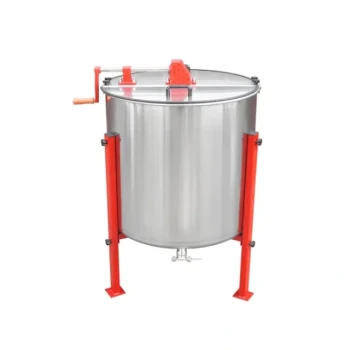
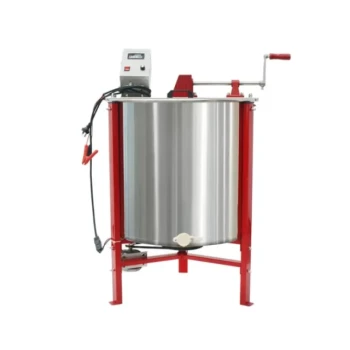
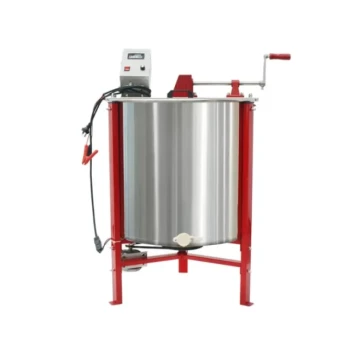
A manual honey extractor is a mechanical device designed to harvest honey from hive frames using human power rather than electricity. It functions by securing the frames inside a drum and spinning them via a hand crank, utilizing centrifugal force to pull the liquid honey out of the wax cells. Due to its simplicity and cost-effectiveness, it is widely considered the standard tool for hobbyists and beginner beekeepers.
The manual extractor balances physical effort with affordability, offering a practical solution for apiaries with fewer than 10 hives where electrical infrastructure may be unnecessary or unavailable.
How the Technology Works
The Principle of Centrifugal Force
The core function of the extractor is to apply centrifugal force to the honeycomb. As the internal basket spins, the physical force draws the heavy liquid honey outward against the drum walls. Gravity then pulls the honey down to a collection valve at the bottom.
The Hand-Crank Mechanism
Unlike motorized versions, this device relies entirely on a hand-operated handle, typically mounted on the top or side. The user manually rotates the crank to generate the necessary speed for extraction. This design eliminates the need for motors, batteries, or power cords.
Preserving the Honeycomb Structure
One of the most critical aspects of this tool is its ability to extract honey without destroying the wax comb. Because the process relies on spinning rather than crushing, the physical structure of the honeycomb remains intact. This allows the beekeeper to return the empty frames to the hive for immediate reuse by the bees.
Strategic Advantages for Small Operations
Simplicity and Portability
Manual extractors are generally lighter and less complex than their electric counterparts. They are often constructed from stainless steel or durable food-grade plastic. This makes them easy to transport to remote locations where electricity might not be available.
Precise Control
The manual crank offers the operator distinct tactile feedback. You have direct control over the speed and direction of the spin. This allows for a gentle start, which is essential to prevent heavy, honey-filled combs from blowing out or breaking under sudden pressure.
Lower Barrier to Entry
For those managing a small number of hives, the cost of automated equipment is often hard to justify. Manual extractors provide a professional harvesting method at a fraction of the price. They are the logical starting point for building a beekeeping inventory.
Understanding the Trade-offs
Physical Labor Intensity
The primary drawback of this device is the physical effort required. Extracting honey manually is labor-intensive, particularly if the honey is thick or the ambient temperature is cool. The operator provides all the energy, which can become exhausting during a large harvest.
Volume Limitations
While excellent for hobbyists, manual extraction is significantly slower than motorized processing. If an operation expands beyond 10 to 20 hives, the time and physical energy required to crank the extractor can become a bottleneck in production.
Making the Right Choice for Your Goal
Selecting the right equipment depends entirely on the scale of your apiary and your available resources.
- If your primary focus is keeping costs low: A manual extractor is the most economical choice and provides everything needed for a high-quality harvest.
- If your primary focus is remote harvesting: The manual crank ensures you can extract honey anywhere, regardless of access to electricity.
- If your primary focus is preserving fragile combs: The tactile control of a manual handle allows you to spin gently to avoid damaging fresh or delicate wax.
Manual extraction connects the beekeeper directly to the harvest, offering a simple, sustainable method for enjoying the fruits of the hive.
Summary Table:
| Feature | Manual Honey Extractor Details |
|---|---|
| Core Mechanism | Hand-cranked centrifugal force |
| Best Suited For | Hobbyists and apiaries with < 10 hives |
| Key Materials | Stainless steel or food-grade plastic |
| Primary Benefit | Low cost, high portability, and no electricity required |
| Comb Preservation | Keeps wax structures intact for hive reuse |
| Control Level | High tactile control over spinning speed |
Elevate Your Beekeeping Business with HONESTBEE
Whether you are scaling a commercial apiary or supplying the next generation of beekeepers, HONESTBEE is your professional partner for high-quality equipment. We specialize in catering to commercial apiaries and global distributors, offering a comprehensive wholesale range that includes:
- Precision Machinery: Advanced honey-filling and hive-making machines.
- Essential Hardware: A full spectrum of durable beekeeping tools and extractors.
- Industry Consumables: Every essential item needed for seasonal hive maintenance.
- Cultural Merchandise: Unique honey-themed products to diversify your portfolio.
Ready to enhance your operational efficiency and product quality? Contact us today to explore our wholesale solutions and see how our expertise can grow your business.
Related Products
- HONESTBEE 4 Frame Manual Self Reversing Honey Extractor for Beekeeping
- Stainless Steel 3 Frame Manual Honey Extractor Spinner for Bee Honey Extraction
- HONESTBEE 3-Frame Manual Acrylic Honey Extractor
- Stainless Steel Manual 8 Frame Radial Honey Extractor Machine for Beehives
- 2 Frame Stainless Steel Manual Honey Spinner Extractor for Beekeeping
People Also Ask
- What is the primary function of a DC motor in a self-reversing honey extractor? Master Precision Honey Extraction
- What are the disadvantages of a manual honey extractor? Overcome Efficiency Bottlenecks in Your Apiary
- Why are manual extractors popular among beginner beekeepers? A Guide to Starting Simple & Saving Money
- Which type of honey extractor is generally more durable? Focus on Material & Build Quality for Longevity
- What are the advantages of a manual extractor? Essential for Small-Scale & Hobbyist Beekeepers