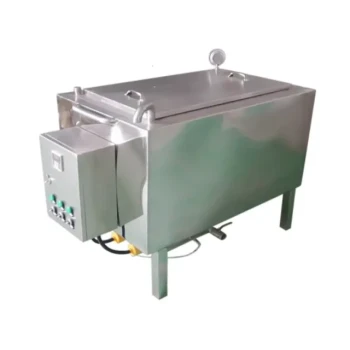
Industrial ovens and desiccators operate in a critical sequential relay to establish a flawless baseline for ash content analysis. The industrial oven acts as the active drying agent, using high temperatures to strip all moisture from the crucibles, while the desiccator serves as a passive shield, preserving that sterile dryness while the vessels cool down for safe weighing.
Core Takeaway Accurate ash analysis depends entirely on a precise "zero" point. This two-step process ensures that the initial weight of the crucible is not skewed by invisible atmospheric humidity, guaranteeing that any weight measured later is purely the ash content of the honey.
Phase 1: Active Moisture Removal
The Role of the Industrial Oven
The process begins with washed crucibles that likely hold residual water from cleaning. The industrial oven is set to 105 degrees Celsius, a temperature specifically chosen to exceed the boiling point of water.
Establishing the Baseline
By subjecting the crucibles to this heat, you ensure the complete evaporation of surface moisture. This step is non-negotiable; even microscopic water droplets will register on an analytical balance, creating a false tare weight.
Phase 2: Controlled Stabilization
The Danger of Open-Air Cooling
You cannot weigh a hot crucible immediately; the heat creates convection currents that destabilize sensitive analytical balances. However, cooling a crucible in open air allows it to act like a sponge, re-absorbing humidity from the laboratory environment.
The Desiccator’s Function
This is where the desiccator becomes essential. It provides a sealed, moisture-free environment utilizing a desiccant agent and a porcelain plate to hold the crucibles.
Preserving the Dry State
As the crucibles cool to room temperature within the desiccator, they remain chemically dry. This ensures that when you finally place them on the scale, the weight recorded is the true mass of the vessel alone, unaffected by the air around it.
Common Pitfalls to Avoid
Understanding Thermal Trade-offs
A common error in this phase is rushing the transfer between the oven and the desiccator. Minimizing the time the hot crucible spends in open air is vital to prevent immediate moisture uptake.
Desiccant Maintenance
The system fails if the desiccant within the chamber is saturated. If the desiccant cannot absorb moisture effectively, the cooling environment becomes humid, and your tare weight will fluctuate, ruining the precision of the final ash calculation.
Ensuring Analytical Precision
To achieve the most accurate ash content results for honey, apply this workflow strictly:
- If your primary focus is Accuracy: Ensure crucibles remain in the oven at 105°C until fully dry, and verify your desiccant is active (often indicated by color) before transfer.
- If your primary focus is Consistency: Standardize the cooling time within the desiccator for every batch to ensure all crucibles are weighed at the exact same temperature.
The integrity of your entire analysis rests on this initial establishment of a moisture-free baseline.
Summary Table:
| Stage | Equipment | Temperature | Primary Function |
|---|---|---|---|
| Phase 1: Drying | Industrial Oven | 105°C | Active evaporation of residual moisture to establish a zero baseline. |
| Phase 2: Cooling | Desiccator | Room Temp | Passive shielding to prevent humidity re-absorption during stabilization. |
| Phase 3: Weighing | Analytical Balance | Room Temp | Precise measurement of the true mass of the dry crucible vessel. |
Elevate Your Lab Efficiency with HONESTBEE
Precision in honey ash analysis starts with the right equipment. HONESTBEE specializes in supporting commercial apiaries and distributors with high-performance industrial tools designed for accuracy and scale. From specialized honey-filling machines and hive-making hardware to the essential laboratory consumables needed for quality control, we provide the full spectrum of beekeeping machinery and equipment.
Ready to optimize your production line or distribution inventory? Contact HONESTBEE today to discover how our wholesale solutions can enhance your operational precision and product quality!
References
- Fatima IJ, M Lavaniya. Physicochemical Characteristics of Malaysian Stingless Bee Honey from Trigona Species. DOI: 10.31436/imjm.v17i1.1030
This article is also based on technical information from HonestBee Knowledge Base .
Related Products
People Also Ask
- Why might a commercial beekeeper prefer an electric beeswax melter? Maximize Profit with Speed & Scale
- What safety precautions should be taken when melting beeswax? A Guide to Flammable Wax Handling
- What types of beeswax melters are available for different scales of beekeeping? Solar vs. Electric Melters Compared
- What are the three popular methods for melting beeswax? Safely Process Your Wax with Ease
- How do you melt beeswax without making a mess? Master Safe & Clean Techniques