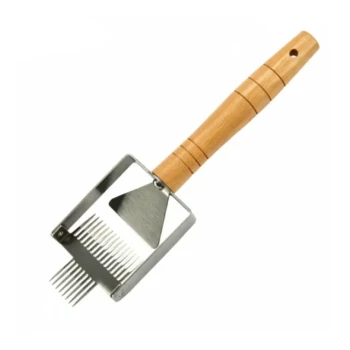
Portable micro-sampling and dissection tools function as precision instruments that allow researchers to physically access and verify the hidden nectar reserves within honey-source plants. By utilizing surgical tweezers to mechanically open flower corollas and micro-pipettes or syringes to extract fluids, these tools provide direct contact with the nectar secretions at the base of the flower. This process is the fundamental step for conducting on-site qualitative analysis to confirm if a specific plant variety is biologically capable of producing nectar.
Core Takeaway While visual inspection of a habitat is useful, micro-sampling provides definitive biological proof of a plant's value to an apiary. These tools enable the immediate, physical verification of nectar secretion, serving as the primary filter for screening and selecting high-yield plant varieties in the field.
The Mechanics of Field Evaluation
Overcoming Physical Barriers
Many high-value honey plants have complex flower structures that hide their nectar glands. Simple observation cannot confirm the presence of nectar in these cases.
Surgical tweezers and dissection tools are used to carefully open the corollas (the petals) of the flower. This dissection removes the physical barrier, exposing the base of the flower where nectar accumulates.
Precision Extraction
Once the flower is opened, the goal is to retrieve the nectar without contamination or loss.
Micro-pipettes and syringes allow for the targeted suction of minute liquid quantities. This "micro-sampling" capability ensures that researchers can extract the secretion directly from the gland, even when the volume is incredibly small.
Strategic Value in Plant Screening
Qualitative Verification
The primary function of this toolset is qualitative analysis. Before measuring how much sugar is in the nectar or how much honey a colony produces, you must answer a binary question: "Does this plant secrete nectar?"
These tools provide the direct evidence required to answer that question affirmatively. They validate the plant as a genuine honey source rather than just a pollen source.
Identifying High-Yield Varieties
Not all plants within a species perform equally. By using these tools to sample various plants, researchers can identify specific varieties that actively secrete nectar.
This screening process is essential for selecting high-yield varieties for propagation or for mapping the most productive zones within a forest or experimental field.
Understanding the Trade-offs
The Scope of Data
It is critical to understand that these tools provide a snapshot of a single flower's performance.
They confirm biological capability, but they do not measure the total yield of a colony over time. For total production data, one must rely on industrial beehive scales to monitor colony weight changes, rather than individual flower sampling.
Labor and Scalability
Micro-sampling is an inherently manual, labor-intensive process.
While it is the gold standard for verifying the biology of specific plants, it is not an automated solution. It requires skilled manipulation of dissection tools and is best used for targeted sampling rather than broad, landscape-level quantification.
Making the Right Choice for Your Goal
To maximize the value of your fieldwork, apply these tools based on your specific objective:
- If your primary focus is screening new plant varieties: Use dissection and micro-sampling to definitively confirm the presence of active nectar secretion before investing in further testing.
- If your primary focus is analyzing nectar quality: Use these tools as the collection method to feed samples into a portable refractometer for immediate sugar concentration readings.
- If your primary focus is total production volume: Recognize that these tools are for plant analysis, not colony analysis; rely on beehive scales for aggregate yield data.
Micro-sampling transforms nectar evaluation from a guessing game into a verifiable science, ensuring you focus your resources on plants that actually deliver results.
Summary Table:
| Tool Type | Primary Function | Evaluation Benefit |
|---|---|---|
| Surgical Tweezers | Mechanical Dissection | Opens complex corollas to expose hidden nectar glands. |
| Micro-pipettes | Precision Extraction | Retrieves minute liquid volumes without contamination. |
| Syringes | Targeted Suction | Direct contact sampling for immediate qualitative analysis. |
| Portable Refractometer | Quality Analysis | Measures sugar concentration from collected micro-samples. |
Elevate Your Apiary's Productivity with HONESTBEE
At HONESTBEE, we specialize in empowering commercial apiaries and distributors with the high-precision tools necessary for professional-grade beekeeping. Whether you are screening for high-yield honey sources or scaling up production, our comprehensive wholesale portfolio has you covered.
Our Value to Your Business:
- Advanced Equipment: From specialized honey-filling and hive-making machines to essential field tools.
- Quality Consumables: A full spectrum of industry-standard supplies for commercial operations.
- Expert Solutions: Tailored hardware and cultural merchandise to enhance your brand's market presence.
Ready to optimize your beekeeping yield? Contact HONESTBEE today to access premium tools and equipment designed for the modern industry professional!
References
- Agussalim Agussalim, I Gede Suparta Budisatria. VARIATION OF HONEYBEES FORAGES AS SOURCE OF NECTAR AND POLLEN BASED ON ALTITUDE IN YOGYAKARTA. DOI: 10.21059/buletinpeternak.v41i4.13593
This article is also based on technical information from HonestBee Knowledge Base .
Related Products
- HONESTBEE Professional Mini J-Hook Hive Tool for Beekeeping
- Professional Plastic Honey Dipper for Easy Honey Drizzling
- Double-Sided Pivoting Honey Uncapping Fork with Scraper for Beekeeping
- Professional Grade Foldable Beehive Handles
- Professional Stainless Steel Pry-Bar Hive Tool
People Also Ask
- What specific challenges do beekeeping hive tools address during hive maintenance? Essential Solutions for Apiaries
- What is the recommended method for storing beekeeping tools? Expert Vertical Storage Solutions for Your Apiary
- Why is the treatment of beekeeping tools with high-concentration chemical disinfectants necessary for preventing AFB?
- How does a favorable microclimate interact with beekeeping tools? Boost Overwintering Success and Equipment Longevity
- What are the features of a J-hook hive tool? Effortlessly Lift Frames with Superior Leverage