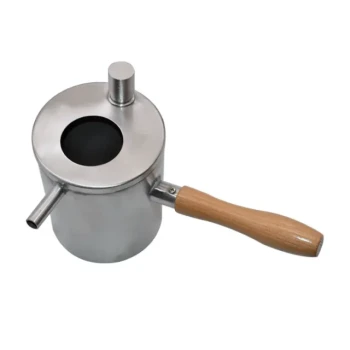
Experimental consistency relies on controlled inputs. An industrial-grade beekeeping smoker ensures standardization by delivering a precise, regulated volume of smoke to the hive, rather than relying on variable manual application. This controlled delivery triggers a stress response in the honeybees that is uniform across all trials, allowing researchers to attribute behavioral differences to the colony's genetics rather than the intensity of the disturbance.
Core Takeaway By replacing variable operator input with a consistent smoke delivery system, researchers establish a reliable baseline for stress induction. This allows for the objective scoring of specific defensive behaviors—running, hanging, stinging, and flying—under identical experimental conditions without inducing total colony panic.
The Mechanics of Consistent Stimulation
To scientifically evaluate honeybee defensive behavior, the external stimulus must be reproducible. The industrial-grade smoker acts as a calibrated instrument rather than a simple deterrent.
Establishing a Reliable Baseline
In non-standardized settings, the amount of smoke applied varies significantly by operator technique. Industrial-grade smokers are designed to mitigate this human error.
They deliver a calculated dose of smoke that is identical in every trial. This ensures that every colony experiences the exact same "threat level," making the resulting data comparable across different hives and breeding lines.
Balancing Stress and Disruption
The objective of the experiment is induction, not destruction. The smoker must trigger a defensive instinct without causing a chaotic breakdown of colony organization.
Standardized smoking achieves this by applying just enough stimulus to provoke a reaction while maintaining the colony's natural state. This prevents the data from being skewed by extreme panic behaviors that do not reflect the colony's true temperament.
Quantifying Behavioral Dimensions
Once the standardized stimulus is applied, the focus shifts to observation. Because the input (smoke) is constant, observers can objectively score the output (behavior).
Measuring Agitation and Movement
The first set of metrics involves the colony's immediate physical reaction. Researchers observe running (rapid movement across the comb) and flying (taking to the air).
If the smoke volume were inconsistent, a "high flying" score could simply be the result of too much smoke. With a standardized smoker, high activity can be correctly attributed to the colony's specific sensitivity.
Assessing Aggression and Tenacity
The second set of metrics focuses on direct defensive engagement. These include stinging (attacks on targets) and hanging (bees clinging to the smoker or protective gear).
These behaviors are critical for determining the "grade" of the colony's docility. The standardized smoker ensures that a high sting count represents a genetically aggressive colony, not a reaction to an overwhelming smoke cloud.
Understanding the Trade-offs
While the industrial smoker is a powerful tool for standardization, it functions within a broader ecosystem of variables. Understanding its limitations is essential for accurate analysis.
Equipment Interdependency
A standardized smoker cannot generate perfect data in isolation. It relies on the standardization of the hive environment and protective gear to function correctly.
If hive dimensions vary, the smoke density will fluctuate regardless of the smoker's precision. Similarly, if the protective gear (the target for stinging) changes materials, the "hanging" and "stinging" metrics may become unreliable.
The Limits of Simulation
Industrial smokers simulate a threat, but they are an artificial proxy. They provide excellent relative data for comparing colonies against one another.
However, they may not perfectly mimic the biological nuances of a specific predator attack. Researchers must remember they are measuring a reaction to smoke, which serves as a correlate for general defensiveness, rather than a direct replication of natural predation.
Ensuring Data Integrity in Your Research
When designing your evaluation protocol, the smoker is a variable you must control to ensure your results are statistically valid.
- If your primary focus is genetic selection: Ensure the smoke dosage is low enough to reveal subtle differences between docile and aggressive breeding lines.
- If your primary focus is operator safety: Calibrate the standard smoke volume to the upper limit of the test to ensure the "worst-case" reaction is understood.
The industrial smoker transforms the art of colony management into the science of behavioral metrics.
Summary Table:
| Metric Category | Behavioral Indicator | Standardization Benefit |
|---|---|---|
| Agitation | Running & Flying | Eliminates operator variability in movement scores |
| Aggression | Stinging & Hanging | Ensures sting counts reflect genetics, not smoke volume |
| Consistency | Regulated Dosage | Establishes a reliable baseline for stress induction |
| Objectivity | Docility Grading | Enables accurate comparison across different breeding lines |
Elevate Your Apiary Research with HONESTBEE
At HONESTBEE, we understand that precision is the backbone of successful commercial beekeeping and genetic research. As a leading global supplier, we provide commercial apiaries and distributors with a comprehensive wholesale portfolio designed for reliability and scale.
From industrial-grade smokers that ensure experimental standardization to advanced honey-filling machines and hive-making hardware, our equipment is built to optimize your productivity. Whether you are looking for high-performance machinery or essential industry consumables, we deliver the tools you need to succeed in the competitive honey industry.
Partner with HONESTBEE today to secure high-quality beekeeping solutions at wholesale scale.
References
- Eliana Bianchi, Silvia B. Lanzavecchia. Defensive Behavior and Morphometric Variation in Apis mellifera Colonies From Two Different Agro-Ecological Zones of North-Western Argentina. DOI: 10.3389/fevo.2021.590225
This article is also based on technical information from HonestBee Knowledge Base .
Related Products
- Professional Bee Smoker with Elongated Spout and Durable Bellows for Beekeeping
- Heavy-Duty Bee Smoker with Durable Plastic Bellows for Beekeeping
- Stainless Steel Honey Bee Smoker Hive and Honeycomb Smoker for Beekeeping
- Heavy Duty Manual Bee Smoker Blower for Beekeeping
- Miniature Stainless Steel Bee Smoker for Beekeeping
People Also Ask
- What roles do bee smokers and precision tools play in honey harvesting? Master Safety and Quality Control
- Why is a professional bee smoker considered an essential tool for hive management and safety? Master Colony Control.
- Why is the use of professional bee smokers and specialized fuel essential? Protect Honey Purity & Colony Safety
- How do professional bee smokers facilitate bee management? Enhancing Forest Beekeeping Safety and Efficiency
- Why is a professional Smoker essential during routine apiary inspections? Enhance Safety and Operational Efficiency