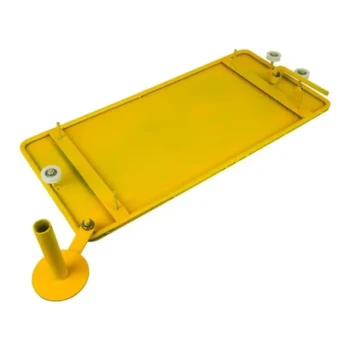
Standardized beekeeping hardware functions as a scientific control mechanism in commercial queen bee production. By utilizing uniform hive components and rearing tools, producers create high environmental consistency that minimizes developmental disturbances caused by equipment variance. This stability is the prerequisite for using advanced statistical methods to isolate and identify specific physical traits that indicate superior quality.
Standardized equipment transforms the hive into a stable laboratory environment, allowing breeders to differentiate between environmental luck and genetic quality. This consistency enables the use of Principal Component Analysis (PCA) to pinpoint objective selection markers, such as the width of the left basitarsus.
Creating a Stable Experimental Environment
To identify true quality standards in queen bees, one must first remove external variables.
Eliminating Environmental Noise
In traditional or non-standardized setups, variations in equipment size or insulation can drastically alter a colony's temperature and humidity. Standardized components eliminate these discrepancies. This ensures that a queen's development is driven by her genetics and care, rather than the specific box she was raised in.
Optimizing Developmental Conditions
Standardized tools, such as multi-layered queen-rearing bars, maximize the use of vertical space within the hive. By placing grafted larvae at uniform, optimized heights, breeders leverage the colony’s natural thermal and humidity gradients. This results in higher acceptance rates and biologically consistent queens.
Facilitating Precision Management
Uniform hardware supports the transition from dispersed, artisanal management to industrial precision. It allows for the accurate recording of colony capacity and health data across specific locations. Consistent hardware provides the physical baseline necessary for comparing production outputs across hundreds of colonies.
From Hardware to Data Analysis
Once the environment is controlled, producers can move from subjective observation to objective measurement.
Enabling Statistical Analysis
Because standardized hardware stabilizes the rearing environment, biological data collected from the bees becomes statistically significant. Producers can employ methods like Principal Component Analysis (PCA) to process complex morphological data. Without the "control" of standardized gear, this data would be too noisy to be useful.
Defining Objective Quality Metrics
Through this statistical approach, producers can identify specific physical attributes that correlate with high-performance queens. For instance, research has identified the width of the left basitarsus as a key quality variable. This provides a measurable, scientific standard for selection that replaces guesswork.
Understanding the Trade-offs
While standardization is critical for modern breeding, it introduces specific challenges that must be managed.
The Risk of Over-Standardization
Rigid adherence to standardization can sometimes overlook local environmental nuances. While uniform hives are excellent for data comparison, they may not always account for micro-climatic variations in different apiary sites.
Initial Investment vs. Long-term Gain
Transitioning to high-precision, interchangeable components often requires specialized manufacturing machinery. While this supports large-scale migratory efficiency and mechanization, it represents a significant upfront capital investment compared to traditional, less uniform equipment.
Making the Right Choice for Your Goal
Standardization is not just about convenience; it is a tool for data integrity and scale.
- If your primary focus is genetic improvement: Prioritize standardized rearing bars and internal components to ensure thermal consistency for accurate statistical analysis (PCA).
- If your primary focus is operational scale: Focus on the interchangeability of hive boxes and frames to maximize mechanization and migratory efficiency.
By aligning your hardware with scientific principles, you turn beekeeping from a variable art into a measurable, scalable science.
Summary Table:
| Aspect | Role in Queen Production | Key Benefit |
|---|---|---|
| Environmental Control | Eliminates equipment variance | Stabilizes colony temperature and humidity |
| Data Integrity | Enables PCA statistical analysis | Identifies objective markers like basitarsus width |
| Precision Management | Uniform rearing tools and bars | Increases larval acceptance and growth rates |
| Operational Scale | Interchangeable components | Maximizes mechanization and migratory efficiency |
Scale Your Commercial Queen Production with HONESTBEE
Transitioning to standardized hardware is the foundation of scientific precision and operational efficiency. HONESTBEE specializes in supporting commercial apiaries and distributors with a robust wholesale catalog designed for scale. We supply the full spectrum of professional beekeeping tools, advanced machinery—including hive-making and honey-filling systems—and essential industry consumables. From specialized hardware to honey-themed cultural merchandise, we provide the tools you need to turn your apiary into a data-driven, high-performance operation.
Contact us today to explore our wholesale solutions and discover how we can enhance your production standards.
References
- Gonca ÖZMEN ÖZBAKIR. The relationship between the internal and external morphological parameters of honeybee queens (Hymenoptera: Apidae) and the determination of morphological variation. DOI: 10.4314/sajas.v53i1.03
This article is also based on technical information from HonestBee Knowledge Base .
Related Products
- Stainless Steel J Hook Hive Tool for Beekeeping
- HONESTBEE 15-in-1 Beekeeper Multi-Tool with Hammer and Pliers for Beekeeping
- HONESTBEE Professional Mini J-Hook Hive Tool for Beekeeping
- Ergonomic Plastic Frame Spacer Tool for Rapid Hive Management Beekeeping
- Professional Stainless Steel J-Hook Hive Tool
People Also Ask
- What specific challenges do beekeeping hive tools address during hive maintenance? Essential Solutions for Apiaries
- What are the features of a J-hook hive tool? Effortlessly Lift Frames with Superior Leverage
- What is a J-hook hive tool and why is it favored by some beekeepers? Master Gentle Frame Handling
- What is the purpose of the J-hook hive tool? Effortlessly Lift Frames with Superior Leverage
- How is a J-hook hive tool designed and what is its primary use? Master Effortless Hive Inspections