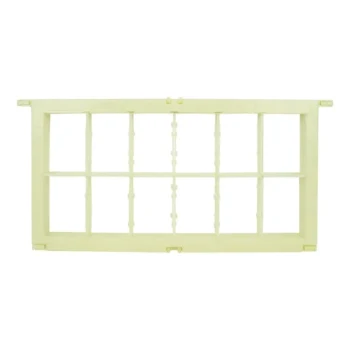
Visual estimation serves as the critical bridge between subjective observation and quantifiable statistical data. By estimating the percentage of a comb covered by bees and multiplying it by the specific surface area of the frame (such as 673 cm²), researchers produce a precise "total coverage area." This metric acts as a reliable proxy for colony strength, allowing for the direct assessment of how bee population density influences the abundance of associated insects within the hive.
By converting visual estimates into total surface area calculations, researchers create an objective, repeatable physical metric. This allows for rigorous statistical analysis to determine if stronger colonies are more or less susceptible to infestation by associated insects.
The Mechanism of Measurement
The Role of Standardization
To assess colony strength accurately, one cannot rely on random observations. The process depends on the use of standardized hives, such as Langstroth hives.
These hives provide a uniform physical living space. Because the dimensions are fixed, researchers can rely on consistent parameters for every calculation.
Calculating Total Coverage Area
The core of this methodology lies in converting a visual percentage into a raw number.
The primary reference notes that a standard frame has a known surface area, specifically 673 cm².
An observer visually estimates the percentage of the comb covered by bees. This percentage is then applied to the known surface area to derive the specific coverage for that frame.
Aggregating the Data
This process is repeated for individual combs within the hive.
By summing the coverage areas of all frames, researchers obtain a total bee coverage area for the entire colony.
This final figure is an objective, physical metric that represents the colony's population size, removing the ambiguity of terms like "strong" or "weak" without data backing.
Correlating Strength to Insect Abundance
Establishing Statistical Relationships
The ultimate goal of this estimation is to understand the relationship between the honeybee host and other insects.
Once the total bee coverage area is calculated, it serves as the independent variable in statistical analyses.
Researchers compare this "strength" metric against the abundance of associated insects found in the hive.
Assessing Infestation Risks
This method allows for the identification of specific trends regarding infestation risks.
By using a repeatable metric, researchers can definitively state whether higher colony strength correlates with a higher or lower presence of specific insect pests or associates in commercial apiaries.
Understanding the Trade-offs
Dependence on Uniformity
This method is highly effective, but it relies entirely on standardization.
If the hive equipment varies or if frame dimensions differ from the standard (e.g., the 673 cm² benchmark), the visual formulas become unreliable. Accurate comparison requires identical physical constraints across all study subjects.
The Element of Observer Judgment
While the final metric is objective, the input remains visual estimation.
The observer must accurately gauge the percentage of coverage. Consistency in how the observer views and rates "coverage" is vital to maintaining the repeatability of the study.
Making the Right Choice for Your Goal
To effectively utilize visual estimation in your own assessments, consider the following applications:
- If your primary focus is academic research: Ensure you are using the precise surface area parameter (e.g., 673 cm²) to convert percentages into raw area data for valid statistical regression.
- If your primary focus is apiary management: Utilize standard Langstroth equipment to ensure your visual assessments of frame occupation remain consistent and comparable across different colonies.
Objective quantification transforms a simple visual check into a powerful tool for diagnosing colony health and pest vulnerability.
Summary Table:
| Metric Category | Measurement Detail | Purpose |
|---|---|---|
| Standard Frame Area | 673 cm² (Standard Langstroth) | Provides a fixed physical baseline for calculations |
| Observation Method | Visual Percentage Estimation | Bridges subjective observation and raw statistical data |
| Calculation Formula | (Est. % x 673 cm²) x Total Frames | Determines total bee coverage area for the entire colony |
| Analytical Goal | Regression/Statistical Analysis | Correlates bee density with the abundance of associated insects |
| Key Dependency | Equipment Standardization | Ensures repeatability and accuracy across different apiaries |
Elevate Your Apiary Management with HONESTBEE
Precise data is the backbone of a thriving commercial apiary. At HONESTBEE, we empower commercial beekeepers and distributors by providing the high-quality, standardized equipment essential for accurate colony strength assessment and pest management.
Our comprehensive wholesale portfolio includes:
- Precision Machinery: Advanced hive-making and honey-filling machines to scale your operations.
- Specialized Hardware: Standardized Langstroth hive components for consistent measurement and reporting.
- Industry Consumables: A wide array of essentials to maintain hive health and productivity.
- Cultural Merchandise: Unique honey-themed products to expand your brand's reach.
Whether you are managing thousands of colonies or supplying the industry, our tools ensure you have the durability and precision needed to succeed. Contact us today to explore our wholesale solutions and see how HONESTBEE can optimize your beekeeping business.
References
- Sarah J. Dolson, Gard W. Otis. Prevalence and behavioral bioassays of Platybolium alvearium (Coleoptera: Tenebrionidae) in colonies of honeybees (Apis: Hymenoptera: Apidae) in northern Vietnam. DOI: 10.1007/s13592-018-0622-y
This article is also based on technical information from HonestBee Knowledge Base .
Related Products
- Professional Sectional Comb Honey Frame with 250g Cassette System for Beekeeping
- Honey Bee Lifecycle Model: A Detailed Honeycomb Display of Bee Development
- Plastic Honey Comb Frames Cassette Box for Honey
People Also Ask
- How are honeybee combs utilized for non-destructive colony monitoring? Master Population Density Tracking
- What is the technical purpose of exchanging honeycomb frames? Master Apiary Equalization for Growth
- What frame to use for honeycomb? Choose the Right System for Pure, Edible Comb
- What is a honeycomb frame? The Key to Modern, Sustainable Beekeeping
- What are the recommended temperature and duration settings for freezing honey frames? Ensure Pest-Free Comb Storage