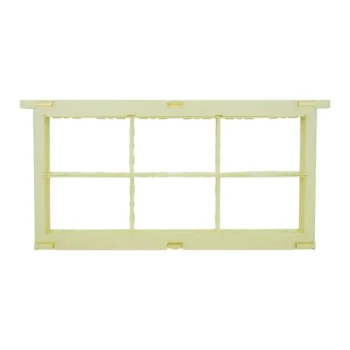
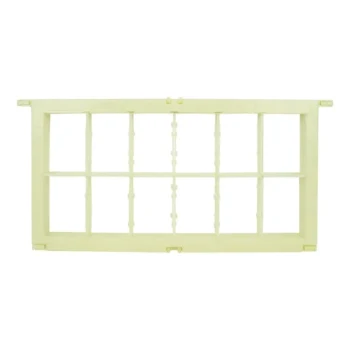
Section comb honey supers are specialized hive components used to produce honeycomb in individual, market-ready units rather than large frames for liquid extraction. These shallow boxes, measuring exactly 4 5/8 inches in height, are designed to house specific inserts—typically basswood section boxes or plastic rings—that confine the bees' construction into distinct, single-serving squares or rounds.
Core Takeaway While these supers allow for the production of classic, high-value comb honey sections, using them is widely considered a specialized art form. Success requires intense colony management and precision, making this method generally unsuitable for beginner beekeepers.
The Hardware Configuration
Specific Dimensions
The distinguishing feature of a section comb honey super is its height. At 4 5/8 inches, it is significantly shallower than standard extracting supers.
Internal Components
Unlike standard supers that hold large frames, these boxes are engineered to hold specific internal fixtures. The most common inserts are basswood section boxes (traditional squares) or plastic rings and section holders (modern rounds).
The Mechanism of Action
These inserts force the colony to draw out comb and fill it with honey within a confined space. This results in a finished product that requires no extraction or cutting; the section itself is the package.
Operational Complexity
A Specialized Art
Producing section comb honey is not merely about changing equipment; it is a shift in methodology. The primary reference classifies this as a "specialized art," indicating that standard beekeeping practices may not suffice.
Intense Management Requirements
Bees generally prefer to work in larger, open spaces rather than the small, confined compartments of a section super. Consequently, this method requires intense management to crowd the bees enough to force them into the sections without triggering a swarm.
Quantifying Success
To track the efficiency of this challenging method, operators often use pre-weighed hardware. By subtracting the initial weight of the super and holders from the final harvest weight, you can precisely calculate the net honey yield. This data is vital for evaluating the economic performance of specific queen breeds in this high-stress environment.
Understanding the Trade-offs
High Value vs. High Skill
The resulting product is pristine and fetches a high market price. However, the learning curve is steep.
The Beginner Barrier
Because of the intense crowding required and the temperamental nature of forcing bees into small sections, this equipment is generally not recommended for beginners. New beekeepers attempting this often face issues with swarming or the bees simply refusing to enter the super.
Making the Right Choice for Your Goal
If you are considering adding section comb honey supers to your apiary, assess your experience level and goals:
- If your primary focus is maximum yield with lower risk: Avoid section supers; standard extracting supers are more forgiving and generally result in higher total honey volume per colony.
- If your primary focus is mastering a specialized craft: Proceed with section supers, but be prepared for a regimen of intense management and frequent hive inspections.
- If your primary focus is data-driven breeding: Utilize pre-weighed section supers to rigorously test which of your queen lines perform best under the pressure of comb production.
Section comb honey production is the pinnacle of hive management precision—rewarding for the expert, but often frustrating for the novice.
Summary Table:
| Feature | Section Comb Honey Super Specification |
|---|---|
| Primary Purpose | Producing individual, market-ready honeycomb units (squares/rounds) |
| Standard Height | 4 5/8 inches (shallow profile) |
| Internal Hardware | Basswood section boxes or plastic rings/holders |
| Management Level | High (Intense management required to prevent swarming) |
| Target User | Experienced commercial beekeepers and specialists |
| Key Benefit | High-value product requiring no extraction or cutting |
Elevate Your Apiary’s Commercial Output with HONESTBEE
Producing premium section comb honey is a specialized art that demands precision-engineered equipment. At HONESTBEE, we empower commercial apiaries and distributors with the high-quality tools needed to master this craft.
From shallow section supers and specialized hardware to advanced honey-filling machines and a complete range of beekeeping consumables, our wholesale portfolio is designed to maximize your yield and market value. Whether you are scaling your honey production or sourcing cultural merchandise for your brand, we provide the industrial-grade solutions you need to succeed.
Ready to scale your commercial beekeeping operation?
Contact HONESTBEE Today for Wholesale Solutions
Related Products
- Professional 500g Sectional Comb Honey Frame System for Beekeeping
- Professional Sectional Comb Honey Frame with 250g Cassette System for Beekeeping
- Heavy Duty Castellated Iron Frame Spacer for Honey Supers
- Heart-Shaped Comb Honey Frame and Honeycomb Cassette
- Durable 16 Way Circular Bee Escape for Efficient Honey Harvesting
People Also Ask
- How are honeybee combs utilized for non-destructive colony monitoring? Master Population Density Tracking
- What frame to use for honeycomb? Choose the Right System for Pure, Edible Comb
- What is a honeycomb frame? The Key to Modern, Sustainable Beekeeping
- What is the technical purpose of exchanging honeycomb frames? Master Apiary Equalization for Growth
- What is the significance of sampling honeycomb frames and hive bottoms? A Guide to Scientific Sanitation Monitoring