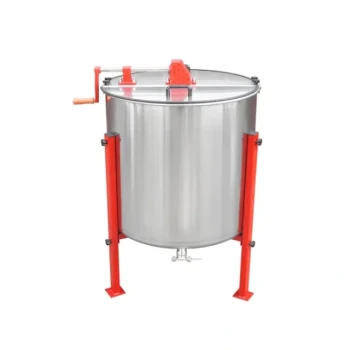
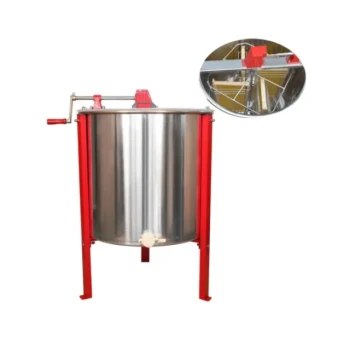
A basic manual honey press operates by applying direct physical pressure to honeycombs to extract liquid honey, rather than using centrifugal force to spin it out. This device is designed for simplicity, allowing you to process small quantities of comb without the need for electricity or complex machinery.
The Core Takeaway While labor-intensive and slower than motorized options, a manual honey press offers a traditional, low-cost method for extraction that excels at preserving the authentic flavor and natural characteristics of honey for small-scale operations.
The Mechanics of Extraction
Pressure-Based Separation
Unlike standard extractors that spin frames, a press works by crushing the honeycomb.
You manually apply force—typically via a screw mechanism or heavy weight—to squeeze the honey out of the wax cells.
Integrated Filtration
As the honey is forced out of the comb, it passes through a fine mesh filter.
This integrated step effectively removes beeswax particles, debris, and other pollutants, ensuring the final product is clean immediately upon extraction.
Gravity-Assisted Flow
Once pressed, the honey relies on gravity to separate fully from the crushed comb structure.
This slow, natural flow helps minimize the introduction of air bubbles, contributing to the preservation of the honey's quality.
Construction and Capacity
Simple, Rugged Design
The construction of a manual press is often distinctively low-tech.
Many models are built using basic materials such as wood, plastic buckets, and metal screws, making them accessible and easy to repair locally.
Small-Batch Focus
This equipment is engineered specifically for low-volume extraction.
It allows you to process a small quantity of combs at one time, making it ideal for hobbyists who treat honey harvesting as an artisanal rather than industrial process.
Understanding the Trade-offs
Labor and Time Intensity
The primary operational drawback is the physical effort required.
Pressing honey is time-consuming and demands significant manual labor compared to the rapid efficiency of centrifugal extractors.
Destructive Extraction
It is critical to note that a press destroys the honeycomb during the process.
Because the comb is crushed to release the honey, the bees must rebuild the wax comb from scratch, which requires energy and time from the hive, potentially slowing down future honey production.
Making the Right Choice for Your Goal
Before investing in a manual press, consider your long-term objectives for your apiary.
- If your primary focus is preserving authentic flavor: The press is ideal as it is a traditional method believed to best retain the honey's natural characteristics.
- If your primary focus is hive efficiency: You should avoid a press, as destroying the comb forces bees to rebuild rather than refilling existing frames.
- If your primary focus is low startup cost: A manual press is an excellent entry point due to its simple construction and lack of electrical components.
Select the tool that balances your willingness to perform manual labor with your desire for a high-quality, artisanal product.
Summary Table:
| Feature | Operational Detail | Benefit/Impact |
|---|---|---|
| Mechanism | Manual Screw/Weight Pressure | No electricity needed; low-tech & reliable |
| Extraction Method | Crushing Honeycomb | Preserves authentic flavor & natural profile |
| Filtration | Integrated Fine Mesh | Immediate removal of wax & debris |
| Flow Type | Gravity-Assisted | Minimizes air bubbles for high-quality honey |
| Scale | Small-Batch/Artisanal | Ideal for hobbyists and niche producers |
| Comb Impact | Destructive | Bees must rebuild; higher wax yield |
Elevate Your Apiary with HONESTBEE Quality
At HONESTBEE, we specialize in supporting commercial apiaries and distributors with the tools needed for every scale of production. Whether you are looking for traditional manual presses or advanced honey-filling and hive-making machinery, our comprehensive wholesale portfolio has you covered.
Why partner with us?
- Full Spectrum Supply: From essential beekeeping consumables to specialized hardware.
- Industry Expertise: Tailored solutions for large-scale distributors and professional beekeepers.
- Artisanal to Industrial: Equipment that spans the entire production lifecycle.
Ready to scale your beekeeping business? Contact us today to explore our wholesale equipment and cultural merchandise.
Related Products
- Stainless Steel Manual Honey Press with Guard for Pressing Honey and Wax
- Easy Use Manual Stainless Steel Honey Press for Honey Comb
- Manual Honey Filling Machine Bottling Machine for Honey
- Stainless Steel 3 Frame Manual Honey Extractor Spinner for Bee Honey Extraction
- 6 Frame Manual Stainless Steel Honey Extractor Beekeeping Equipment
People Also Ask
- What other functions can a honey press serve besides honey extraction? Discover Versatile Multi-Purpose Uses
- How does the honey press preserve the quality of honey during extraction? Maintain Pure Enzymes and Flavor
- What materials are used to construct the honey press? Choose Durable, Food-Grade Solutions for Your Apiary
- What are the fundamental differences between manual honey presses and centrifugal honey extractors? A Guide for Pros
- What are some general features of a honey press? Maximize Your Yield with Durable Extraction Tools