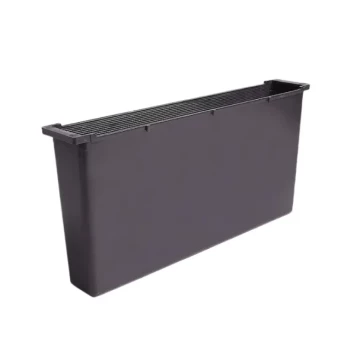
Boardman feeders, often referred to as entrance feeders, act as an external reservoir system designed to slide directly into the hive’s entrance.
Physically, the device consists of a base tray that holds an inverted container—typically a standard glass jar—filled with sugar syrup. The operational success of the feeder relies entirely on a vacuum seal created within the inverted jar; the syrup is suspended against gravity and only released when bees insert their tongues through small holes in the lid to break the surface tension.
The Boardman feeder functions by maintaining a vacuum seal in an inverted jar, allowing bees to access syrup on demand without flooding the hive. While this design allows for easy monitoring and low-cost installation, it is limited by low capacity and high maintenance requirements compared to internal feeding methods.
Operational Mechanics
The Vacuum Principle
The core mechanism of a Boardman feeder is the vacuum seal. When the jar is inverted and placed in the tray, the atmospheric pressure outside and the vacuum pressure inside prevent the liquid from dripping freely.
The syrup does not flow automatically. The bees must actively physically insert their tongues into the tiny holes in the jar lid. This action breaks the surface tension and allows them to draw down the feed.
External Accessibility
Unlike internal feeders, the Boardman unit is installed at the hive entrance. A specialized tray slides into the bottom gap of the hive, leaving the jar exposed on the outside.
This allows the beekeeper to visually check syrup levels without opening the hive or disturbing the colony.
Design Constraints and Capacity
Limited Volume
The standard design utilizes a quart-sized jar. While this makes the unit compact and easy to handle, it significantly limits the nutritional payload.
Because the reservoir is small, the colony can deplete the resources quickly. This necessitates frequent refills, making it a labor-intensive option during periods of heavy feeding.
Multi-Unit Scalability
Despite the low individual capacity, the design features allow for scalability. Because they are inexpensive and external, multiple units can be employed simultaneously on different hives or even the same hive (width permitting) to increase syrup access.
Understanding the Trade-offs
Temperature Sensitivity
Because the feeder sits outside the hive body, the syrup is not warmed by the colony's cluster heat. In contrast to frame feeders (which sit inside the hive), the syrup in a Boardman feeder can become cold.
In lower temperatures, bees may be unable to move to the entrance to feed, or the syrup may become too viscous to draw through the vacuum holes.
Risk of Robbing
The supplementary data on internal feeders highlights that internal placement prevents discovery by robber bees. By logical extension, the Boardman feeder's location at the entrance makes it more visible and accessible to robber bees and wasps.
Placing high-value sugar syrup directly at the front door can incite robbing frenzies from other colonies, whereas internal feeders keep the food source hidden deep within the brood box.
Making the Right Choice for Your Goal
The Boardman feeder is a tool of convenience, but it is not suitable for every season or operational scale.
- If your primary focus is visual monitoring: Choose the Boardman feeder to instantly check feed levels without opening the hive or disturbing the bees.
- If your primary focus is high-volume feeding: Avoid the Boardman in favor of a Top Feeder, as the Boardman's one-quart capacity requires inefficient, frequent refilling.
- If your primary focus is cold-weather feeding: Opt for a Frame Feeder instead, as Boardman feeders leave the syrup exposed to ambient cold, making it difficult for bees to access.
Select the Boardman feeder when you need a low-cost, non-intrusive solution for light feeding in mild weather.
Summary Table:
| Feature | Boardman (Entrance) Feeder | Internal (Frame/Top) Feeder |
|---|---|---|
| Mechanism | External Vacuum Seal | Gravity/Open Reservoir |
| Capacity | Low (approx. 1 Quart) | High (Gallon+) |
| Monitoring | Visual (No hive opening) | Requires opening hive |
| Robbing Risk | High (Entrance location) | Low (Deep in hive) |
| Weather Suitability | Mild weather only | Effective in cold weather |
| Labor Intensity | High (Frequent refills) | Low (Large batches) |
Scale Your Beekeeping Operation with HONESTBEE
Are you looking to streamline your apiary's feeding efficiency? HONESTBEE specializes in supporting commercial apiaries and distributors with high-quality, wholesale beekeeping solutions. From precision Boardman feeders to industrial-grade honey-filling machines and specialized hive-making hardware, we provide the tools you need to succeed at scale.
Why partner with us?
- Comprehensive Inventory: Access a full spectrum of beekeeping machinery and essential consumables.
- Targeted Solutions: We cater specifically to the needs of large-scale operations and global distributors.
- Expert Support: Benefit from our deep industry knowledge to select the right tools for your specific climate and colony needs.
Ready to enhance your productivity? Contact HONESTBEE today to discuss our wholesale offerings and how we can add value to your business.
Related Products
- Boardman Entrance Bee Feeder Durable Galvanized Steel and Wood Construction for Beekeeping
- Classic Boardman Entrance Bee Feeder Hive Front Feeding Solution
- Professional Hive Front Entrance Bee Feeder
- Professional Hive Top Bee Feeder for Beekeeping
- HONESTBEE Entrance Bee Feeder Efficient Hive Front Liquid Feeding Solution for Beekeeping
People Also Ask
- What types of bee feeders are available for beginners? Start with the Simple Entrance Feeder
- How does a bee entrance feeder work? A Simple Guide to Convenient Hive Feeding
- What is a bee entrance feeder and what are its drawbacks? Essential Guide to Hive Security and Feeding Efficiency
- What are the advantages and disadvantages of using an entrance feeder for bees? Balance Convenience and Hive Security.
- How to make an entrance feeder for bees? A DIY Guide for Safe & Effective Feeding