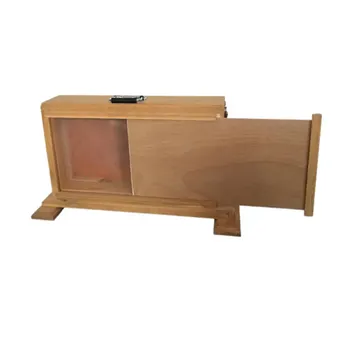
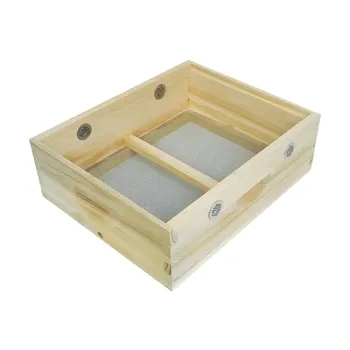
The primary difference is how each hive organizes space, comb, and beekeeper access. Langstroth hives are vertical, modular, and frame-based, making them the strongest choice for standardized and scalable honey production. Horizontal top bar hives use a single horizontal body with individual bars and naturally built comb, while Warré hives are compact vertical boxes designed for lower-intervention management and less frequent inspection.
Choose Langstroth for standardization, scalability, and mechanical honey extraction; top bar for simpler access and natural comb management; and Warré for a compact, low-disturbance operating model. For distributors and professional buyers, the decision also affects accessory compatibility, replacement-parts availability, fulfillment complexity, and customer support requirements.
How the Three Hive Designs Are Structurally Different
Langstroth: Vertical and modular
A Langstroth hive consists of stackable rectangular boxes, or supers, containing removable rectangular frames. Bees build comb on the frames, usually with foundation guiding the comb’s shape.
Additional boxes can be added vertically as the colony grows or honey production increases. This modular structure is the basis of Langstroth’s widespread commercial adoption.
Horizontal top bar: One long working chamber
A horizontal top bar hive generally uses one elongated hive body with bars placed across the top. Bees attach naturally built comb to the underside of each bar and extend it downward.
The hive is wider and shorter than a Langstroth system. Because the colony expands along the length of the box, the beekeeper adds or rearranges bars horizontally rather than lifting stacked boxes.
Warré: Compact vertical boxes
A Warré hive uses small vertical boxes arranged above one another. Its traditional design relies on top bars and naturally built comb rather than the standard removable frames used in Langstroth equipment.
Some modern Warré variants incorporate frames, so buyers should confirm the exact internal configuration before ordering. The key design principle remains a compact vertical hive intended to minimize disturbance and routine intervention.
How Management and Inspection Differ
Langstroth provides the most precise access
Langstroth frames can be removed individually for inspection, queen evaluation, brood assessment, disease checks, and honey management. This gives the beekeeper detailed control over colony organization.
The trade-off is more frequent hands-on management. Operators may need to lift boxes, inspect frames, add supers, and manage multiple hive components during the production season.
Top bar reduces heavy lifting
A top bar hive allows the beekeeper to inspect one bar and its attached comb at a time. The horizontal layout avoids lifting full supers, which can be valuable for operators managing equipment without mechanical assistance.
However, top bar comb is more vulnerable to damage during handling, particularly when it is newly built or heavily filled with honey. Careful inspection technique is therefore important.
Warré is designed for minimal disturbance
Warré management generally emphasizes less frequent inspection and a colony environment that is disturbed as little as practical. This can suit beekeepers who prioritize a low-intervention approach.
The design provides less precise, frame-by-frame control than a Langstroth system. It is therefore less suited to operations that depend on frequent colony manipulation or highly standardized inspections.
How Expansion and Harvesting Affect Equipment Selection
Langstroth supports scalable expansion
Langstroth hives can be expanded by adding compatible boxes and frames. Deep and medium supers, bottom boards, framed combs, and other woodenware are widely standardized within particular size systems.
This makes Langstroth especially suitable for commercial apiaries, distributors, and resellers serving customers who require repeatable equipment compatibility. It also simplifies inventory planning when replacement components must be sourced quickly.
Top bar expands along the hive length
A top bar colony generally receives additional bars as it expands. This avoids vertical stacking and reduces the need to lift heavy hive bodies.
Harvesting usually requires cutting or pressing the comb because the comb is not held in a conventional rectangular frame. As a result, top bar equipment is generally less compatible with standard centrifugal honey extractors and automated uncapping systems.
Warré uses a lower-intervention expansion model
Warré hives expand through additional small boxes rather than the larger Langstroth-style supers commonly used in commercial apiaries. Their compact box format can make individual components easier to handle.
The system is less standardized across suppliers and is typically less integrated with high-throughput extraction and processing equipment. Buyers should verify box dimensions, bar or frame specifications, and compatible accessories before committing to inventory.
What This Means for Commercial and Distribution Operations
Langstroth offers the broadest product ecosystem
Langstroth is the most widely used of the three designs and benefits from extensive equipment availability. Compatible products commonly include frames, foundation, supers, bottom boards, roofs, feeders, pallets, extractors, and uncapping equipment.
For wholesalers and B2B resellers, this broad ecosystem supports one-stop sourcing, repeat orders, and easier cross-selling. Standardized components can also reduce customer confusion and simplify after-sales support.
Top bar requires a more specialized product range
Top bar customers may need hive bodies, replacement bars, comb-handling tools, manual harvesting equipment, and suitable protective accessories. The product range can be narrower but requires more specialized customer guidance.
Distributors should clearly communicate whether a top bar design uses a Kenyan-style sloping body, a straight-sided box, a hinged roof, or another configuration. Small design differences can affect bar dimensions and replacement compatibility.
Warré requires careful specification control
Warré equipment is less universally standardized than Langstroth equipment. Suppliers should specify internal dimensions, box height, bar or frame arrangement, roof design, quilt or cover configuration, and the intended expansion method.
This makes technical product documentation particularly important. Accurate specifications help prevent mismatched components and reduce returns caused by assuming that all Warré equipment is interchangeable.
Understanding the Trade-offs
Standardization versus natural comb management
Langstroth’s frames and foundation provide strong control over comb placement and make mechanical extraction practical. The cost is a more component-intensive system with more equipment to inspect, move, clean, and replace.
Top bar and traditional Warré systems support natural comb construction with fewer frame-related components. However, natural comb is more difficult to transport, store, and process using conventional commercial machinery.
Low lifting versus structural stability
Horizontal top bar hives minimize heavy lifting because the hive expands sideways. Their free-hanging comb, however, requires careful handling and may be less suitable for rough transport or frequent repositioning.
Langstroth and Warré use vertical box structures, but the boxes differ in size and management method. Vertical stacking can improve space efficiency while increasing the need to handle components during inspections or expansion.
Low intervention versus inspection control
Warré is attractive to customers seeking minimal disturbance and less frequent inspections. That benefit may not align with beekeepers who require close control over brood condition, queen performance, swarm prevention, or production scheduling.
Top bar hives provide individual-bar access but still require frequent monitoring according to the primary reference. Langstroth offers the most detailed inspection capability, but also demands the most active management of the three systems.
Commercial efficiency versus operating simplicity
Langstroth is generally the strongest fit for scaled honey production because its framed comb integrates more readily with extractors, uncapping machinery, and transport systems.
Top bar and Warré systems may reduce structural complexity or lifting demands, but harvesting is more manual and equipment compatibility is narrower. They should not be positioned as direct substitutes for Langstroth in highly mechanized operations.
Common Selection Mistakes to Avoid
Treating all components as interchangeable
Hive names alone are not sufficient for purchasing decisions. Buyers should verify exact dimensions, internal layouts, frame or bar specifications, and roof and bottom-board compatibility.
This is especially important for Warré and top bar equipment, where construction details can vary between manufacturers.
Choosing based only on initial price
A lower purchase price may be offset by higher manual labor, specialized harvesting tools, limited replacement availability, or slower order fulfillment.
Evaluate the full operating cost, including accessories, extraction, transport, maintenance, and future replacement demand.
Overlooking the customer’s operating scale
A hobbyist, smallholder, and commercial apiary may need entirely different equipment priorities. A design that is easy to manage manually may not suit a customer investing in automated extraction or palletized transport.
Distributors should qualify the intended use before recommending a hive type rather than presenting all three designs as equivalent options.
How to Apply This to Your Project
The correct choice depends on the beekeeper’s management philosophy, production scale, handling capacity, and downstream harvesting equipment.
- If your primary focus is scalable commercial honey production: Prioritize Langstroth equipment because its modular frames, standardized woodenware, and extractor compatibility support efficient expansion and mechanization.
- If your primary focus is reducing heavy lifting and supporting natural comb management: Consider horizontal top bar equipment, while planning for more manual harvesting and careful comb handling.
- If your primary focus is low-intervention beekeeping: Consider a Warré system, but confirm its exact bar or frame configuration and accept its narrower equipment standardization.
- If your primary focus is distribution efficiency and one-stop sourcing: Build the broadest inventory around Langstroth components, then support top bar and Warré customers with clearly specified, model-compatible accessories.
- If your primary focus is fast fulfillment and reliable after-sales service: Standardize product specifications, replacement-part lists, and compatibility guidance before expanding across multiple hive designs.
The best hive design is the one whose management method, harvesting process, and supply chain requirements match the customer’s actual operating model.
Summary Table:
| Hive Type | Structure | Management Approach | Expansion Method | Harvesting | Best For |
|---|---|---|---|---|---|
| Langstroth | Vertical, modular frames | Frequent, detailed inspections | Add boxes vertically | Mechanical extraction with extractors | Scaled production, standardization |
| Top Bar | Horizontal, single body | Individual bar access, less lifting | Add bars horizontally | Manual cutting/pressing of comb | Natural comb, low lifting |
| Warré | Vertical, small boxes | Minimal disturbance, low intervention | Add small boxes | Manual, limited mechanical integration | Low-intervention beekeeping |
Ready to source the right hives for your customers? At HONESTBEE, we supply a full spectrum of beekeeping equipment—from Langstroth woodenware to top bar and Warré components—with wholesale pricing, OEM/ODM support, and certified quality. As a trusted B2B partner, we offer rapid response, dedicated service, and ultra-fast delivery to keep your inventory moving. Contact us today to discuss your bulk needs and let us power your business with reliable supply and expert guidance. Contact us now.
Related Products
- Australian Langstroth Beehive Boxes for Beekeeping Wholesales
- High-Performance Langstroth Bee Hives for Global Professional Beekeeping
- Langstroth Honey Bee Box Hive Boxes for Different Depths
- Professional Observation Hive: The Ultimate Portable Solution for Beekeeping Education, Exhibitions, and Colony Displays
- 5 Frame Langstroth Poly Nuc Corrugated Plastic Nuc Boxes
People Also Ask
- What are the primary advantages of using standardized Langstroth boxes? Scale Your Commercial Beekeeping Operation
- What are the differences between the three standard depths of Langstroth boxes? Choose the Best Size for Your Apiary
- What role do standardized Langstroth boxes play in commercial apiary management and honey bee research? | HONESTBEE Guide
- How many beehive boxes are needed when starting a new hive? A Guide to Proper Hive Setup
- What are the disadvantages of using a combination of deep and medium boxes? Avoid Costly Incompatibility Issues