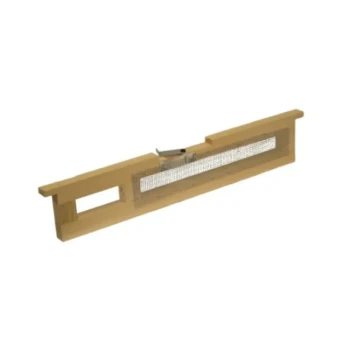
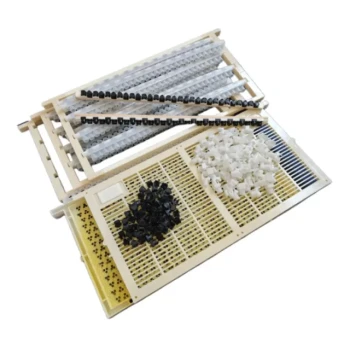
A queenright queen bank requires a specific vertical configuration designed to balance isolation with resource sharing.
Structurally, this system consists of a queenless banking box placed directly on top of a healthy, functioning colony that contains a laying queen. These two sections must be separated by a physical barrier—typically a queen excluder or a double-screened board—to prevent the resident queen from accessing and killing the banked queens.
The success of a queenright bank relies on a "separate but supported" architecture: the banked queens are physically isolated from the resident queen's aggression but metabolically supported by the colony's rising heat.
The Vertical Architecture
The Foundation (The Bottom Unit)
The base of this structure is a standard, healthy colony. It is critical that this bottom unit contains a functional laying queen. Her presence maintains the colony's population and stability.
The Banking Unit (The Top Unit)
The banking box is placed directly on top of the established colony. This upper unit holds the queens you wish to store in cages. While it houses queens, it functions as a "queenless" space because the queens are confined and cannot rule the hive.
The Critical Separation Layer
Purpose of the Barrier
You must install a robust physical separator between the top and bottom boxes. Without this interface, the laying queen from the bottom colony will perceive the banked queens as rivals. She will instinctively attempt to enter the upper box to eliminate them.
Hardware Options
There are two primary structural components used for this separation:
- Queen Excluder: This allows worker bees to move freely between the colony and the bank, but its grid is too small for the queen to pass through.
- Double-Screened Board: This provides complete physical separation of the bees but allows air and heat to pass through.
Resource Dynamics
Thermal Regulation
The structural advantage of this setup is thermodynamic. Heat generated by the massive brood nest in the lower colony rises naturally. This warms the banking box above, ensuring the stored queens remain at an optimal temperature.
Brood Support
The lower colony acts as the engine for the system. Beyond heat, it provides the "brood resources" necessary for a healthy hive environment. If using a queen excluder, nurse bees from the bottom can move up to feed and care for the banked queens.
Common Pitfalls to Avoid
Barrier Failure
The most significant structural risk is a faulty separator. If a queen excluder is bent or a screened board has a tear, the isolation is compromised. A single breach allows the resident queen to enter the banking box, leading to the loss of your banked stock.
Weak Foundations
The banking box is parasitic; it relies on the host below. If the structural integrity or population of the bottom colony is weak, it cannot generate sufficient heat. A weak bottom colony jeopardizes the survival of the queens stored above.
Making the Right Choice for Your Goal
To establish a successful queenright bank, choose your separation equipment based on the level of interaction you desire between the nurse bees and the banked queens.
- If your primary focus is maximizing care: Use a queen excluder to allow nurse bees from the strong bottom colony to circulate up and tend to the banked queens.
- If your primary focus is total isolation: Use a double-screened board to utilize the colony's heat while preventing direct contact between the two populations.
The stability of your bank ultimately depends on the absolute security of the barrier you place between the rival queens.
Summary Table:
| Component | Purpose | Key Hardware |
|---|---|---|
| Bottom Unit | Provides heat, brood resources, and population stability. | Healthy colony with a laying queen |
| Top Unit | Houses caged queens in a "queenless" environment. | Banking box/Super |
| Physical Barrier | Prevents the resident queen from killing banked queens. | Queen excluder or double-screened board |
| Thermal Source | Maintains optimal temperature for queen survival. | Natural rising heat from the lower brood nest |
Maximize Your Apiary’s Potential with HONESTBEE
Efficient queen management is the backbone of a successful beekeeping operation. At HONESTBEE, we understand the complex needs of commercial apiaries and distributors. Whether you are scaling up your queen rearing or optimizing your honey production, we provide the industrial-grade tools you need to succeed.
Our comprehensive wholesale portfolio includes:
- Precision Machinery: Hive-making and honey-filling machines to streamline your production.
- Professional Equipment: High-quality queen excluders, screened boards, and specialized banking hardware.
- Essential Consumables: A full spectrum of beekeeping supplies and tools for daily operations.
- Cultural Merchandise: Unique honey-themed products to diversify your retail offerings.
Partner with a supplier that values durability and expertise. Contact HONESTBEE today to discuss your wholesale needs and let us help you build a more productive apiary.
Related Products
- Queen Bee Artificial Insemination Instrument Equipment for Instrumental Insemination
- Stainless Steel Queen Grafting Tool for Beekeeping and Bee Queen Grafting
- Stainless Steel Beekeeping Queen Grafting Tool for Honey Bee Rearing
- Professional Dual Action Queen Excluder Scraper for Beekeeping
- JZBZ Langstroth Queen Rearing Frame for Beekeeping
People Also Ask
- Why is maintaining sanitary conditions important during artificial insemination? Protect Your Queen from Fatal Infections
- Why are artificial insemination instruments critical in bee hybridization? Master Genetic Control & Pure Breeding
- What is the core value of bee artificial insemination instruments in breed improvement? Achieve Precise Genetic Control
- Why is professional bee artificial insemination equipment considered a core tool for genetic control in honeybee breeding? Ensure 100% Purity
- Why is high-purity CO2 used for queen bee artificial insemination? Unlock Precision Breeding & Faster Egg-Laying