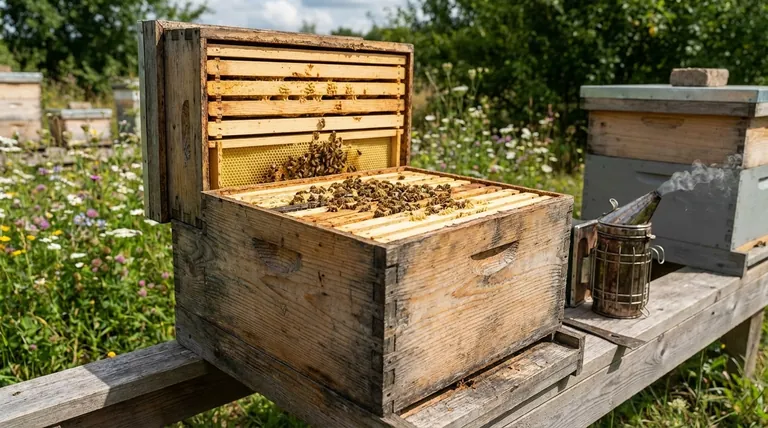
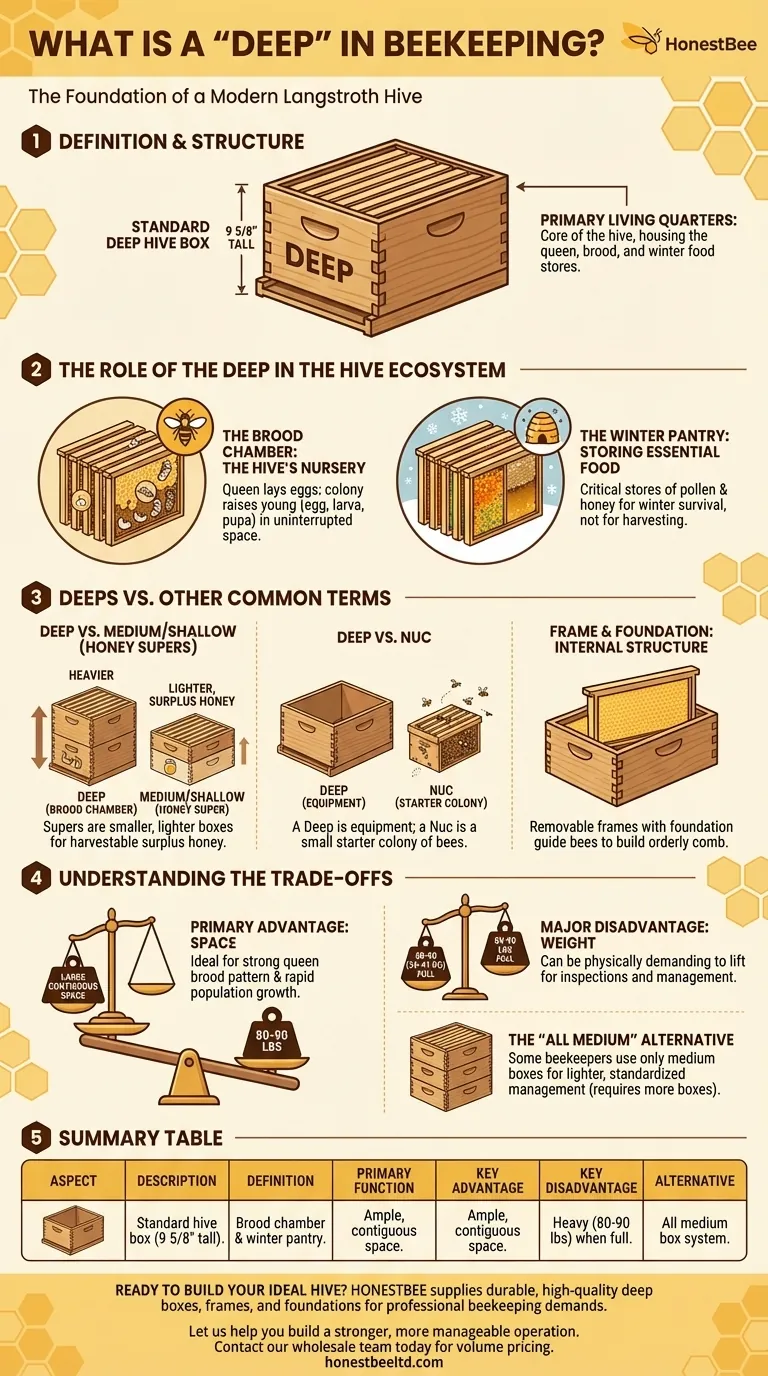
In beekeeping, a "deep" refers to a standard, full-sized hive box. These boxes are typically 9 5/8 inches tall and serve as the primary living quarters for the bee colony. They form the core of the hive, housing the queen, the brood (developing bees), and the colony's essential food stores for winter.
A "deep" is not the bees themselves, but the physical wooden box that functions as the hive's nursery and pantry. Understanding its role is the first step to understanding how a modern beehive is structured and managed.
The Role of the Deep in the Hive Ecosystem
A standard Langstroth hive is a stack of modular boxes. The deeps form the foundation of this stack, serving two critical purposes for the colony's survival.
The Brood Chamber: The Hive's Nursery
The most important function of the deep box is to serve as the brood chamber. This is where the queen bee lives and lays her eggs.
Within the frames of the deep, the colony raises its young through all stages of development: egg, larva, and pupa. A healthy, thriving colony requires a large, uninterrupted space for this, which the deep provides.
The Winter Pantry: Storing Essential Food
Bees also use the frames in the deep boxes to store pollen and honey. These stores are not for the beekeeper to harvest.
This food is the colony's critical resource for surviving the winter months when fresh nectar and pollen are unavailable. A full deep provides the insulation and nourishment necessary to keep the colony alive until spring.
Deeps vs. Other Common Beekeeping Terms
Beginners often encounter a flood of new terms. Differentiating a "deep" from other common components clarifies the entire system.
Deep vs. Medium/Shallow (Honey Supers)
While deeps form the main hive body, beekeepers often place smaller boxes on top called mediums or shallows.
These boxes, known as honey supers, are intended for the bees to store surplus honey. Because they are smaller and lighter than deeps, they are easier for the beekeeper to lift and harvest.
Deep vs. Nuc
A "deep" is a piece of equipment, but a nuc (short for nucleus colony) is a small, starter colony of bees.
A nuc is essentially a mini-hive, typically containing 3-5 frames of bees, brood, honey, and a laying queen. Beekeepers purchase nucs to install into their full-sized equipment, often transferring the frames from the nuc directly into a new deep box.
Frame and Foundation: The Internal Structure
Deep boxes are empty shells. They are designed to hold a set number of removable frames (usually 8 or 10).
These frames often contain foundation—a sheet of wax or plastic embossed with a hexagonal pattern. This foundation guides the bees to build straight, orderly comb, making hive inspections and management far simpler.
Understanding the Trade-offs of Using Deeps
While deeps are the industry standard for brood chambers, they come with significant advantages and one major disadvantage.
The Primary Advantage: Space
The large, contiguous space in a deep box is ideal for a productive queen to establish a strong brood pattern. It closely mimics the space a colony would naturally seek in a hollow tree, promoting rapid population growth.
The Major Disadvantage: Weight
The single biggest drawback of a deep is its weight. A deep box full of bees, brood, and honey can easily weigh 80 to 90 pounds (36-41 kg).
This substantial weight can make hive inspections and management physically demanding, posing a challenge for some beekeepers.
The "All Medium" Alternative
Because of the weight, some beekeepers opt to use only medium-sized boxes for their entire hive, including the brood chamber. This standardizes equipment and ensures no single box is excessively heavy. The trade-off is that it requires more boxes (three mediums instead of two deeps) to create a similarly sized brood nest.
Making the Right Choice for Your Goal
Your equipment choice depends on your physical ability and beekeeping philosophy.
- If your primary focus is a traditional setup: Start with one or two deep boxes for your brood chamber, as this is the most common and well-supported method.
- If your primary focus is minimizing heavy lifting: Consider an "all medium" hive from the start to create a more manageable system.
- If you are buying bees to start a hive: You will likely be purchasing a "nuc" and will need to transfer that small colony into your new deep or medium hive body.
Understanding these core components empowers you to build and manage a hive that works for both you and your bees.
Summary Table:
| Aspect | Description |
|---|---|
| Definition | A standard, full-sized hive box (9 5/8" tall). |
| Primary Function | Serves as the brood chamber (nursery) and pantry for winter food stores. |
| Key Advantage | Provides ample, contiguous space ideal for a strong, thriving colony. |
| Key Disadvantage | Can weigh 80-90 lbs when full, making it difficult to lift. |
| Alternative | Some beekeepers use an "all medium" box system for easier management. |
Ready to Build Your Ideal Hive?
Whether you're a commercial apiary scaling up operations or a distributor stocking reliable equipment, choosing the right components is key to success. HONESTBEE supplies durable, high-quality beekeeping supplies and equipment, including deep boxes, frames, and foundations, designed for the demands of professional beekeeping.
Let us help you build a stronger, more manageable operation.
Contact our wholesale team today to discuss your equipment needs and volume pricing.
Visual Guide
Related Products
- Professional Galvanized Steel Frame Rest for Beehives
- Langstroth Solid Bottom Board for Beekeeping
- Solid Bottom Board Australian Pine Wood Langstroth Bottom Board for Wholesale
- Precision Stainless Steel Frame Cleaner for Hive Grooves and Corners
- Professional Large-Format Hive Number Set for Beekeeping
People Also Ask
- What are the standard dimensions for frame rests in a beehive? Essential Guide for Perfect Bee Space
- How does balancing the number of frames impact hive productivity? Optimize Your Apiary's Biological Output
- What are the main considerations when choosing between wooden and plastic bee hive frames? Optimize Your Apiary's Efficiency
- How do wooden and plastic hive frames compare in terms of durability? Wood vs. Plastic Longevity & Repairability
- What are the main types of beehive frames used in modern beekeeping? Find the Perfect Fit for Your Apiary