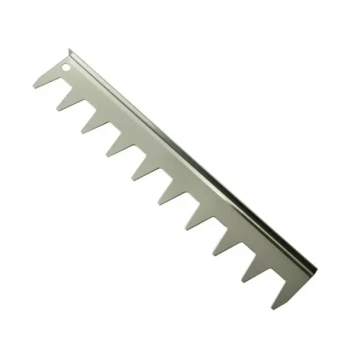
The approximate measurement of "Bee Space" is five-sixteenths (5/16) of an inch. This specific dimension represents the crucial gap required between adjacent comb surfaces to allow bees to move freely without feeling the need to modify the structure.
Bee space is the biological "Goldilocks zone" of hive construction. It is the precise tolerance where the gap is neither too small, which triggers bees to seal it, nor too large, which encourages them to fill it with new comb.
The Engineering Principle Behind the Gap
Defining the Tolerance
In the context of hive design, "Bee Space" (or Bee Passage) refers to the open corridor needed for bees to navigate between frames and hive components.
According to standard measurements, this optimal distance is approximately 5/16 of an inch.
The "Movable Frame" Revolution
This measurement is the foundational concept of modern beekeeping.
By respecting this specific dimension, beekeepers can utilize movable frames that do not get fused to the hive walls or to each other.
Why Precision Matters
The Consequence of Too Little Space
If the gap between components is smaller than 5/16 of an inch, the bees perceive it as a crack or a draft source.
Their instinct drives them to seal this narrow void with propolis, a sticky, resinous "bee glue," effectively cementing the hive parts together.
The Consequence of Too Much Space
Conversely, if the gap exceeds this optimal dimension, the bees view it as open construction territory.
They will build burr comb (irregular honeycomb) to bridge the gap, which also fuses frames together and makes hive management difficult.
Understanding the Variables and Trade-offs
Biological Variations
While 5/16 of an inch is the standard reference, it is important to recognize that biology is rarely static.
Different honeybee species may require slightly different tolerances.
Species-Specific Dimensions
The required space fluctuates based on the size of the bee.
For example, Indian bees generally require a space between 7 and 9 mm.
Italian bees, which are often slightly larger, may utilize a space closer to 10 mm.
The Manufacturer's Challenge
While the approximate 5/16 inch measurement is the target, slight deviations in equipment manufacturing can cause issues.
Beekeepers must be vigilant about mixing equipment from different manufacturers, as accumulated tolerance errors can violate the bee space principle.
Applying Bee Space to Your Apiary
Beekeeping is as much about precision carpentry as it is about biology. Use these guidelines to ensure your equipment functions correctly:
- If your primary focus is standardizing equipment: Adhere strictly to the 5/16 inch standard to ensure frames remain movable and interchangeable.
- If your primary focus is managing specific subspecies: Verify the optimal gap for your breed (e.g., 10mm for Italian bees) to minimize burr comb buildup.
Respecting this simple fraction of an inch is the difference between a manageable colony and a fused, difficult-to-inspect hive.
Summary Table:
| Aspect | Dimension (Imperial) | Dimension (Metric) | Biological Response to Deviation |
|---|---|---|---|
| Optimal Bee Space | ~5/16 inch | 7.5 - 9.5 mm | Free movement; no excess wax/propolis |
| Too Small (< 1/4") | < 1/4 inch | < 6 mm | Bees seal the gap with Propolis (glue) |
| Too Large (> 3/8") | > 3/8 inch | > 10 mm | Bees build Burr Comb (extra wax bridge) |
| Italian Bee Var. | ~3/8 inch | ~10 mm | Larger bees require slightly wider tolerances |
Maximize Your Apiary Efficiency with HONESTBEE Precision
Maintaining perfect bee space is the difference between a high-yield operation and a maintenance nightmare. At HONESTBEE, we specialize in supporting commercial apiaries and distributors with high-precision beekeeping machinery and tools designed to meet exact industry standards.
Whether you need automated hive-making machines to ensure structural accuracy, honey-filling equipment for your harvest, or a bulk supply of professional-grade consumables, our comprehensive wholesale portfolio has you covered. Don't let manufacturing deviations fuse your hives—invest in equipment built for professional beekeepers.
Ready to scale your beekeeping business? Contact our expert team today to discuss your wholesale needs and custom machinery solutions.
Related Products
- Durable Plastic Frame Spacer
- Ergonomic Plastic Frame Spacer Tool for Rapid Hive Management Beekeeping
- Stainless Steel 9 Frame Hive Spacer Durable Precise for Commercial Beekeeping
- Professional Bee Frame Machine for Side Bar Shaping
- Assembled Wooden Bee Frames with Beeswax Foundation Ready to Use by HONESTBEE
People Also Ask
- Are plastic bee hive frames good? A Guide to Modern Durability vs. Natural Appeal
- Are plastic bee frames good? A Guide to Durability, Efficiency & Bee Acceptance
- What are the advantages of using Standard Langstroth 10-frame equipment? Scale Your Commercial Apiary Efficiency
- How do you clean plastic frames? A Gentle Guide to Preserving Your Frames
- How must plastic frames be prepared for bees? Expert Tips for 100% Acceptance & Success