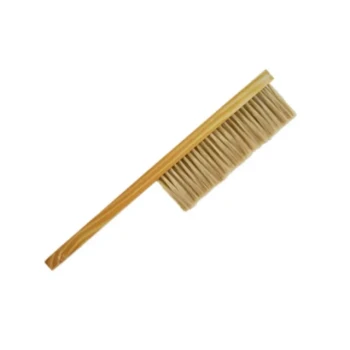
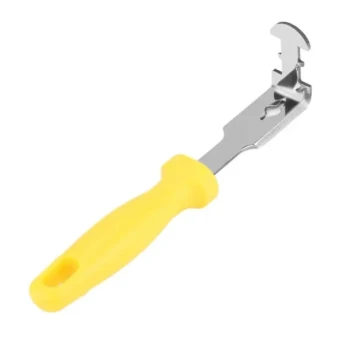
The larva removal needle is a specialized instrument used to extract larvae from queen cells immediately prior to the harvesting of royal jelly. Its primary mechanical function is to lift the larva out of the cell cup rapidly using a rounded tip, which prevents the piercing of the larva's skin and ensures no bodily fluids contaminate the surrounding jelly.
Core Takeaway The value of the larva removal needle lies in its ability to separate the biological waste (the larva) from the product (the royal jelly) without cross-contamination. Its rounded design prioritizes the physical integrity of the larva to guarantee the high purity required for commercial-grade royal jelly.
The Mechanics of Clean Extraction
The Importance of the Rounded Tip
The defining feature of a proper larva removal needle is its tip geometry. Unlike standard needles or sharp forceps, this tool typically features a rounded or blunted tip.
This specific design allows the operator to slide the tool under or around the larva to lift it. The lack of a sharp point is critical to avoid accidental puncture during the high-speed movements required in commercial harvesting.
Preventing Fluid Contamination
The most significant risk during extraction is the rupture of the larva. If a larva is pierced or crushed, its body fluids will leak into the royal jelly.
The removal needle mitigates this risk by allowing for a gentle, scooping leverage. By keeping the larva intact, the harvester ensures that the final product consists solely of pure royal jelly, free from biological impurities.
Operational Efficiency in Harvesting
Enabling Rapid Processing
Commercial beekeeping requires processing thousands of queen cells efficiently. The larva removal needle is designed for rapid repetition.
Because the tool is purpose-built for the shape of the queen cell cup, an experienced operator can clear a frame of cells quickly. This speed is essential to maintain the freshness of the jelly before it is filtered and frozen.
Preserving Cell Structure
While the primary focus is removing the larva, the tool also protects the harvesting environment.
Supplementary data indicates that precision tools prevent damage to the artificial queen cell structures. Using the correct needle ensures the cup remains intact for potential reuse or efficient cleaning.
Understanding the Trade-offs
Needle vs. Tweezers
While the primary reference highlights the removal needle, some operators utilize tweezers or forceps for the same task.
Tweezers offer a firm grip, which can be useful if a larva is slippery or difficult to scoop. However, tweezers carry a higher risk of crushing the larva if too much pressure is applied, whereas the needle relies on leverage rather than compression.
The Skill Barrier
The larva removal needle is a manual tool that relies heavily on the dexterity of the user.
An unskilled operator can still damage the larva or the cell cup even with the correct tool. Unlike automated suction methods, the needle requires a steady hand to maintain consistency across hundreds of frames.
Making the Right Choice for Your Goal
Select your extraction tools based on the scale of your operation and your quality control standards.
- If your primary focus is Maximum Purity: Prioritize a rounded-tip removal needle to eliminate the risk of piercing the larva and contaminating the jelly with fluids.
- If your primary focus is Difficult Extractions: Consider having specialized tweezers on hand for larvae that cannot be easily scooped, provided the operator is highly skilled in pressure control.
- If your primary focus is Speed: Use a dedicated removal needle, as the scooping motion is generally faster and more fluid than the pinch-and-pull motion of forceps.
The larva removal needle is the gatekeeper of quality, ensuring that the transition from a biological environment to a consumable product happens without contamination.
Summary Table:
| Feature | Larva Removal Needle | Specialized Tweezers |
|---|---|---|
| Mechanism | Scooping/Leverage | Pinch-and-Pull |
| Tip Design | Rounded/Blunted | Pointed/Angled |
| Contamination Risk | Very Low (No piercing) | Moderate (Risk of crushing) |
| Processing Speed | High (Fluid motion) | Moderate (Requires precision grip) |
| Best For | Commercial high-purity harvesting | Removing difficult or stuck larvae |
Elevate Your Royal Jelly Production with HONESTBEE
At HONESTBEE, we understand that commercial success in beekeeping depends on the purity of your harvest. As a dedicated partner to commercial apiaries and distributors, we provide a comprehensive wholesale range of professional-grade beekeeping tools and machinery.
Our specialized larva removal needles and harvesting equipment are designed to protect the integrity of your royal jelly, ensuring a premium product for your customers. From precision hand tools to honey-filling machines and hive-making hardware, we supply the full spectrum of equipment and industry consumables needed to scale your operations.
Maximize your apiary's efficiency and product quality today. Contact our expert team to discuss our wholesale offerings and discover how HONESTBEE can support your business growth.
References
- A. Sherif, K.I.M. Helaly. FACTORS AFFECTING THE ACCEPTANCE OF HONEYBEE QUEEN CUPS AND ROYAL JELLY PRODUCTION. DOI: 10.21608/mjapam.2018.123952
This article is also based on technical information from HonestBee Knowledge Base .
Related Products
- Black 2 Pack Beekeeper Queen Grafting Tool for Bee Queen Larva Transferring Needle
- Double Row Artificial Fiber Bee Brush for Beekeeping
- Retractable Chinese Queen Rearing Grafting Tools Equipment
- Stainless Steel Queen Grafting Tool for Beekeeping and Bee Queen Grafting
- Plastic Beekeeping Honey Bee Larvae Grafting Tools for Queen Rearing and Chinese Grafting
People Also Ask
- What is the primary function of a queen grafting tool? Master Precise Larval Transfer for High Queen Acceptance
- What is the step-by-step process for using a queen grafting tool? Master Larva Transfer for Better Queen Rearing
- What are the benefits of using a queen grafting tool for queen rearing? Master Precision for Superior Bee Genetics
- What is grafting in queen rearing? Take Control of Your Apiary's Genetics
- What are the steps involved in using a queen grafting tool? A Guide to Successful Queen Rearing