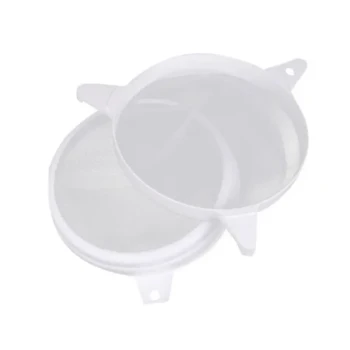
A plastic double sieve serves as the primary mechanical filtration stage for processing raw honey, specifically designed to mount securely over standard honey buckets. Its function is to separate physical contaminants—such as beeswax cappings, bee parts, and general debris—from the liquid honey using a gravity-fed system that prepares the product for immediate bottling.
By utilizing two varying gauges of mesh in a single tool, the double sieve effectively balances high flow rates with thorough purification, ensuring honey remains clear and marketable without the need for heat processing that degrades nutrients.
The Mechanics of Dual Filtration
Two Distinct Mesh Layers
The core functionality of this tool lies in its two-tiered design. The top sieve typically features a coarser mesh intended to catch larger solids, such as substantial chunks of beeswax or stray bee parts introduced during harvesting.
The bottom sieve utilizes a finer mesh. This second layer captures smaller particulates that pass through the top layer, refining the honey's clarity.
Maximizing Flow Efficiency
Filtration can often create a bottleneck in honey production. The plastic double sieve addresses this by featuring a large surface area.
This expanded area allows the honey to spread out, reducing back-pressure and ensuring the honey flows quickly through the mesh rather than pooling and stalling.
Gravity-Fed Operation
Because the sieve is designed to fit directly over honey buckets, it relies on simple gravity.
This eliminates the need for complex pumping systems for small-to-medium operations, streamlining the workflow from extractor to bucket.
Preserving Honey Quality
Avoiding Thermal Damage
Industrial filtration often uses high heat to reduce viscosity, but this damages honey. As noted in the supplementary context, raw honey production avoids high-temperature processing.
The double sieve allows for effective physical filtration at ambient temperatures. This preserves the honey's natural enzymes, pollen, and nutritional components, which are critical for "raw" certification.
Achieving Commercial Clarity
While maintaining raw qualities, honey must still look appealing to the consumer.
The double sieve ensures the final product meets commercial standards for cleanliness and clarity, removing the visual impurities that can deter customers.
Understanding the Trade-offs
Flow Rate vs. Viscosity
While the large surface area helps, filtering cold or particularly thick (low moisture) honey through a double sieve can still be slow.
Gravity filtration requires patience; if the honey is too cold, the flow through the fine lower mesh may trickle significantly.
Maintenance During Processing
The double sieve effectively traps debris, which means it will eventually clog during a heavy harvest.
You must monitor the top sieve; if it becomes saturated with wax cappings, it will block the flow, requiring you to pause and clean the mesh to resume operations.
Making the Right Choice for Your Goal
- If your primary focus is Production Speed: The large surface area of the double sieve is essential to prevent bottlenecks during the extraction of heavy honey frames.
- If your primary focus is "Raw" Quality: This tool allows you to achieve a debris-free, professional product without resorting to pasteurization or heating that destroys enzymes.
- If your primary focus is Marketability: The dual-mesh system ensures your bottled honey has the visual clarity consumers expect while retaining the pollen they value.
The plastic double sieve is the bridge between a raw, messy harvest and a polished, professional product.
Summary Table:
| Feature | Component/Method | Primary Function |
|---|---|---|
| Top Layer | Coarse Mesh | Traps large solids like beeswax cappings and bee parts. |
| Bottom Layer | Fine Mesh | Filters out smaller particulates for commercial clarity. |
| Design | Large Surface Area | Maximizes flow rate and prevents processing bottlenecks. |
| Method | Gravity-Fed | Allows cold filtration to preserve natural enzymes and nutrients. |
| Outcome | Raw Quality | Produces clear, marketable honey without thermal damage. |
Elevate Your Honey Production with HONESTBEE
Are you looking to scale your commercial apiary or expand your distribution inventory? HONESTBEE provides the professional-grade tools you need to succeed. From precision-engineered honey-filling machines and robust hive-making equipment to essential consumables like our high-efficiency plastic double sieves, we offer a comprehensive wholesale solution for every stage of beekeeping.
Our mission is to help you maintain the highest standards of honey purity and operational efficiency. Partner with us to access competitive wholesale pricing and industry-leading hardware.
Contact HONESTBEE Today to Discuss Your Wholesale Needs
Related Products
- Two-Stage Plastic Honey Filter for Buckets
- Stainless Steel Double Layer Honey Strainer Sieve Filters
- Electric Double Wall Honey Filtering Machine Purifier Equipment for Honey Processing Plant
- Professional Stainless Steel Honey Filter with Support Handle
- Stainless Steel Triangle Support Honey Strainer and Filters
People Also Ask
- What are the benefits of using honey filters? Achieve Purity, Efficiency, and Market Appeal
- How do you filter raw honey at home? A Beekeeper's Guide to Clean, Pure Honey
- Should I filter my honey? A Guide to Clarity, Crystallization & Quality
- What are the types of honey filters? Choose the Right System for Your Honey's Clarity & Quality
- Why do people filter honey? For Clarity, Stability, and Consumer Appeal