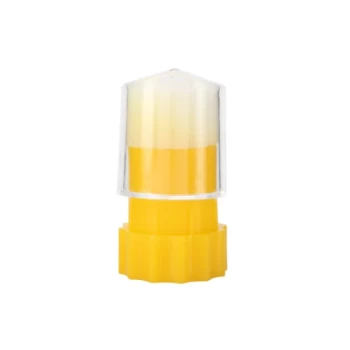
Artificial queen pheromone acts as a biochemical stabilizer for newly created nucleus colonies (nucs). Often appearing as a two-inch yellow rubber stick, it mimics the presence of a matriarch to keep bees calm, settled on their frames, and structurally cohesive. Its critical function is to suppress the colony's natural impulse to rear emergency queens for a brief, strategic window of one to two days.
The pheromone acts as a temporary bridge, overriding the colony's panic response to queenlessness and preserving resources until a proper queen cell can be introduced.
The Strategic Role in Nuc Creation
Inducing Artificial Calm
When a nuc is first split from a parent colony, the sudden absence of a queen can cause immediate chaos. The artificial pheromone releases a scent that simulates a queen's presence.
This effectively tricks the worker bees into a state of normalcy. It prevents the agitation and roaring behavior typically associated with queenlessness.
Preventing Resource Drift
A significant challenge in making nucs is keeping the bees inside the new box. Without a queen to anchor them, bees often abandon the new frames or drift back to their original hive.
The pheromone strip keeps the bees settled on the frames. By anchoring the population, you ensure the nuc maintains the critical mass of bees required to care for brood and regulate temperature.
Suppressing Emergency Cells
The most technical function of the pheromone is the inhibition of emergency physiology. Upon realizing they are queenless, bees will instinctively rush to convert young larvae into "emergency" queen cells.
The pheromone suppresses this urge for one to two days. This delay is vital because it allows the beekeeper to introduce a carefully selected queen cell later, without it competing against inferior emergency queens raised by the bees in a panic.
Operational Constraints
A Strictly Temporary Measure
It is crucial to understand that this tool is a stop-gap, not a replacement. The primary reference explicitly notes it is intended for the one to two days before a proper queen cell is introduced.
The Risk of Extended Use
Relying on the pheromone beyond this short window offers diminishing returns. It does not lay eggs or produce the full spectrum of signals a real queen provides. If a replacement queen cell is not introduced promptly, the colony's stability will eventually collapse.
Optimizing Your Nuc Workflow
To effectively utilize artificial queen pheromones, you must view them as a timing tool rather than a biological substitute.
- If your primary focus is colony retention: Use the pheromone to anchor bees to the new equipment immediately after the split, reducing the rate of drifting.
- If your primary focus is genetic control: Use the pheromone to pause emergency rearing for 24-48 hours, ensuring the colony is calm and ready to accept the specific queen cell you wish to introduce.
This simple tool converts a chaotic biological crisis into a managed, orderly transition.
Summary Table:
| Feature | Function in Nuc Creation | Benefit to Beekeeper |
|---|---|---|
| Biochemical Stabilizer | Mimics queen presence to induce calm | Prevents colony agitation and "roaring" |
| Population Anchor | Keeps workers settled on new frames | Reduces drifting back to the parent hive |
| Physiological Suppressor | Delays emergency queen cell building | Ensures acceptance of selected queen cells |
| Strategic Timing | Provides a 24-48 hour window of stability | Allows for managed, orderly colony transitions |
Scaling Your Apiary Operations with HONESTBEE
Successful nuc creation requires the right tools to turn biological chaos into a managed workflow. At HONESTBEE, we specialize in supporting commercial apiaries and distributors with high-volume, professional-grade solutions.
Whether you need specialized hive-making machinery, high-efficiency honey-filling equipment, or the full spectrum of beekeeping tools and consumables, our comprehensive wholesale offering is designed to drive your productivity and profitability.
Ready to elevate your beekeeping business? Contact us today to discuss how our specialized hardware and industrial equipment can streamline your operations.
Related Products
- Queen Bee Artificial Insemination Instrument Equipment for Instrumental Insemination
- Professional Plastic Queen Excluder for Modern Beekeeping
- 10-Cell Silicone Beeswax Bee Queen Cups Forming Mold
- Wooden Queen Bee Excluder for Beekeeping
- Premium Nicot Style Cell Bar Holder and Queen Cell Cup Holder System
People Also Ask
- Why is maintaining sanitary conditions important during artificial insemination? Protect Your Queen from Fatal Infections
- Why are artificial insemination instruments critical in bee hybridization? Master Genetic Control & Pure Breeding
- What is the core value of bee artificial insemination instruments in breed improvement? Achieve Precise Genetic Control
- Why is professional bee artificial insemination equipment considered a core tool for genetic control in honeybee breeding? Ensure 100% Purity
- Why is high-purity CO2 used for queen bee artificial insemination? Unlock Precision Breeding & Faster Egg-Laying